North Downs Way 100 DNF: Reaching Limits Is Part of It
Ultra running is hard, especially if the distance is longer than what you’ve ever done. Mistakes are bound to happen but the lessons learned will always lead to growth.
Published on 14th of October, 2026
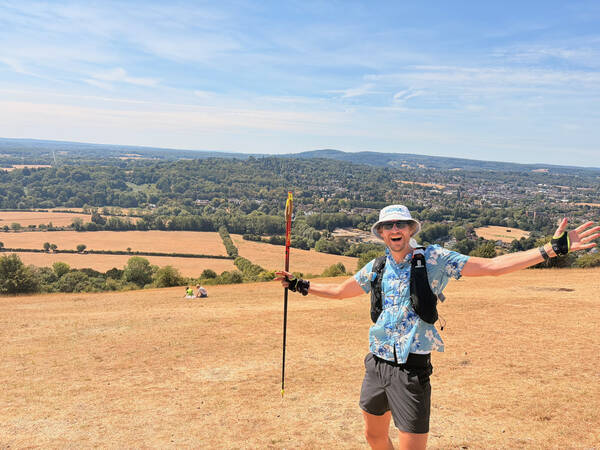
Welcome to the fifth-year anniversary of me trying to get into Western States 100!
Yes, it’s already been that long. What started in 2021, when I was fresh off the pandemic and eager to experiment with mountain ultras, now has become a real tradition. Getting one of the 369 tickets for arguably the most popular 100-mile foot race in the world is as difficult as it’s ever been. So far I haven’t succeeded and the chances are not exactly doubling like the doubled ticket count each year would suggest.
🎟️ What ticket count, you ask? Explanation follows!
Quick reminder: the Western States 100 Endurance Run is one of the oldest races of the 100-mile (160.9 kilometer) distance and takes place at the end of every June in California, in the area between Lake Tahoe and Sacramento. It’s beautiful, legendary, and many ultra runners really want to take part one day such as many triathletes would like to go to Hawaii one day to race there.
The local environmental conservation efforts have prohibited more than 369 people moving through the wilderness for a race, meanwhile interest has grown so much that over 10,000 would like to come. My own interest had been sparked by watching the movie Unbreakable (for free on YouTube) many years ago.
The system of admission the board of the race has come up with is actually quite simple to understand, but because of the huge amount of participants in this weighted lottery the chances of getting in are still low in general. But here’s the kicker: you increase your chances with each year you participate in the ticket lottery. To do that, you need to have finished a qualifier race from the official list each time you want to enter the lottery.
The races on the list are all tough ones. They are at least 100 km long and always feature big hills or mountains. The board in California wants to make sure you have what it takes before they let you join the drawing. Thankfully, the list of qualifying races is long and features diverse and interesting options all over the world.
So far I have raced 🇦🇹 Mozart 100 in 2021 to enter the lottery for the first time, followed that up with a disappointing drop-out at 🇫🇷 Festival des Templiers in 2022 which meant I had to skip the lottery that year, but bounced back in 2023 at 🇮🇹 Lavaredo Ultra Trail 120K, then ticked of 🇩🇪 Zugspitz Ultra Trail in 2024, and went all-in in 2025 by unnecessarily completing two qualifiers, 🇮🇹 Tuscany Crossing 103K and the infamous 🇫🇷 CCC 100k race at the UTMB weekend in Chamonix, France.
Because the amount of tickets you get per drawing doubles with every time you lose, I was at 8 tickets at the end of 2025, but of course lost at the lottery that year as well.
- Mozart 100 in 2021 → 1 ticket, lost at the drawing ❌
- Templiers in 2022 DNF → No drawing ❌
- Lavaredo in 2023 → 2 tickets, lost at the drawing ❌
- Zugspitz in 2024 → 4 tickets, lost at the drawing ❌
- Tuscany and CCC in 2025 → 8 tickets, lost at the drawing ❌
By the way, the theoretical chances of me getting in with 8 tickets in 2025 were calculated to be at 2.4%.
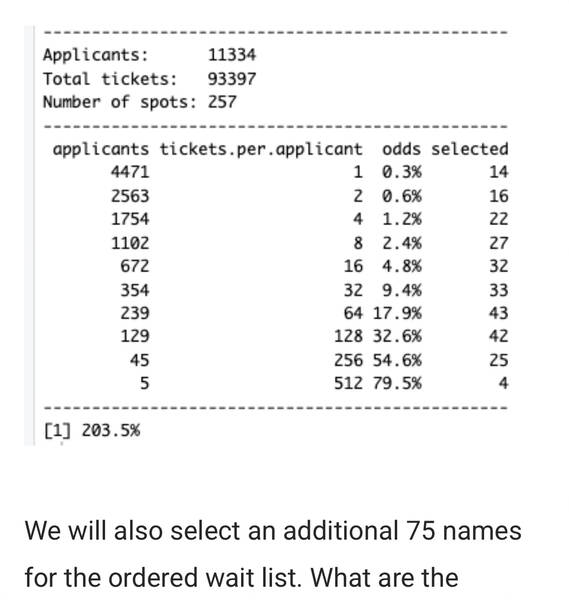
It’s part of the fun, though. I see it like a game to play. You throw your hat in the ring and maybe you get lucky but most likely you won’t. The way towards that Western States race is a long one and that’s totally fine with me. There are lots of challenging and fun race options to choose from, and having this arbitrary reason to select a big race each year fills me with joy.
For 2026 I chose a relatively small event in southern England called North Downs Way 100.
🙋 Why North Downs Way 100?
I wanted to do something special and finally complete a race which would also be as long as Western States would be, 100 miles. So far, the longest distance race I’ve ever done has been Lavaredo at just over 120 km. Time to learn how to go the ultimate distance. Ultra running hasn’t come easy to me so far because I’m not a particularly talented runner. It’s always a long process to get my body and mind ready to take any unfamiliar next step.
There are lots of options in Europe to run a 100-miler that’s also a qualifier, but this one stood out for several reasons. One of them is that my friend Micha had taken part a few years back and enjoyed it — except for the lack of beer at the finish line, alas. But I can bring my own, so that shouldn’t stop me.
Another reason I wanted to go is how well my friend Patrick spoke about the lovely people behind the race series, Centurion Running, founded and headed by James Elson. They make several 100-mile races in the UK happen each year and do so with lots of love for the sport.
A third strong reason for me to sign up was the small field size. Coming fresh from the traffic jams on the trails at CCC with its over 2,000 participants, a race with a hard limit of just 250 runners sounded quite attractive to me.
And last not least: this race is in England, not in the Alps. I’ve done enough tough races in the Alps and after the fun rolling hills I experienced at Tuscany Crossing last year, I wanted to make it a little easier for myself. The CCC had nearly 6,000 m of vertical gain to overcome on about 106 km, while North Downs Way 100 only claims 3,350 m over 167 km of distance. That’s an average of just 2.01% of elevation gain compared to 5.66% at CCC.
Of course, the race would also be a lot longer than the mountain races I’ve done, but then again, that was a plus in my book because I want to find out what that’s like and also prepare for Western States in a way.
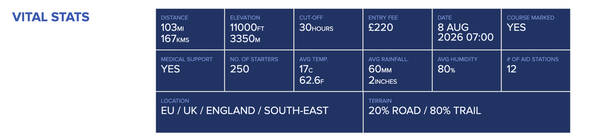
Signing up for the race was comparatively easy, but since the limited field size and the good name that Centurion Running has in the UK, I carefully monitored when the sign-up forms would become first available and made sure to get it done in time. The fee was very reasonably set at 220 British Pounds, that’s about €250 or $300. You also needed to present proof that you’re theoretically capable of completing the long distance, but a race result that’s at least 80 km long which you completed in under 15 hours was enough. No problem for me.
📊 How to Prepare for a 100-Mile Race
My annual Western States qualifier race will usually have the highest priority for me in terms of season planning and training because it’s the biggest and longest endurance event in my calendar. In 2026, this has not been the case.
I had another huge endurance task planned for this year’s summer, the Challenge Roth long distance triathlon just five weeks before North Downs Way. My goal for that big triathlon was to give it my absolute best shot, stay focused on the specific training during the six months leading up to it, and try to break the 10-hour barrier.
My idea was that the five weeks after Roth would suffice to recover from it and still get in a few specific running sessions before taking the huge aerobic fitness acquired for Roth right into England. After all, ultra running is a lot less complicated than triathlons are. You just put one foot in front of the other until it’s over, right? At least the chances of drowning or crashing your bike are a lot lower in an ultra.
My general fitness during the first half of 2026 was very promising. I took home a new personal best from Barcelona Marathon in March, a solid 2:53. A bit later, a low 1:21 at a local half marathon also set a new fastest benchmark for me in that distance. Some more fun marathons rounded off the spring season, getting in easy kilometers. Afterwards, I shifted into making real progress on the bike and also tried to increase my swim speed. Before the triathlon race in Roth I added a big hero session by running hard up and down a long hill with some added marathon pace effort afterwards, coming in at 30 km in the end, hoping this might have been a specific session for both the final marathon in Roth as well as the North Downs Way.
The long distance triathlon race at Challenge Roth turned out to be a very mixed bag in the end. Conditions were tough with the heat requiring a non-wetsuit swim and the bike part becoming rather demanding due to strong headwinds, but I also made some beginner’s mistakes such as not drinking enough water with my high carbohydrate intake, ending up having to battle stomach cramps for the last five hours of the race. But I made it to the end, and while massively failing to reach my sub-10-hour goal time, I still pulled off a new personal best in the distance by about 43 minutes, coming in after 10:43.
Recovery after that went according to plan. No injuries, no really sore muscles. After about one quiet week of short and easy streak runs, I was able to increase my mileage back to normal. The weekend after Roth I did two more triathlon races, but shorter ones. One sprint distance race, one standard distance. On the 10k at the end of the standard distance race I did a fast 38:30 minutes result, the 17th fastest run split of all 2,300 males. Run fitness is up there.
Except for that I didn’t feel like doing any more hard sessions, no speed, no hills. I think the triathlons took some mental power out of me — recovery isn’t just about the muscles and body in general. Then, on the weekend before North Downs Way, my wife Sophie and I celebrated our birthdays which are just four days apart, and since I turned 42 years old, I wanted to run 42 kilometers. A few friends joined and that easy long run turned out to be the final training session before leaving for England. Honorable mention: my 10-yo daughter #3 also joined the lap-based birthday marathon and completed a total of 18 kilometers with me! The day was definitely great for my mental state and gave me some confidence for my ability to endure long and slow running.
Fitness-wise, I felt like I was there. Ready to attack 100 miles.
Now, after all that has happened during the race, I’m still sure that was a correct assessment.
Training was sufficient. Not perfect, for sure, but I don’t know if I’ve ever had an absolutely perfect training cycle going into a race. Who has? There’s always something not going according to plan or being a little off — this time everything basically worked out fine, it has just been quite a stretch to recover and keep the fitness level up high enough with all the triathlons so close before the main event.
🚆 Race Weekend in Southern England
The race course follows a marked hiking path of which it’s named after. The North Downs Way hiking path is starting in the town of Farnham in the county named Surrey, and ends after 153 miles in Dover, Kent. With a few very minor detours to reach acceptable locations to set up aid stations, the North Downs Way 100 follows exactly that path, but ends after 103 miles in the city of Ashford.
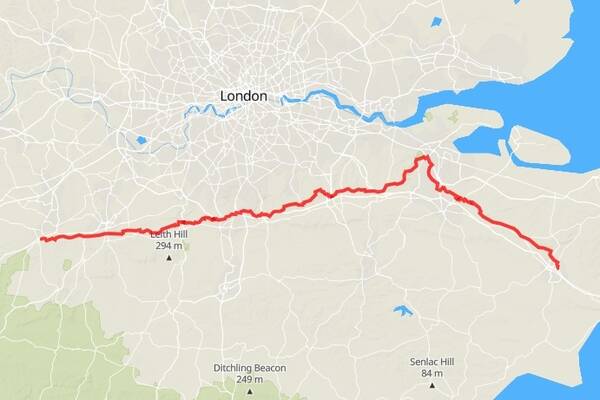
This location is very practical for us continental Europeans, because everything is fairly close to London and because it ends near the Eurotunnel and ferry back to the continent.
Last year, during the big CCC race in Chamonix, France, my wife Sophie was my crew for the first time during an ultra race. Our four kids are now old enough so we can finally leave them with some supervision for an extended weekend, which is great. Being a supporter at CCC has been rather challenging, because over 2,000 runners move across the Alps in three different countries and the mountain roads and villages along the course don’t support all those cars. Which is why supporting is very much restricted and can only be done using special shuttle buses. Sophie made it all happen despite the harsh conditions during the rainy night and my 5:00 AM finish. I was super grateful for having her with me, and thankfully she offered to do this again for my first go at the 100-mile distance here in England.
This race is completely different, because the field of runners is about one tenth the size and narrows mountain roads won’t be an issue for supporters. In order to make it a lot more comfortable for Sophie, we decided to take our family van to the UK so she would have plenty of space, protection from the elements, and a place to also nap for a few hours while I run through the night. Without a car, crewing wouldn’t have been possible. Her boss gave her Friday off so she could arrive in time for the race start on Saturday morning, but I would have to do the long drive from Hamburg alone the day before, on Thursday. Otherwise I wouldn’t have been rested for the race.
After the eight-hour drive from Hamburg to Calais, I drove the van into LeShuttle to help me cross the English Channel and enter the UK. I had done that before a few times, but it’s always quite unreal to actually sit inside a train in your car.
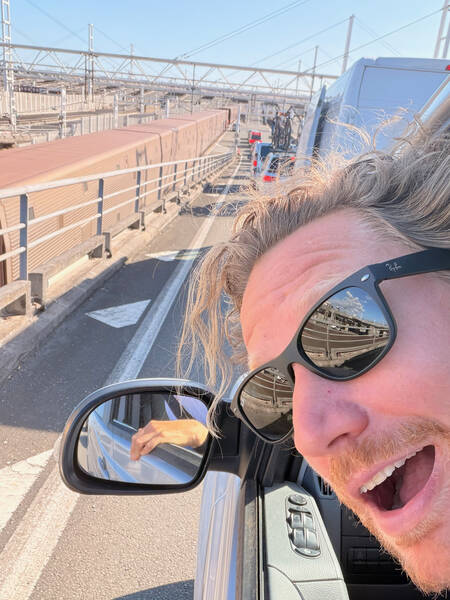
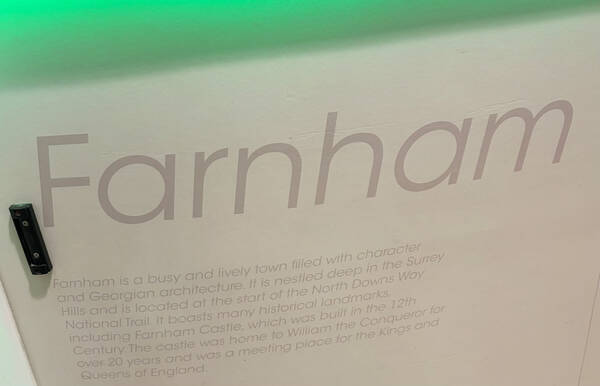
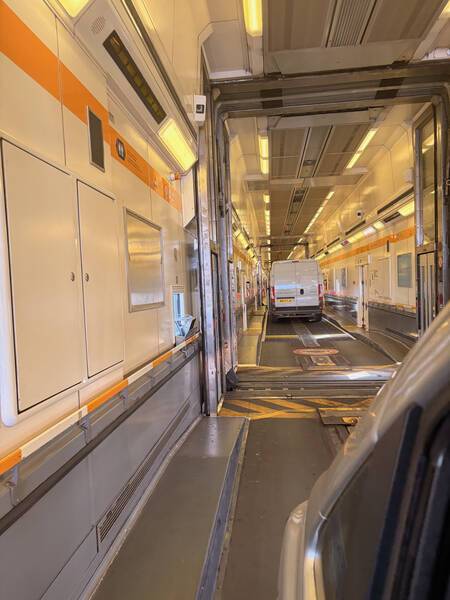
Driving a car for eight hours through three different countries, followed by half an hour inside a train and another two hours of driving in a fourth country sure is an energy drain. But a different one from the three weeks of summer holidays I’ve had before with all the kids not going to school. So it was a welcome type of energy drain. Being alone for a full day really is a nice holiday for me right now.
I chose to treat myself by visiting my favorite ever airport hotel, Premier Inn at Heathrow Terminal 4. I’ve mentioned it before on this blog, the hotel still rocks to the point I will try to book flights with a Heathrow overnight stay just to visit. It’s cheap, offers a great meal-deal including dinner and a full English breakfast, is super quiet and clean, can be accessed by skywalk directly from the terminal, and even has some nice running options surrounding it! It was a bit odd to come here without having arrived by plane, though. But a room with a view of the airfield for the first time made me really happy today.
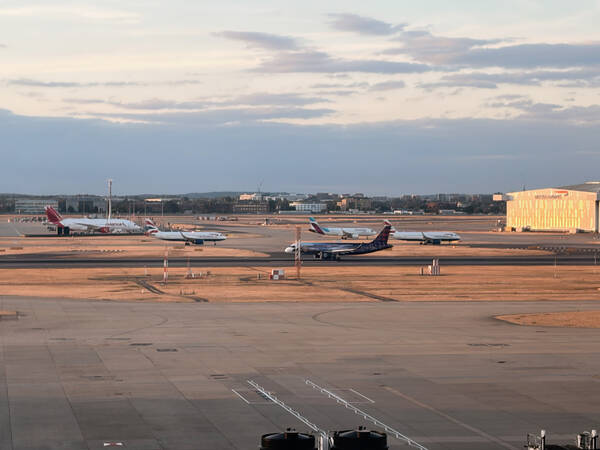
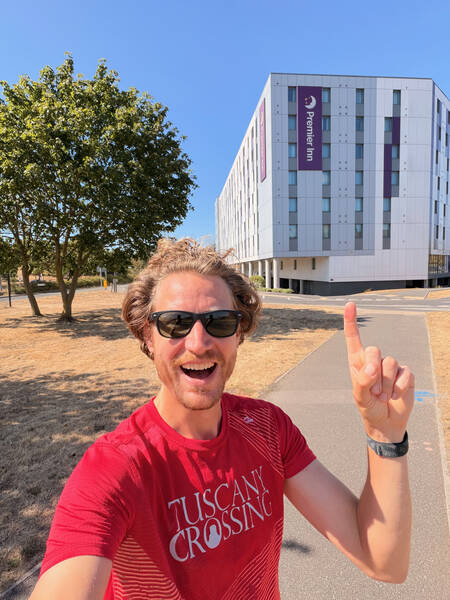
I also chose the hotel because it would make it really convenient to pick up Sophie the next day right here so we could go to Farnham together in our van.
Sophie wasn’t the only passenger, though. My friend Nick from Hamburg had also signed up for North Downs Way 100, wanting to complete his first 100-miler, and had booked the same flight as Sophie had. Convenient again! The three of us drove the 50 minutes to Farnham, staying the night at different hotels, though. Sophie and I had a lovely little cottage hotel called “The Princess Royal”, lots of flowers everywhere, but located next to a loud road. Didn’t matter. Before a nice pizza dinner in the center of Farnham, we checked out the surroundings of tomorrow’s race start, most importantly the parking situation. Not easy! We also met a father-son pair who had come here for the race. The 20-yo son Charlie would race with his father crewing. Admirable.
The night was alright and the alarm clock went off at 5:00 AM.
🌅 Race Day, August 8 of 2026
Coffee and breakfast in our room, vaseline, race kit, bags, 5:30 go-time to the Leisure Centre in Farnham’s middle. It’s a cool morning with clear skies, promising to become rather hot later on. Sophie and I have a fifteen minute walk from the car park to the race headquarters. I’m nervous.
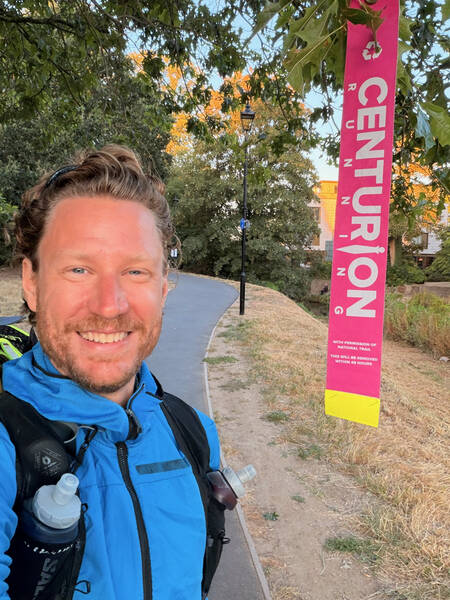
The headquarters are really well organized — Centurion Running has high standards. There are several tables with volunteers helping us get our bib numbers, taping the individual active GPS trackers to our running vests and answering questions. Centurion Running also runs a little shop selling trail running gear and they had smartly put up a table here for us to buy last minute forgotten items.
Nick is here as well, we talk race tactics for a bit. Looking around, everyone here looks really fit and healthy.
Centurion chief James Elson finally holds the short but mandatory race briefing, going over some details he had already mentioned during a Zoom call he hosted a few days ago. Both were a great idea and cleared up questions. He also asked the crowd to learn who was about to do their first 100-miler — my hand went up together with a few dozen others. Then he asked who had done multiple Centurion Running 100-milers — some hands went up still; and when he wanted to know who has a North Downs Way 100 tattoo one single hand went up. Now that’s commitment! If that’s not the biggest compliment ever. Maybe one day a participant of our own 100-mile foot race, BremenSanktPauli, will also get a tattoo of that logo. I think if that will happen we can be sure to have put together a fine event.
The speech James gave was short and sweet. You really feel like you’ve come to the right place. He then reminded us all we had to walk to the start of the course right now to arrive there in time. Supporters like Sophie were separated from runners to make sure it’s not too crowded on the narrow streets. Nick and I followed the throng.
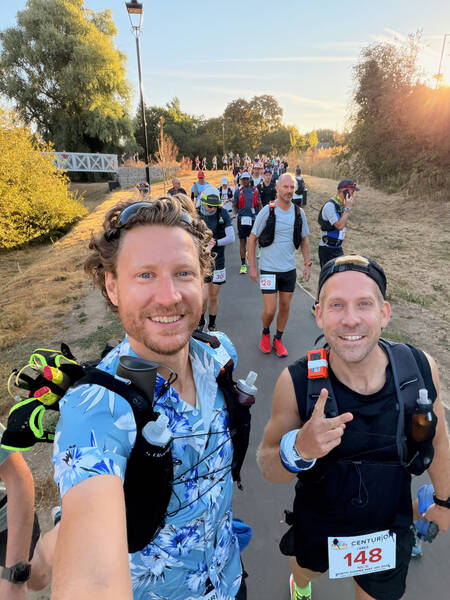
It’s a surprisingly long 10-minute walk for the 250 people we are. We have to cross a big street and see the official sign at the beginning of the hiking path that is the North Downs Way.
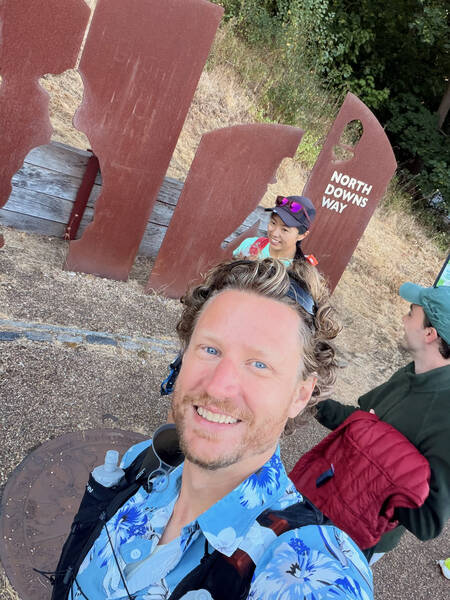
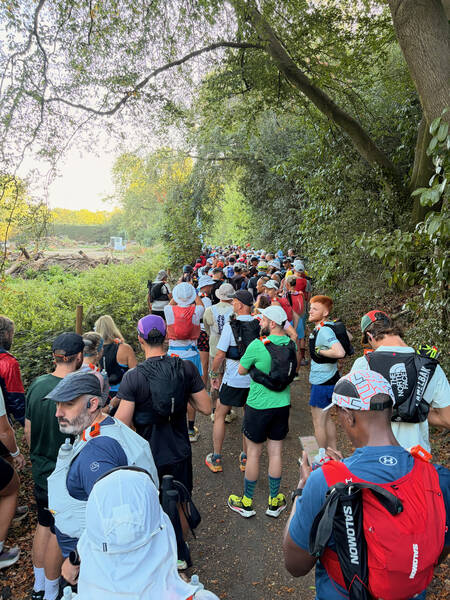
Sophie manages to meet us inside the queue before the starting line and we have a final chat before the race. James toots a horn somewhere in front of us and that’s the signal to start running for one hundred miles.
📣 Let’s Go!
It starts out very smooth. These early morning conditions are perfect, the English sun is out at 7:00 AM but not too strong yet.
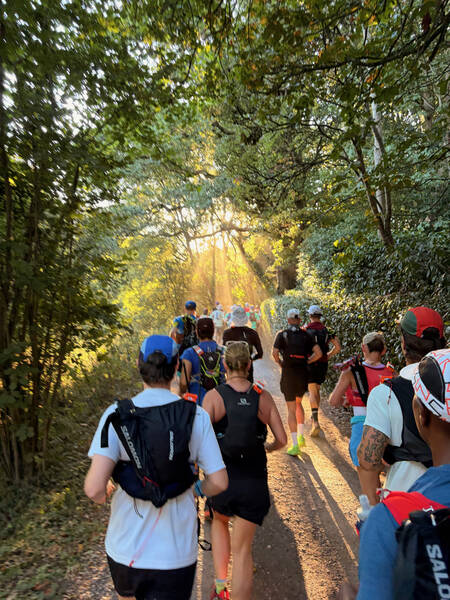
As you can see in the picture, quite a few runners have chosen to carry poles. I took mine, too. Nick doesn’t have any. Even though this isn’t a race through the Alps, there are some climbs on which poles will help. And I think that their low weight won’t make a big difference. Many others seem to agree.
The first kilometers are flat and easy, leading through the lovely outskirts of Farnham. Nick and I chat. I very much enjoy the scenery and say so quite often but it seems that Nick doesn’t care as much as I do. Fair, everyone is here for their own reasons. For me, scenery is a big motivating factor to do these hard races.
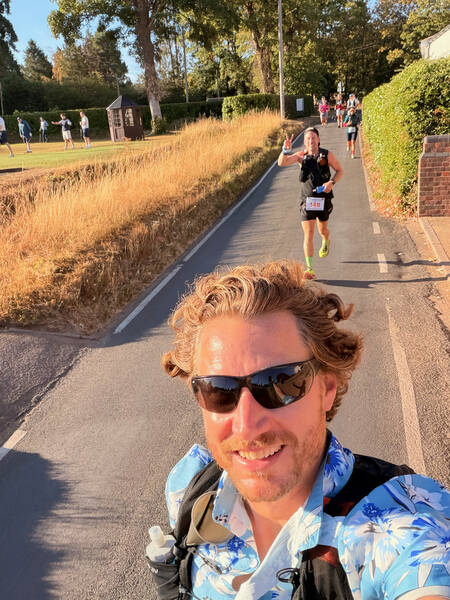
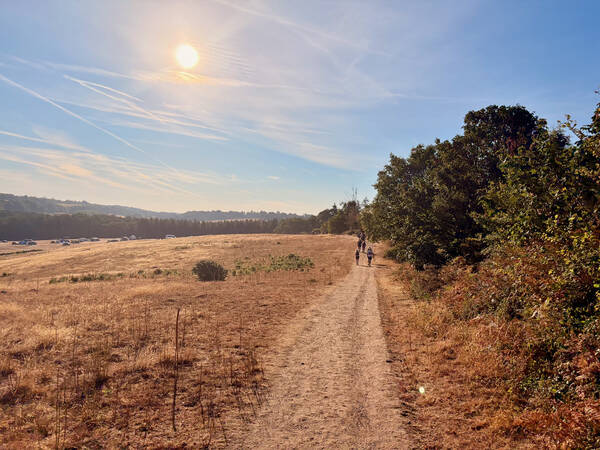
The stereotypical green meadows of England are unfortunately all brown these days. There hasn’t been any rain for the past six weeks, James Elson said. A drought such as that is obviously very bad for everyone, except for the running conditions today: dry paths are a lot better than wet ones.
Which brings me to the choice of shoes. James said during the Zoom call a few days ago that he was expecting many runners to use road shoes instead of trail shoes because of the dry conditions of the course. I played with that thought for a bit but decided against it. Choice of shoes is very important to me in these demanding ultra trail races and I will go through great lengths to end up having made a shoe choice I’m happy with.
For North Downs Way I actually bought the trail racing shoes made by HOKA, called the Rocket X Trail. Fairly new, featuring HOKA-typical cushioning as well as a carbon plate. They are light and fast. But, while they fit my feet okay, there wasn’t enough room in them at the front to make me feel comfortable that they would be great after 16 hours plus of running in them. Unfortunately, I’m already at the largest size shoes they produce, US 14, so sadly the Rocket X Trail was off the table for this particularly long race. I recommended them to Nick, and with his smaller feet he was able to get them in a size that would be well suited for an ultra run.
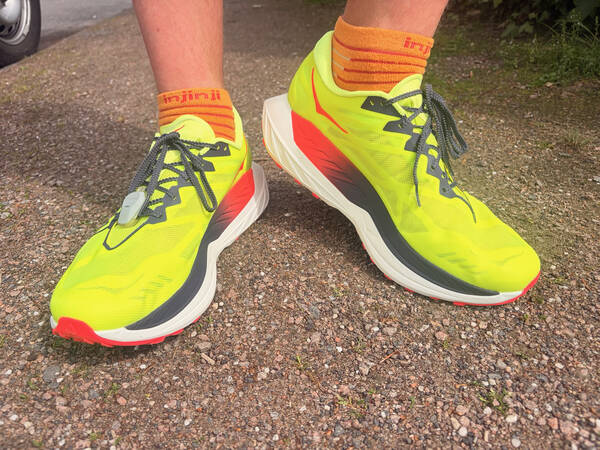
I considered a few other models by different brands, but my choices were limited because of the same problem: no availability in my size. In the end I decided to use my old LaSportiva Prodigio Pro, because they got me through the CCC last year without much damage to my feet.
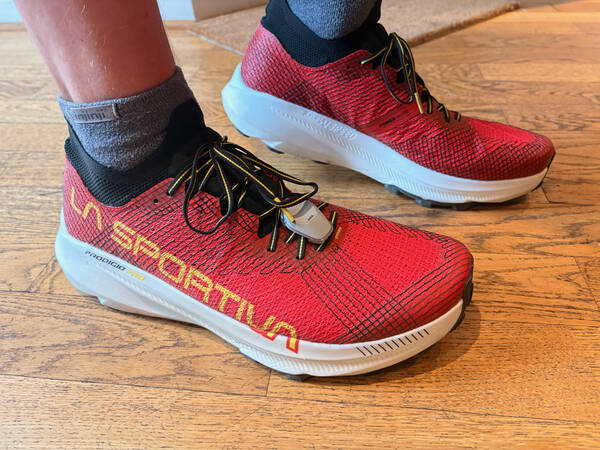
Of course, one of the advantages of having a car with basically unlimited storage accompanying me during the race is all the shoes I’ve been considering can just go in it, ready to be used if for some reason my shoe choice turns out to be less than ideal. So I packed the Rocket X Trail just in case anything goes wrong.
The ground is fairly easy to run on in the early kilometers, some sandy stretches, some flat asphalt, but mostly hard and wide trail paths, no single trails. Nothing technical, doesn’t require much attention. Nick’s and my main focus is to avoid over-pacing, because that’s the biggest mistake you can make in the early stages of such a long race. We keep the pace between 5:30 min/km and 6:00 min/km and since there aren’t many big hills to overcome yet it mostly stays in that range.
Next to making sure to keep a suitably low pace, nutrition is highly important from the beginning. My rough plan is to have one gel per hour, containing 40 grams of carbs. On top of that, I’ll have one 500 ml soft flask with the provided energy drinks and one with plain water on me at all times. Some salt pills as well to top off lost electrolytes which can’t be replaced by the drinks here. Speaking of which, after about 12 km we’re reaching the first aid station near the town of Puttenham. This is a small one, because most people will not need much refilling here so early into the run. I use the chance for some fresh drinks, though. They offer sugary drinks by the Tailwind brand, which is popular in the US but I’ve never had it before. Time to check it out, and I’m glad to report it tasted quite neutral. I think this is a solution that works for many different people. There’s also always at least one 20 liter container with water mixed with Precision Hydration electrolytes, no carbs. This is unusual but very appreciated. Sometimes it’s nice to switch.
Of course, the usual staple drinks such as cola are also always available. They have pitchers so it’s easy to refill our collapsible plastic cups.
In terms of food, the aid stations really leave nothing to be desired. One detail I thought was clever is the little paper bowls they used for food items such as cherry tomato, salty pretzels, gummy candy, cheese bits, and similar things. Instead of grabbing the stuff with your sweaty hands from a big bowl, this was a hygienic approach. The broad selection and special items at some aid stations to come was also way up there — they had sandwiches with cheese, Marmite, or jam. Ice at the mid-day stations. All volunteers are wearing high-viz vests so we could immediately spot those who could help us. They were also instructed to do the refilling of soft flasks for us so we could use the gained time to think about our other needs.
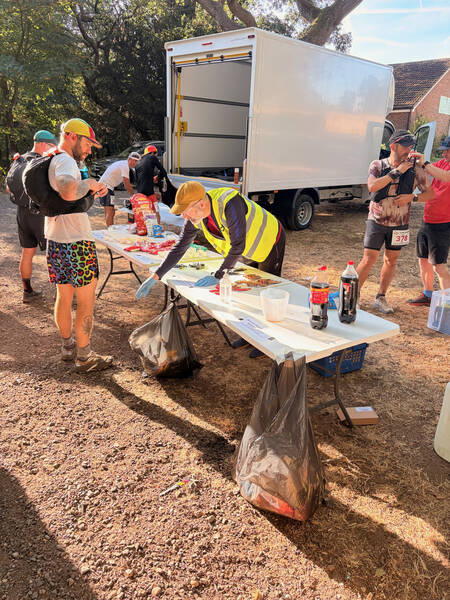
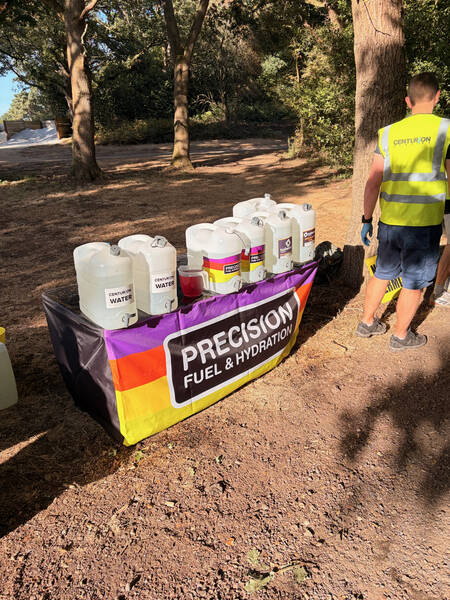
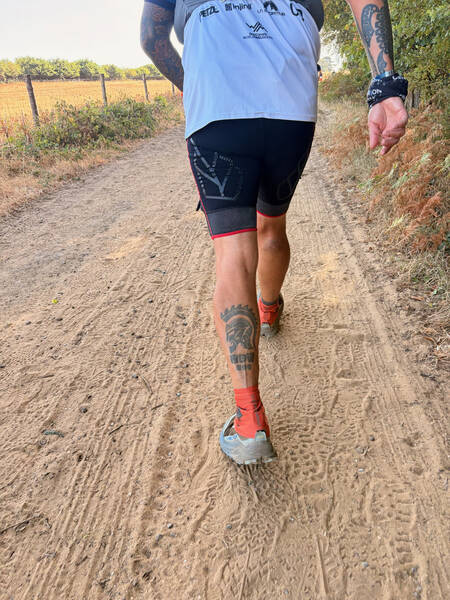
Nick doesn’t refill his bottles, so he keeps running. I don’t plan to catch him — it’s important we both run according to our own rhythms and what feels right for each of us. Even though he has slower personal bests in the marathon and half marathon compared to me, he is very fit and has been training focused towards this singular goal here today, as opposed to me with the big Challenge Roth shaped obstacle in the way. I was quite sure he would be performing better than me today.
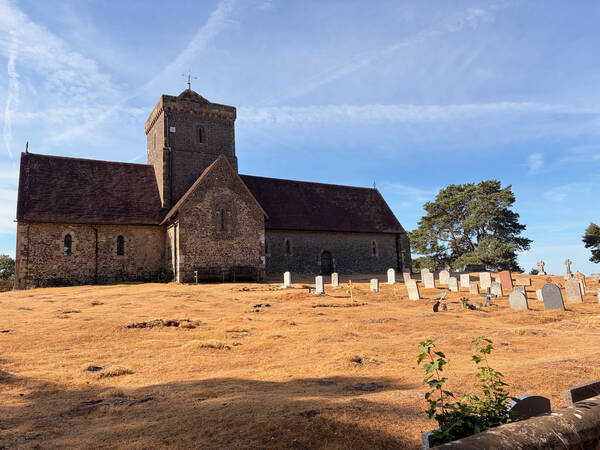
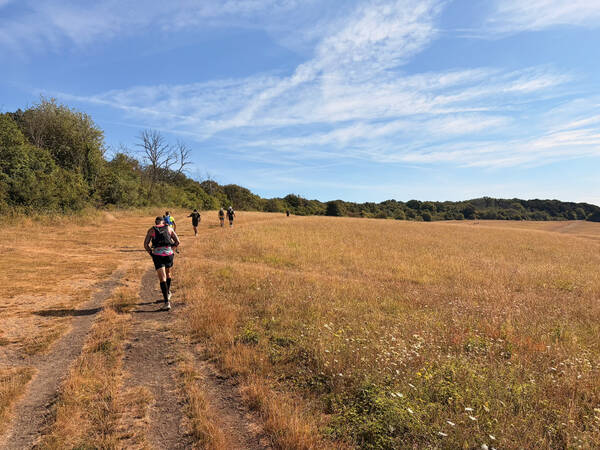
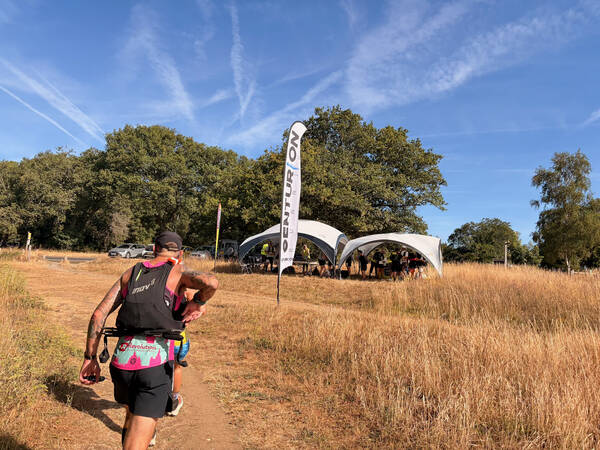
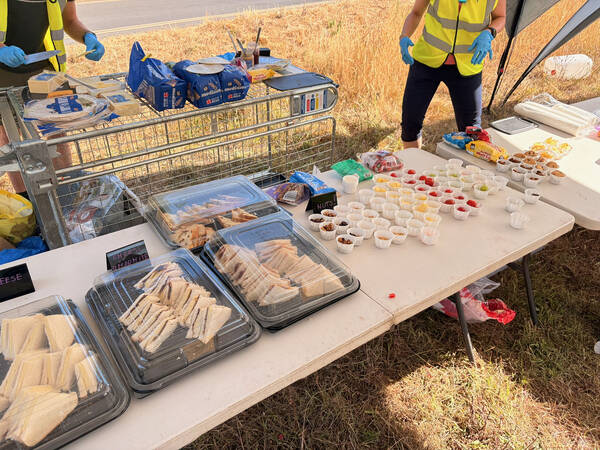
At the Newlands Corner aid station after 24 km I start to feel my legs, which is absolutely normal. This is the point at which the distance makes it a run I’m going to feel tomorrow instead of a short and easy training run. It’s a slight low-point, but an expected one. And right now standing in the shade and enjoying some items of this great food selection lifts the spirit immediately.
🦶 The Thing with My Toes
Some time around this aid station it happens. I bump my left big toe against a stone sticking out the path really hard. Blood is pumping into my foot, it hurts hard so I have to let out a short scream.
This had happened to me before, actually. Last year at Tuscany Crossing 103K I destroyed that same toe in a similar situation, running against a stone sticking out from the flat path after around 80 km. It’s not just a black toenail, of which I’ve had plenty. It hurt for two weeks on every step I took, much like when I broke a toe a few years back. It might have been broken, actually. The nail was removed from the bed instantly and it took over half a year to regrow. This bump right here was similarly powerful and I knew it immediately. I felt the toe increase in size due to the swelling. Pulsating. My big toes are really big, quite a bit longer than the other four on each foot. This makes my shoe choice extra tricky. The Prodigio Pro shoes do have a good shell at the front, but when I slip forward in them, the big toe is the only one to catch the impact.
Of course I continued on running despite the pain. There’s nothing that can be done about it, the damage is done. It took a big effort to endure the pain, though. The pain remained noticeable for about half an hour until my brain forgot it. Which was just about the exact time I bumped that same foot AGAIN on a stone, nearly falling down. This time it was even harder to take the hit, because the toe was already swollen and the nail had risen from the toe, taking yet another hit pushing into the back from where it usually starts growing.
Why does this happen?
My guess is that most of this route just requires no attention because it’s so easy and non-technical, so I got lazy and tried to save energy by not lifting my feet up high enough. The growing fatigue makes that harder to do. But in the exact moments it happened I was additionally distracted: the first time I think I was looking at the watch or sipping a gel, and during the next time I was both talking to another runner who was just behind me, while simultaneously fiddling with my running poles. During the fall I nearly broke one of the poles.
This time, the pain stayed with me for another half an hour. Gritting my teeth, trying hard not to let this have an impact on my run technique because that would lead to more problems down the road.
⛱️ Crew Support by Sophie
After 34 km there’s a spot that offers the first practical chance to accept crew support, Denbies Hillside. This is highly regulated, crews can’t just show up wherever they please, there are a few designated spots for them. Mostly the spots are not corresponding to the official aid stations. This is due to the parking situation. James said that around 40 percent of the 250 runners here have a crew, the others don’t. That means roughly 100 cars need to find parking in these little English towns. During these first hours that can lead to congestions, but later in the race it’s not much of a problem anymore.
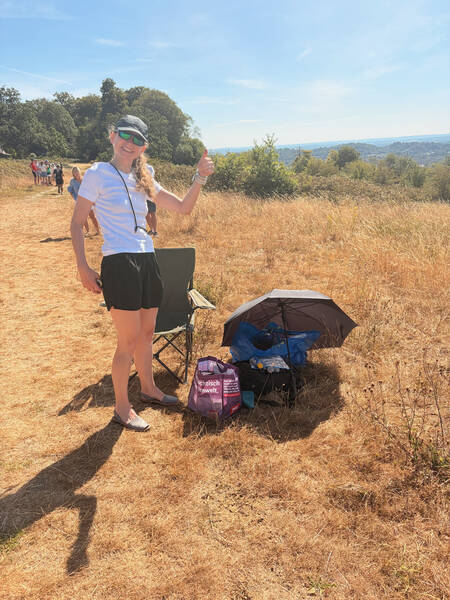
It’s obviously great to see Sophie. She has set up a little spot with everything I could want right now from the car. The foldable chair in case I need to sit for a minute (which I don’t), an umbrella to shield me from the sun (which I don’t need), and many gels and newly filled soft flasks, which I very much want and need. It’s great to see her. I also take the white hat because the sun really is burning right now. And then she pulls out a zip lock bag full with ice she managed to get somewhere, which is really amazing. I stick it between my running vest and my neck for maximum cooling effect and this feels like magic.
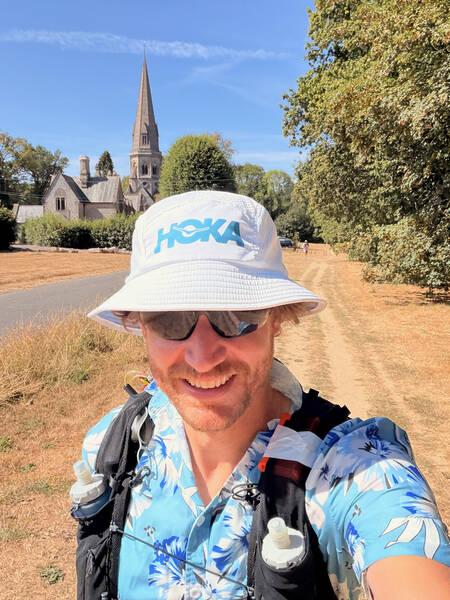
Moving on, the heat really starts to become the main enemy today. We have crossed into the region of 25 °C to 30 °C by now and it is apparent. I try to think about how this race is going to be very long and the later bits will definitely take part during the upcoming night which is going to be cooler.
In fact, the heat does not annoy me that much. I don’t hate it like many others do, I actually prefer it to cold racing. But the fact is that it takes a toll on people and just makes everyone go slower, there’s no way around it. The effort it takes to keep up a good pace is so much higher in the heat, and crossing into overheating territory usually is irreversible. You just have to take it easy if you want to make it.
While I think about how beautiful the course is and how good the ice feels on my neck — BAM! — I hit my left big toe for the third time. What’s going on today?!
Shortly after that, still trying to work through the pain from this hit, I hit my right big toe as well. So that one is done, too, I’m thinking. It was already black from some hard running during the weeks before, which means it’s hurting like hell, too. Any other of my toes would have been fine. Eight of the ten can be black and I don’t care. Just those two big one are hurting when I hit them, and today I’ve already hit them four times total before even completing the first marathon of this four-marathon ultra race. If I remember correctly, both these occasions were also happening because I was distracted and kept my eyes off the path for a second, not noticing the big stones I’m running against. It’s always stones.
So it took another half an hour for me to process the pain and get over it. It consumes a lot of willpower. Thankfully the views helped. We’re running next to some vinyards to the right of the little ridge we’re on during most of the course.
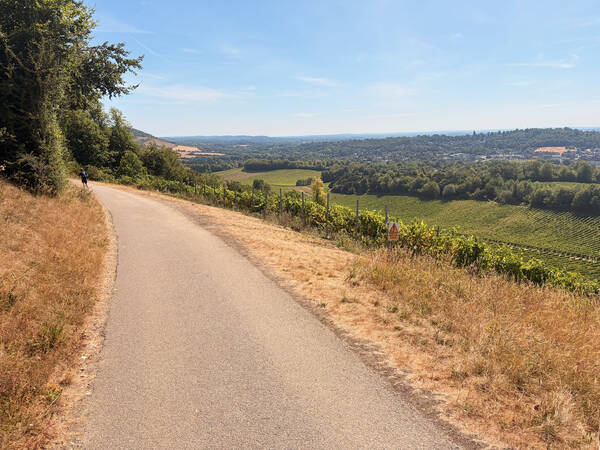
At 38 km, there’s another aid station. It’s called Westhumble Fields and is next to a busy multi-lane street. The crew here is again super proactive and refills my bottles while I’m drinking as much as I can of everything to replenish all the lost fluids from the sweating. They also have a container with lots of ice I put into my zip lock back to get my neck cool again. The ice melts within 10–15 minutes, but the resulting cold water feels great to pour over my head afterwards.
We have to cross the big road at some traffic lights and run back on the other side now, making for a bit of an out-and-back section during which I see Nick again! He is just a few minutes in front of me, but this just makes me happy to see that he’s apparently doing well. There’s nothing left in me that says it would be cool to catch him. I’m just managing the heat and the pain in my two big toes, trying to move on. Thankfully, the main attraction of the path is about to happen.
🪜 Famous Box Hill
Right after that short bit where we got to see the runners in front and then behind us, we reached the one section of the course I was quite familiar with. About 40 km in, the Stepping Stones up to Box Hill wanted to be climbed. While I’ve never been here in person, I have virtually cycled up and down the road right next to it many times before. Virtually, meaning I did so on Zwift, the digital cycling platform connected to my indoor bike setup. Zwift offers many different routes around the world but always with a little spin instead of copying them exactly. The London map of Zwift connects the inner city underground tube right to these Surrey Hills, although in reality they are about 50 km apart. The reason being that Box Hill is a famous London cyclist’s spot for training and also part of many large professional bike races.
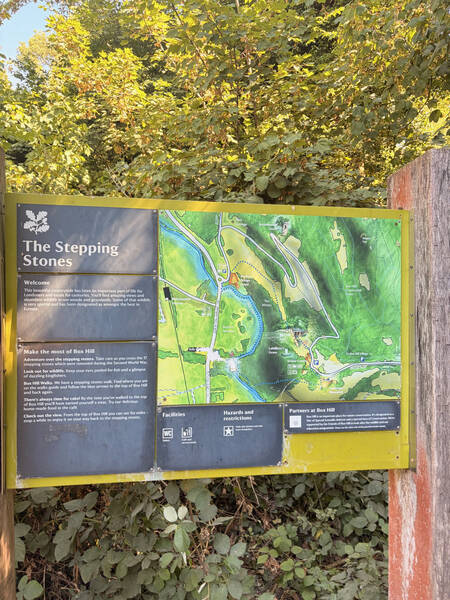
Next to the entry into the area was a mobile coffee shop and place to get some cake, surrounded by dozens of people in tight cycling clothes. Coffee and cake and up the hill! Not for me though, I stayed with electrolytes and gels.
We would not run the exact road that goes up the hill which sits at 172 m and has three switch-back like turns, but go up the hiking path just south of it. The full ascent here is just about 100 m, laughable really, but after all the rather flat rolling hills you do notice it because it’s compressed into just about 500 m, so it’s steep. Here, I was glad to have my running poles with me.
Also, I was glad I did only have to do this section once, as opposed to the 13 times I needed to cycle up and down on Zwift in order to get the Route Badge Achievement called “The PRL Full,” very glad.
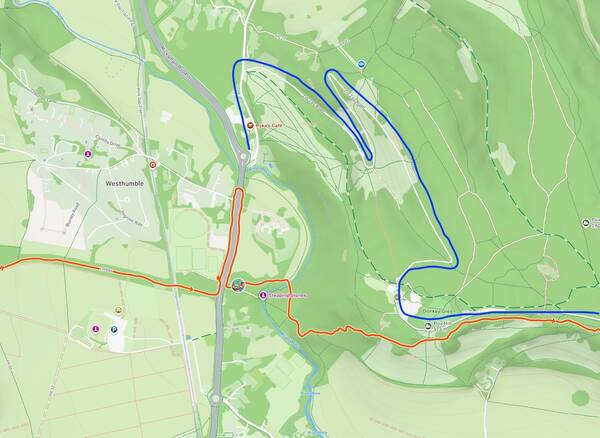
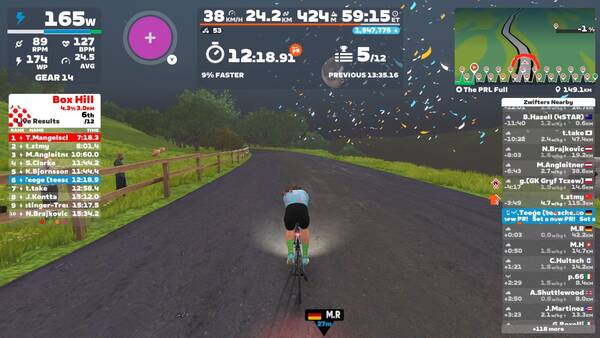
The popularity among hikers and families was hard to overlook. It was the most crowded section of the whole course so far, and I had to overtake many tourists. Uphills are my strength so I also passed a few runners here.
I tried to get a glimpse of the road next to us I was so familiar with, but unfortunately the dense green forest made that impossible. Lovely cool section though, because the trees above blocked lots of the heat of the sun. The top of it was roaming with tourists relaxing after having made the climb. One proactively offered to take a photo of me even as I passed by.

🥊 The Notoriously Toughest Section: Box Hill to Knockholt Pound
You have to love these very English names. This next section is roughly the second of the four marathons, if you’d like to divide the 167 km long route like that. From race reports I knew this was going to be the part with most tricky ups and downs. And yes, even though it’s still rolling hills, the tired legs do notice it. The difficulty only partly comes from the elevation gain and loss, though, it’s mostly the circumstances of the route for me. Some very narrow single trails with lots of thorny bushes on both sides scratching me, having to duck from time to time — once I’ve lost my hat on a thorny bush above me. This is draining energy more than just the plain distance and elevation is. Of course my pace is also massively decreasing now that the route is becoming more difficult.
Although it’s not the smartest thing to do at long ultras, I had a few time-based goals memorized. My absolute dream goal time, the fastest result I could have hoped for, was 20 hours flat. The next best thing would be 24 hours, because making it in under a day would yield a special belt buckle gift at the finish line, and the main goal was to make it under the 30-hour main official cut-off time, which is also the limit needed for entering the Western States lottery.
- 20:00 hours → 7:13 min/km
- 24:00 hours → 8:39 min/km
- 30:00 hours → 10:48 min/km
These paces of course include everything, especially the stops at aid stations. Standing still for five minutes will make the average pace go down by a lot.
At this point I wasn’t sure anymore if I had calculated the paces based on a distance of exactly 100 miles, or the official 103 miles. The GPX route we got to download was even a bit longer, 166.45 km. And then, the actual path I’m taking and especially the tree-covered parts will mess with my watch’s measurement. These are the reasons I need to take the numbers with a grain of salt anyways. You have lots of time on your hands when running ultras, so thinking about the numbers and necessary paces to reach certain goals becomes a pastime of mine every time.
I try to refrain from judging myself while I see the average inevitably get slower as the day goes on, but I think it definitely is a source of frustration.
One thing I learned today is that I definitely should only have one single goal in mind, and that’s the average pace for the Western States lottery qualification.
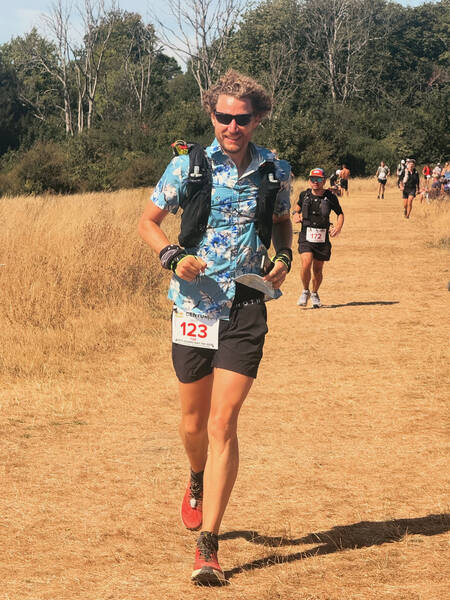
At some point after the gradual downhill from Box Hill, one of the hikers noticed my flower shirt. This had happened before, when last year during my Tuscany Crossing 103K race an elderly Italian guy saw it and exclaimed loudly, raising his hands into the air: “Elegantissimo!!!”
This time, the response was much more English. The bloke said: “Lovely shirt! I like the casual approach!”
The fun shirts I like to wear remind me not to take everything too seriously. And these positive responses, of which I’ve gotten many more during all the marathons I usually do, definitely lift my spirits every time.
Reaching the next official aid station at 51 km, Reigate Hill, I’m surprised to meet Nick again! We have a little chat and both agree on two main points: the heat is really making us suffer today and that our legs are already smashed. He doesn’t do the crushed ice zip lock bag trick, but I really love that here at the aid stations.
Once we get going again, we stay together for just a short bit. His shuffling pace is a bit faster than mine and we of course both like to run at what feels comfortable for us. If you can even call it that. As he slowly drifts out of my view in front, I’m still quite chipper about having made so much progress despite the heat and pain in my toes. The longer it goes on, the less I feel them throbbing.
🚐 Rockshaw Road, Merstham Crew Access Point
Just a few kilometers later, right after passing by a field with Cricket players on it, all dressed in white, I reach the place where all crews have lined up their cars along Rockshaw Road, a long straight road leading through Merstham. Many vans with open trunks and a few folks standing around each, refilling stuff or just waiting for their runners during this warm day. This is nice because they obviously know about the race and cheer for us who come by. And after a few hundred meters of these parked cars, the one that’s most interesting to me appears, too. Our own! Sophie is standing next to it and has everything ready. Perfect.
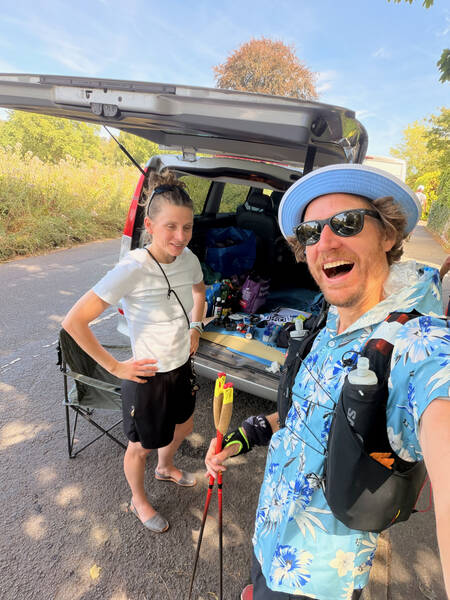
New gels, two new cold soft flasks, removing all the trash from my pockets, a bit of ice-cold Coke, new crushed ice into my zip lock bag on my neck. This all feels really good, again. This is the place where I also need to remember to put my headlamps into my vest, because it will become mandatory equipment from the next aid station on which offers no crew access. I also pack my extra battery pack in case my phone or watch need power later on. The vest is more heavy now. Saying goodbye to Sophie because I won’t be seeing her for a while. The next point at which we can meet up is over 30 km ahead.
Some very pretty sections follow, wide fields, even some asphalt. I do like the course and general area. The only downsides are the thorny overgrown bits and the loud motorway which is very often within earshot. The stones which were stuck in the paths and destroyed my feet are not at fault here, this was one hundred percent on me.
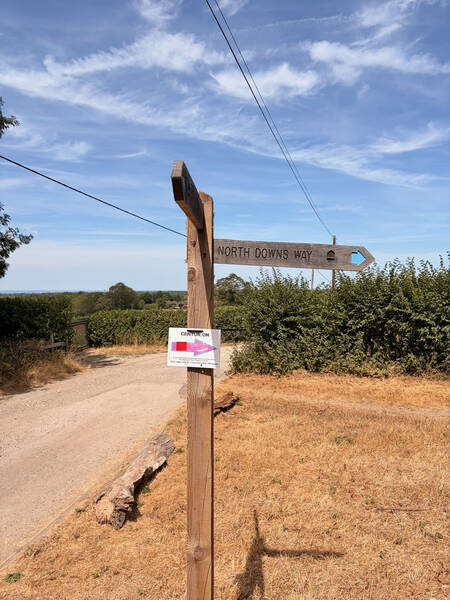
It’s slightly past 4:00 PM as I reach Titsey Brewery, the aid station after 71 km. It’s still super hot and I long to refill and drink as much as I can. The gels still work great for me, I’m switching between those of the 4ENDURANCE and MNSTRY brands. But the non-sweetness of the cheese sandwiches here at all aid stations really help in resetting the palate and make it easier to get some more gels down later on. This stop here went over really fast, I’m in a groove.
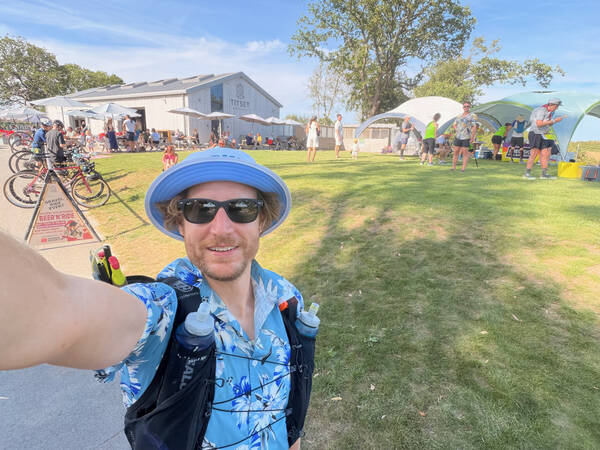
I’m happy I’ve already gotten this far. The pace is alright, I’m making progress. Sure, the legs hurt but that’s just normal. Sophie texts that I’m currently in 70th place of the 250 runners. That’s good news but shouldn’t really affect me in any way. I have to run this race according to my own abilities. Nick is about ten places ahead of me, she writes, just for pure information’s sake. There’s no battle going on between us.
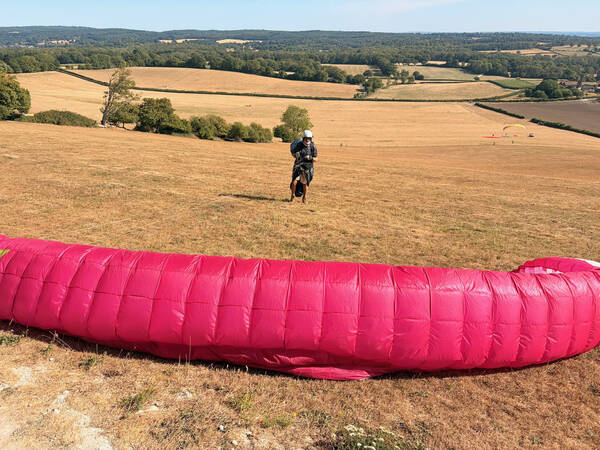
Suddenly there’s a wide field with a few people learning how to do paragliding. I think that’s great and try to take a picture next to one, when suddenly his chute surrounds me! He accidentally dropped it or the wind must have left, so I now need to find my way out of it from all these cords. That’s new in an ultra race! We laugh, he apologizes.
Some fields with cows and horses are next, we run straight through them. There are gates at the entry and exit points which we have to open and close. After a few dozen of those this starts to annoy me, because it always means you have to come to a full stop and accelerate again into running on these tired legs.
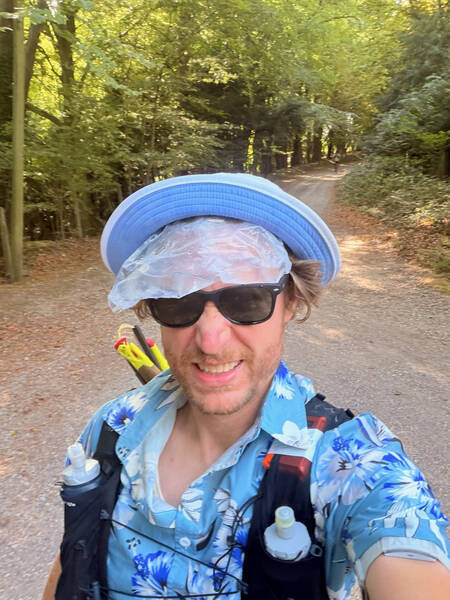
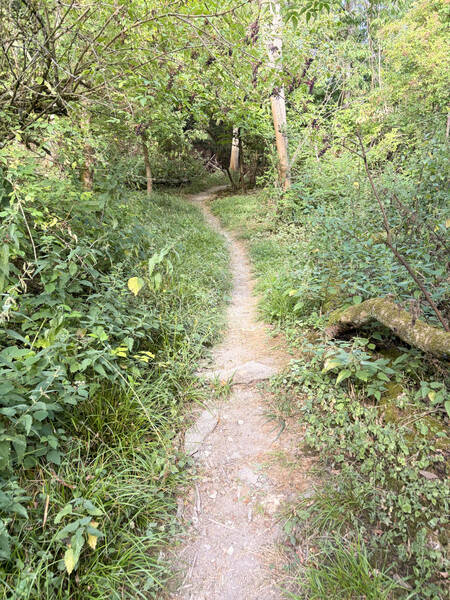
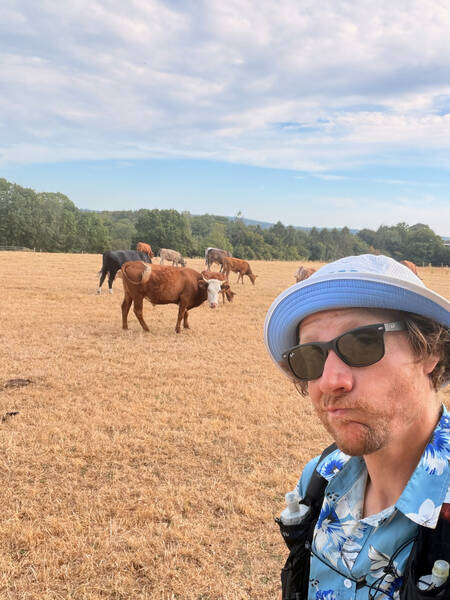
Somewhere in this area I again repeat my biggest mistake of running against a stone with full force on my left big toenail which has already suffered enough. Again, the pain is shooting through the roof and stays with me for about 20–30 minutes. At which point I hit it for the fifth time. I’ve actually counted the times because they were so significant. Just so much pain. Once or twice I could’ve handled, but repeating this in this regular fashion is really taking a toll on me today. At the time I’m contemplating solutions.
- Some sort of re-enforced framing on the front of the shoe?
- Custom made stronger rubber bumpers?
- Silicone caps around the toes inside the shoe?
- Training to lift the legs up higher, even after ten hours of running?
Right now I know I can’t do anything except to try and be more focused. But this is easier said than done during such a long race. These trails are so treacherous for me because 99 percent of the time you don’t need to pay attention. And then right when you’re eating a gel the pointy stone appears. At the way more technical CCC race in France last year, this happened to me not at all, because I had to pay attention at every single step. I wore the same shoes. My toes looked alright afterwards.
🍝 Knockholt Pound, Halfway Aid Station
I’m reaching the halfway aid station, located at 80 km in, after 10:38 hours of running. No crew allowed, but it’s a major aid station that also holds drop bags which you could have prepared yourself and handed in at the start to be transported here. I didn’t need that because Sophie is with me during the race. But I did really appreciate the hot pasta they also offered here.
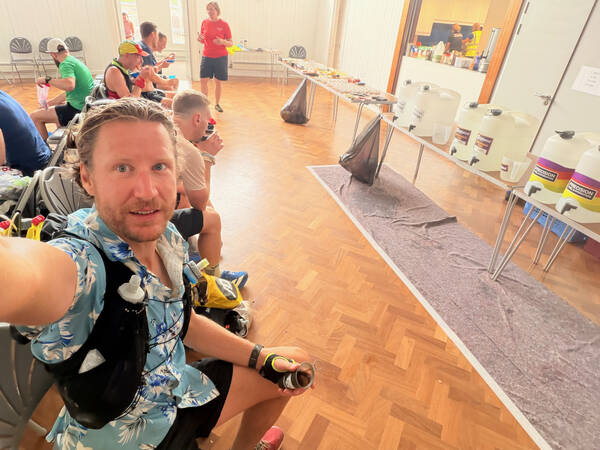
Mentally it’s always great to reach the halfway point, even though this one is technically just short of half the distance. I spent a few minutes relaxing and refilling everything before moving on. Some sit here for half an hour or longer. That sounds bad, but it can be a valid strategy. The race is long and there are many hours left — more than 19 until the final cut-off, to be exact.
I’ve also sent an update to Sophie via text message and she replies that Nick is about 38 minutes in front of me. She’s watching the tracker. That’s really far, I’m happy for Nick to be doing to well. On the other hand, it’s just as possible that I have slowed down by a bit. I have been feeling quite slow during the past couple hours.
Moving out of the aid station building I notice a bucket full of icy water, which is perfect to cool down a bit more. Even though it’s nearing 6 PM, it’s still rather hot outside. The next crew point is under 8 km ahead of me and it takes me about an hour. Good pace this far into the race because it’s an easy section, but I hit my left big toe for the sixth time somewhere here.
Time to think about getting full toe removal surgery? No toe, no pain?
🚐 Otford Crew Access, Mile 54.5
It’s great to meet Sophie again after a long stretch of over four hours since Merstham when I last saw her. She had a good time, got some food, shopped a few books at a tiny used books store and seems to be happy to be here. She’s holding her clipboard with the print-out of the crew access points and some hand-written notes on it.
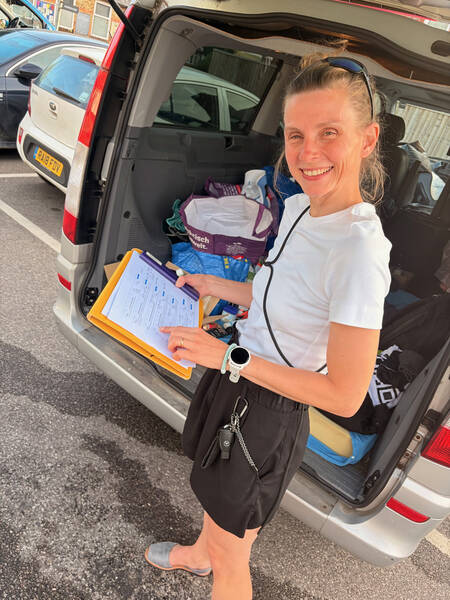
Sophie tells me she’s met Nick here, as well as Karsten, who is pacing Nick for the next few hours. He came here using the train from Brussels, where he currently lives. Karsten is a great guy, very funny. Nick is about an hour ahead now, but that still has no meaning to me.
It’s good to know that 91 km are already behind me at this point, but on the other hand 76 km are still left to go. Quite far. I use a trick I have up my sleeve, and that’s eating some tomato paste. Another effective palate cleanser.
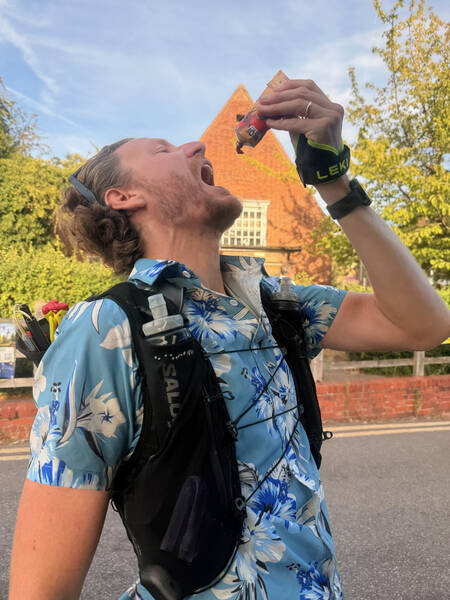
Another great trick is spraying Franzbranntwein on my calves, which is a menthol solution that cools the muscles very nicely, having an effect lasting up to an hour. When Nick came be earlier, she offered that to him too and he really liked it.
Apart from restocking on gels I also hand Sophie my white hat in exchange for a warm jacket. The night is about to start. At that moment an older guy approaches us and tells me that he has already seen me at the Titsey Brewery aid station earlier today, where he watched me and found it very funny when I was done with everything, looked left, looked right, shrugged my shoulders and started running away. It looked to him as if he could see my thoughts: “Alright then, might as well move on!”
The way he tells it that sounds really funny. It’s good to have a laugh when you’re so exhausted.
Sophie tells me about talking to a few other crews around here and finding one which had a laminated plan for the race prepared by their runner. She liked the professional approach and took a photo of it.
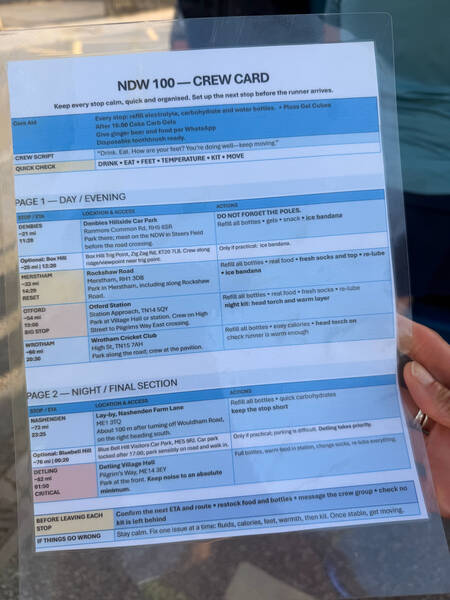
Moving on, I kind of miss having a pacer now, like Nick has with Karsten. Usually I prefer to do ultras on my own, but here it’s somehow different. The field is stretched far apart, it’s getting lonely in the setting sun. With some people I pass or who pass me I have a bit of smalltalk, which is nice. It’s also good that the temperature has gone down. My phone needs some charging, so I plug it into my power bank. A bit disappointing, I barely used it.
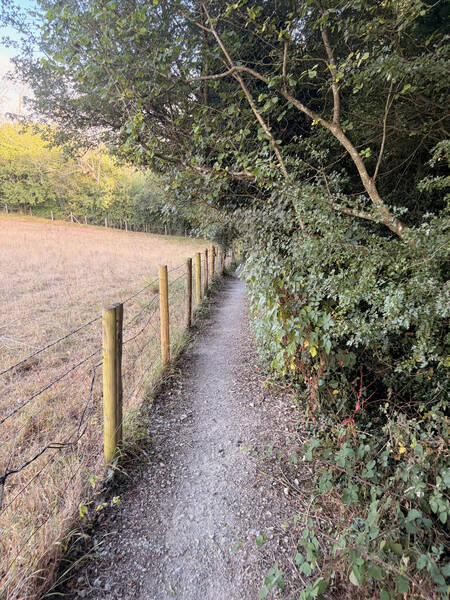
The course more or less stays the same. Some easy patches, some harder ones. One particular bit had a wired fence to the left and thorny bushes to the right, but was so overgrown I had to duck to get through. It was short but again made me lose my rhythm.
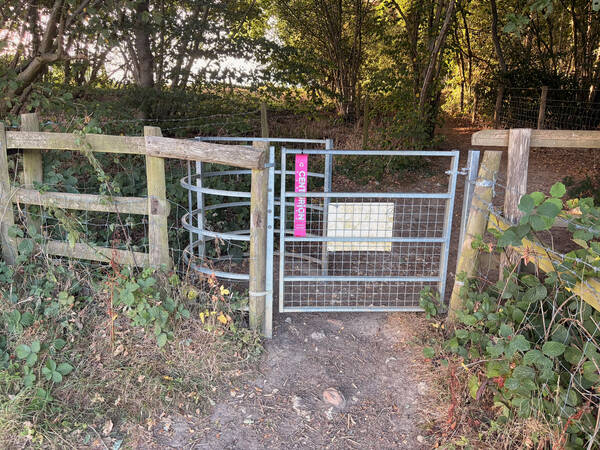
🏏 Wrotham Cricket Club Aid Station, 100 Kilometers
I keep moving forward quite well under the circumstances. Just over thirteen hours for 100 kilometers makes me happy. It’s really empty now, I don’t think I’ve seen more than a couple of runners during the past hour since the crew stop at Otford. This aid station here is inside the club house of a cricket club and maintained by a bunch of teenage girls and a few adults. Super nice people, all of the volunteers so far. As it’s getting cooler outside I’m not as thirsty as I was before, but still refill everything and have lots of coke because of the caffeine. I sit down on a chair in order to get my headlamp out of my vest and put it on my head because it’s soon getting dark.
There are a few more runners sitting on chairs and taking a longer rest. It’s very quiet, the emotions are flat-lining and people have this emptiness in their eyes. I do to, I guess. Pure exhaustion after this long and hot day. Cheese sandwich. Some cherry tomatoes. Watermelon with salt on it. “How far to the next aid station?” — “A little under 11 miles.”
That’s a long way. I better fill up my third soft flask, too. While doing that, something seems to fall down from my head, but I can’t see anything lying on the floor. As I look up confused, a volunteer girl asks me what’s wrong and I tell her I feel like I dropped something. She answers that it must have been my hair or so, and that I’m surely tired, and rightfully so. Nothing to worry about. I shrug and move on, thinking nothing of it.
💡 The Importance of Light
As I leave the aid station, another runner is next to me and we chat for a while. Ten minutes later, we’re still next to each other, I test out my headlamp but it won’t light up. Odd. While running I take a look at the super light device from the Petzl brand I just recently bought after doing heavy research, but nothing seems wrong. It just won’t switch on when I hit the button. Oh no, maybe it was the detachable battery that fell down from my head back at the aid station? How dumb! That must have been it, I think. Good that I have a second headlamp, since it’s part of the mandatory gear list. It’s a much smaller and lighter headlamp, but it does the trick for now. I remember I bought it because it holds power for more than ten hours, too, which should be enough to get me to the finish. Just over 60 km left, can’t take that long. Right now it’s not yet necessary to have the light switched on so I try to save battery and keep it turned off, but it doesn’t take long until that changes.
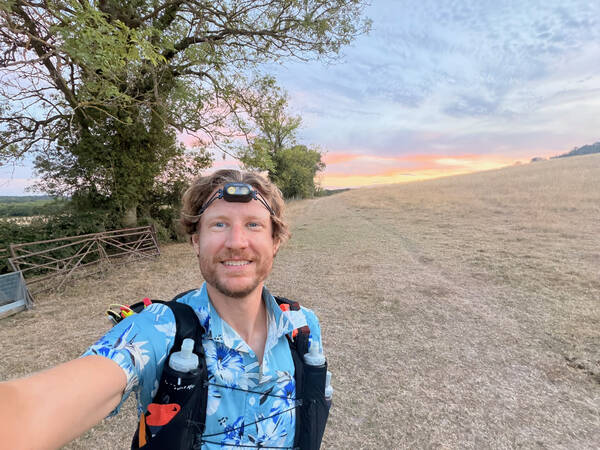
The routing is getting a bit more difficult and I make a few mistakes at turning points. One especially annoying one adds about a full kilometer to the total distance for me because I need to turn back and find the signs. On my GPS watch the tracking looked like it was correct, but there were two paths right in parallel to each other, one leading up and one down and I took the wrong one. No one is here and it’s dark. It’s also harder to see the thorns in the bushes now and since it’s dark I can’t see all the pretty things around me anymore I like so much here in England. My mood is deteriorating quickly, and right when I made my peace with the situation, I hit my toe against a stone for the seventh time.
That does it. The pain is again so much and so hard to digest. Each time the nail is pushed back into the toe with what seems to be my full body weight. I manage to not fall down, but it just is taking so much effort to breathe through the pain. It has become nearly impossible to run pain-free now. I resort to walking for most of the time, even using my poles on the flat bits just to take some relief from the swollen toes. Opening and closing all the farm gates with my poles attached to my gloves is even more annoying than doing that without poles.
An hour later with just maybe 5 km of progress I try to increase the intensity of the backup headlamp because it’s getting really hard to see. As I do that, the device blinks three times. I know that’s the signal that the battery is nearly empty.
🤦♂️ Oh sh… that’s not according to the plan.
I remember that I just bought the lamp, tested it once if it worked, and threw it into my bag. No one ever uses the backup lamp, is what I thought. So I didn’t charge it! It must have been half empty when it shipped to my house, I guess. Pretty standard. But right now, even with my foggy brain I do realize how bad that is. I can’t continue without light, it’s just too dark to see, plain as it is. My phone’s light might have worked for a while, but the idea of holding the device in front of me for the next 5–10 hours horrifies me. And I don’t know if the battery on that one would even be enough. I could have definitely connected my power bank to the now empty headlamp but I’m so drained I just keep dismissing the solutions popping into my head.
It seems to me this is just too much to take at this point. It’s mainly the pain in my toe and the lack of a plan for fixing the light source situation. Even though objectively it doesn’t sound unsolvable, I just can’t come up with ways in which I see myself moving on for the next 50–60 km. Maybe I subconsciously wanted to fail because that would finally stop the pain.
This is when the first thoughts about giving up entered my mind.
😓 Falling Apart
This all happened between maybe 8:30 and 10:30 PM. In addition to the pain in my feet, the lack of energy makes it harder to run. Maybe I over-paced in the earlier hours? Now I’m only hiking. It takes forever. I take a look at the watch a lot just because it’s the only interesting thing to see in the dark. I know all the mantras, “right-foot, left-foot,“ and “every step gets me closer,” but none of them seem to help. My most ambitious goal time of 20 hours has sailed by long ago, and 24 hours isn’t realistic anymore either, even if I somehow managed to solve the light problem. I also feel guilty for Sophie now having to spend so much longer waiting for me. She’ll be at the Nashenden Farm Lane crew access point, 116 km, shortly after the 114 km Ranscombe aid station.
I can’t imagine actually hiking the whole remaining distance to the finish. Even though in theory it should be possible — there are 8–9 hours left to the 30-hour final cut-off. I switch the watch to show remaining kilometers instead of completed ones, because I had a few involuntary detours and that messes up my estimates. I text Sophie. She says I’m in 64th position but I can’t really believe it. I’m starting to get overtaken more and more often, because I’m only hiking. Nearly everyone asks me if I’m doing okay, which is of course quite nice of them but annoys me a lot. What am I supposed to answer? “Yeah sure,” or give them my life-story and the full truth? Whine about my toe to every one of them? I resort to sometimes responding that I’m just in a low right now, and that’s probably the most relatable thing I can say. They all understand.
Ultras are about overcoming all the lows. But when is a low just too low to overcome?
The sandy downhills are also hurting so much since my feet shift forward within my shoes, hitting the toes to the front on each step. After 110 km I’m thinking about planning a short nap in the car when I reach Sophie. But it’ll be 7 km more until I see her — a laughable distance, but walking with pain for that long fills me with dread. The fun level has reached zero by now. Sure, in theory I might be able to walk it in, but the thought of walking for so many more hours in these conditions? Please, no!
I send Sophie a message to ask if she could pick me up somewhere.
Just to see if that’s even possible. She tries to encourage me to keep going and checks the traffic situation. Turns out, there’s no other access point apart from a few hundred meters before the actual crew point. But she then manages to find a way to get closer to the next aid station and we agree to meet there and talk.
A few minutes later, I start to feel dizzy. The headlamp is at the lowest level, barely giving any light at all. There’s no moonlight, it’s super dark. Putting my feet on the path becomes a real challenge. But what’s with the dizziness? Maybe a light heatstroke from the long day out? Dizziness is tricky, because it needs to be taken seriously whatever the cause.
I have to fight so hard just to keep on walking. During the half hour that’s left until Ranscombe aid, mile 71, I make my decision. This right here is absolutely no fun. I’d rather be doing almost anything else. Who cares about finishing, I certainly don’t anymore after these past 2–3 hours. Sure, the thought of missing out on a Western States qualifier for the year crossed my mind dozens of times and might have been the biggest argument against quitting, but in the end it wasn’t important enough for me. I just want this to be over. I text this to Sophie and she calls me immediately. We have a chat but she realizes she can’t motivate me because I have made my decision. I just want to be done with it. I run to have fun and this isn’t it, I’ve reached my limit. When I tell her that I even got dizzy during the past half hour she agrees I should probably call it. As we speak on the phone I see the aid station appearing in front of me.
🚶♂️ Walking Away After 70 Miles
The aid station is great, as they all are. The head volunteer lady talks to me. Two more runners are here, sitting in chairs staring into the void. Four more cheese sandwiches for me, in the hope that they change anything but they don’t. Meanwhile the head volunteer is performing mandatory gear checks on the other two runners. At that point I hope she won’t ask for mine, because now that I’m down to the last few minutes of battery on my backup lamp, I’m pretty sure I wouldn’t even be allowed to continue even if I wanted to. Are there any written rules for this specific situation? Surely with two failing lamps you can’t be allowed to continue. On the phone Sophie told me she had a headlamp for herself in the van I could use, but even that doesn’t change my mind.
This just sucks.
Sitting in the chair, eating the cheese sandwiches, the decision is final. I’m out. I tell the lady and hand the bib number to her as it’s the usual way to drop out. She also gets the borrowed GPS tracker I was carrying, and that’s it.
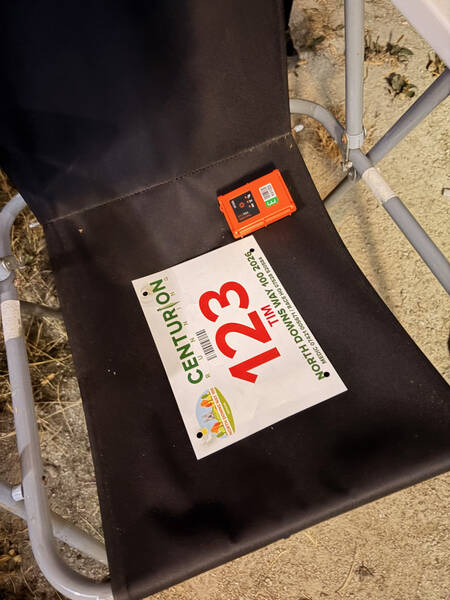
The race bib number 123 was much too good to let go, but I felt like this was the correct call at the moment. I just couldn’t imagine going on for 50 km more. I pushed “FINISH” on my watch, it said 116.8 km. The volunteer lady reminds me that I should still take recovery seriously, because the distance isn’t nothing. It’s weird, but this is actually a good reminder. DNF’ing even after such a long run kind of feels like it didn’t really count or wasn’t an effort. But of course that’s wrong, it takes a huge toll. Not just on the toes.
Sophie has found a spot to park, just about 300 meters away from the aid station. Super sad I wobble down there, and even that feels like forever and just hurts.
🛌 Post Race
Falling into Sophie’s arms helps. I’m sad but determined not to whine around. It was my own decision, I’m responsible, and it’s just a race. Sure, this messes with my plans and makes Western States even more unlikely to happen for me, but it’s also fine. Things just don’t always go according to the plan. If it would be easy to run a hundred miles, everyone would do it.
I made a decision and I’ll live with the consequences.
Frankly, those consequences are relatively minor. The toes will heal, the batteries will be recharged — both my own as well as those in my two headlamps. I’ll live to try again to conquer the hundred miles one day.
Now that it’s just around midnight, we still get the chance to spend the night in a real bed in a hotel. I hadn’t thought of the possibility and didn’t book a backup hotel, because I was sure to finish at some time in the early morning hours. So Sophie made a few calls and we drove around and asked at a few places in the city of Ashford and also in Folkstone, where we finally got lucky and scored an available room at 2:00 in the morning for way too much money. But a shower and a real bed were so worth it.
What a race! I can’t blame anything or anyone except myself. I made some stupid mistakes. The North Downs Way 100 is a class event, though. James Elson and his one hundred volunteers really put this together perfectly. I can’t say much about the final 30 miles because I never saw them, but extrapolating from the 70 before it has been a fun and interesting course. Not too demanding, definitely possible. I’m recommending it and I even think it’s quite likely I’ll be back one day to give this particular race another go.
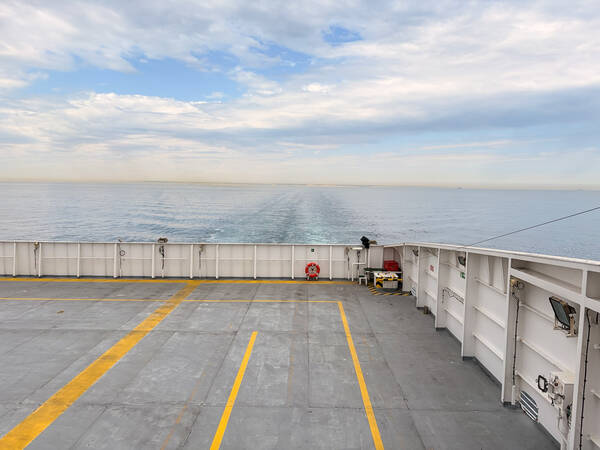
The next day we drove over to the ferry terminal in order to cross the English Channel back to the continent in the morning. I did my bare minimum 2-kilometer streak run and it was just super painful. My feet wouldn’t really fit into my widest shoes as I hobbled around the parking lot. But I was determined not to have my 1,600+ day run streak go to waste as well after this failure. I needed a win and got it. A tiny one.
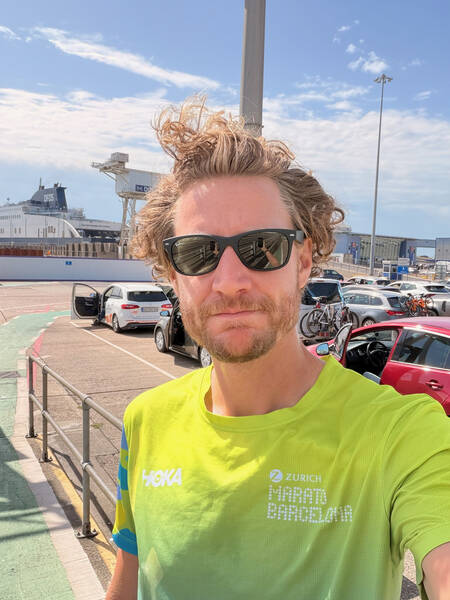
💭 Post Race Thoughts
Of course, at first the emotions just run wild after such a big disappointment. It takes days or maybe weeks for me to digest this and come to the most sensible conclusions.
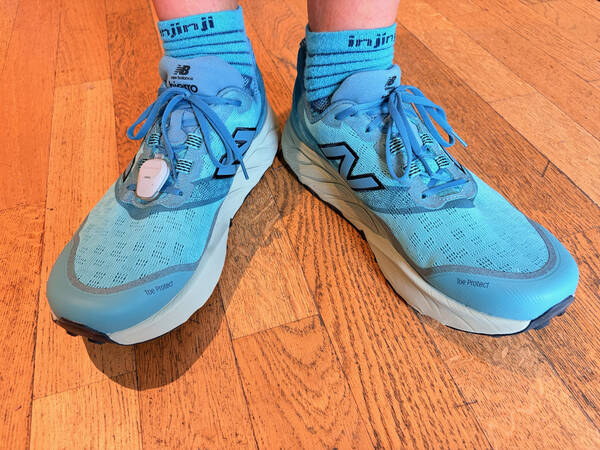
My immediate thoughts went to blaming the shoes and looking for technical solutions to that. I impulse ordered a pair of New Balance Hierro V9, which have the feature “TOE PROTECT” written on them. Sounds like exactly what I need, right? But the cushioning in them is really weak and they just are poor shoes in comparison to the LaSportivas, I found out after a few hours of trail running in them. It’s not so much about the shoes.
The main problem was my focus, and maybe also a bit of a lack of strength in my legs. I’ve got the endurance, but the sheer power to keep the feet up from the ground seems to be missing at times. But if that’s true, how did I succeed at all the other hard ultras I did before? The only time I also had problems with hitting my toe too hard was at the Tuscany Crossing last year, as I said. Two very similar routes: mostly flat and easy so you start thinking you don’t need to pay attention to the ground.
The day after I listened to a new episode of the Dirt Church Radio podcast, co-hosted by my friend Andrew McDowall. It was bad timing for me personally, because he made the following joke: “Ultra running is so weird. You never hear anyone saying that they punched themselves in the balls for 24 hours straight, and when they finally stopped, kept talking about how great they finally felt after they stopped!”
Of course it’s a good joke, but it hit too close to home to me. Why do I do this stupid hobby? I could also just choose to not punch myself in the balls — or toes. Coming to terms with that took a while.
It has been a tough day for everyone. The heat really diminished the field. In the end only 136 out of 245 starters made it to the finish line, that’s about 55 percent. In other years, the ratio is a lot better. I don’t think it was the problem for me, though. Nutrition also wasn’t it. Training-wise, I could’ve focused more on hills for sure, but the general fitness was there. I also don’t think I was too exhausted going into this race with all the triathlons in the weeks before and the slow marathon run six days ago. I know my body can usually take this.
It really came down to the missing will to continue with the pain in my toes in the dark without a proper solution to the lighting problem. As stupid as it sounds.
On Monday after the race I arrived at the conclusion that I should maybe drop the goal to one day run UTMB as well. It’s just too hard and I felt so humbled here in England I didn’t think I’d stand a chance. This has changed now, because I gave it some more time to process. I still don’t prioritize UTMB now, but within the coming ten years I’d still think I’d be nice to give it a try.
Western States though, is still fully on my mind. I just need to make sure to take more care about my footing and headlamps in the upcoming races for it.
And now here’s the absolute kicker: a few days later I realized that I didn’t even lose the battery of my main lamp at that Wrotham aid station. It just was completely empty, too! But it had USB-C and my power bank would have easily charged it in half an hour while I was using the backup lamp.
This just shows were my mind was at. I didn’t even check properly. The pain clouded my judgment so much, it’s astonishing to me.
But even before the race: what idiot doesn’t check and charge both their headlamps for a race that’s definitely taking place during the night? I really can’t believe it. What was I thinking?
Anyways, at least I’m absolutely sure not to make that stupid mistake again. Immediately I ordered another backup battery for the main headlamp. Who knows, with better lighting maybe I wouldn’t have gotten dizzy in the dark hours before midnight and might have even continued despite the pain in the toe. I doubt it, but it’s possible.
A week later I was thinking I shouldn’t have quit. I should’ve hiked on to see Sophie and have a chat with her. With her clear head she would have solved the battery problem. Problem solving is the main thing at ultras, apart from overcoming discomfort. I’ve done this before, I have the ability. This is what I’m taking into future races. Bad things will happen and they will be even worse than I might imagine, so I need to remain calm and avoid spiraling into despair as I did here. Resourcefulness is the key. That’s my main lesson from North Downs Way 100, 2026.
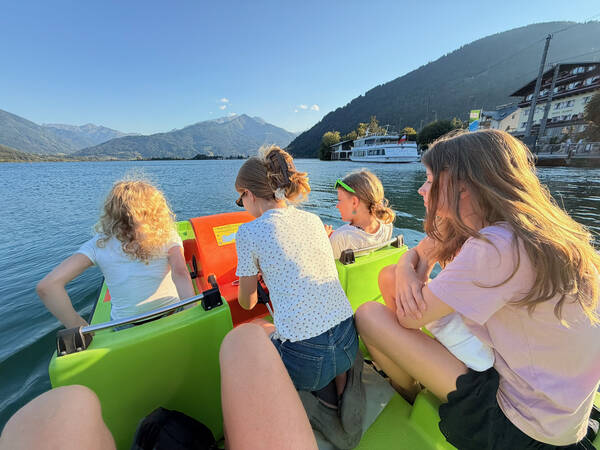
After returning home to Hamburg, I had one day to pack things before taking our four daughters on a week-long trip to Zell am See in the Austrian alps. Sophie had work, but the kids were still on summer holiday from school. Time to relax as much as that’s possible when you have to take care of four kids alone. It gave me the opportunity to focus on what’s important and then slowly start making new plans.
🗺️ Planning Ahead
One of the first things I did was trying to find out if there was any other qualifier race for Western States left in the calendar in Europe before the window closes on November 8th. I went through the long list and researched the ones that fit. But it looked really bad. Those that made sense and fit my schedule were sold out. That’s when I remembered I still had a ticket for the 50-kilometer trail race during the relatively new Mallorca by UTMB race on the Mediterranean island. Initially I booked it to collect the 2 “Running Stones” that help with qualifying for UTMB, but the event itself has a few more race distances to offer. There’s a 100-kilometer and a 140-kilometer race, too, both of which get you into the Western States lottery.
But both were also sold out!
Already having the 50K ticket, I thought I might have had a foot in the door and started trying to convince the staff to get me an upgrade to the 100K. It was a tough thing to do, but after several emails they agreed to give me a spot if I gave some money to a charity on the island. It wasn’t a tiny amount, so I had to think it through, but agreed in the end. The two benefitting charities work towards solving childhood leukemia and conservation of the Mallorca biodiversity, respectively. Worthy recipients.
I’ll be running Camins de pedra en sec, or CPS for short, on October 31st. It’s a 104 km race with about 3,700 m of gain on highly technical terrain. I hope that the focus I will have to put into every single step will help me to avoid crashing the toes which have just healed. I also got silicone toe protectors and tested them on a recent 50 km training run with good results. My training for CPS has been very focused during the past weeks. Lots of elevation gain, long runs, and I even did the boring strength training. At the time of writing I’m two and a half weeks out from CPS and feel confident. My race strategy is to take it very slow in the beginning, start hiking at small inclines already, and just keep my focus. I’ll leave the running poles at home because I feel like they were a distraction in England. Sure, they help with saving some energy and would probably get me to the finish in thirty minutes less, but it’s too much of a risk to get hurt again. I do attribute about half of my toe stumps to fiddling with the poles.
When I finish CPS in Mallorca in less than 18 hours, which I think is absolutely possible if the weather plays nicely, that would be the last minute Western States qualifier. It’s just eight days before the window closes. A last chance. I’ll be incredibly happy if that actually works out.
And for 2027?
Having a qualifying race earlier in the year is better for my peace of mind I realized. And also I’m determined to give the 100-mile distance another go. I feel like I can do it — I’ve learned some more lessons here in England I want to put to the test. Every failure makes us stronger. And also, I really liked it here in England and especially the Centurion Running organization of the event. They have a few more 100-milers in the calendar, and those are also qualifiers. Out of the bunch, the Thames Path 100 on May 1st of 2027 looked best. It’s along the river Thames, as the name says, leading from the outskirts of London to Oxford. Not much elevation — and while that represents a risk that I might forget to focus on footing again, I do think it’s a good idea to try and improve my performance. Also, I really want to visit the pub in Oxford where J.R.R. Tolkien and the late Sir Christopher Lee met! I’m really excited for the race and somehow also inspired three friends to sign up for the race as well. Nick will be one of them. By the way, he strongly finished the North Downs Way in an impressive 21:59:43, securing that sub-24-hour belt buckle, placing 22nd overall, 19th male. Hats off!
My own journey continues, the first 100-miler has yet to happen but I’m confident about it. Every failure comes with many new lessons, and there were a lot of those for me this time. It’s a fun project to try to improve and make fewer mistakes to get these difficult challenges done.
Reaching limits is just part of it. Onwards!
How do you feel after reading this?
This helps me assess the quality of my writing and improve it.
Leave a Comment