🎨 Impressions
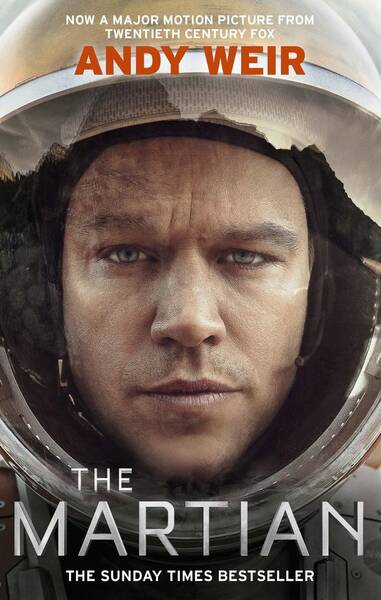
Influenced by the Artemis 2 mission that had humans fly around the Moon once again in spring of 2026, I got back into space. Not literally though. I’ve always been fascinated with it and wanted to become an astronaut as a small child. In fact, that’s the only profession I ever really wanted to have. None other got me excited ever again in my life so far.
I remembered the movie that had been made on the basis of this book some ten years ago. I saw it at the theater back then and enjoyed it a lot. So now I watched it with my four kids, aged between 7 and 14 currently. It was too much for the smallest, but the others enjoyed it.
Seeing the movie again made me want to read the book, because it has even more information and more science which had to be cut from the movie, probably. This assumption turned out to be true.
For me, it was an oddly relaxing read. Of course, the tension of being completely alone and at the brink of death on Mars all the time is there, but it’s so nice that the only thing protagonist Mark Watney ever has to do is solve physical problems. No issues between crew members or any other psychological and sociological drama to navigate, just bare problems like how to make water from oxygen and hydrogen. I like the simplicity of this a lot, it calmed me. At home I’ve been dealing with psychological issues like teenage rebellion or inconsiderate behavior a lot lately. It’s basically 100% of the problems I need to solve every day. That’s what stories are for: Providing us with a little break from reality and showing different perspectives.
A welcome difference between the movie and the book was the number of problems Watney has to solve. It’s great to read all of that. He solves them all so creatively, it’s really well written. Two examples are the dust storm on the way to the Ares 4 site, as well as the the rover tipping over going down Schiaparelli crater.
While reading the book, I looked up lots of things about Mars. I wanted to know how realistic this all was. The answer is that the book basically gets everything right with a few little exceptions. It’s overly optimistic that Watney’s risky strategies all work out somehow. But there’s one big flaw: the accident at the beginning that leaves him stranded on Mars couldn’t have happened in the first place, because the thin atmosphere doesn’t carry any power, so the tipping of the Mars Ascent Vehicle wouldn’t have happened. Also, the satellite dish wouldn’t have flown away in the storm to hurt Watney and fling him away for the same reason. Additionally, we now know that the Mars soil has toxic features, so the potato farming wouldn’t have worked. But that wasn’t part of our collective knowledge at the time the book was written, which was around 2010.
The style of writing is great, too. It’s mainly done as a log book written by Watney himself, in his colloquial style. Funny at times, too. Whenever it’s important to the storyline, the narrator perspective changes, for example when discussing things happening at NASA headquarters or the Chinese equivalent. Later in the book there are sections that are written from a different third perspective, sort of watching Watney live. These changes make it more interesting, it’s a smart choice by Andy Weir. The language is very simple, even the scientific processes are explained in easy terms so it’s all understandable with just a bit of knowledge in physics and chemistry. The story has a bit of an abrupt ending, though. The movie did this a bit better with its “a few years later” epilogue.
The five crew members are rather shallow characters, I would have liked for their characters to have a bit more depth and development. Some just seem to be there for comedic effect, which is fine but I’d have liked to know more about what they were thinking. How they see the whole situation. The token German astronaut, who is named Vogel, behaves in a cringy stereotypical way, which took me out of the story whenever he appeared. Answering questions with “Ja” instead of “Yes” and making odd grammatical sentences (as I’m sure I do as well) — is that really what a highly trained professional astronaut would talk like? At one point they need to access his computer inside the space station and it has the language set to German. Pretty sure no German astronaut would set their computer language inside a shared space to something different than the language of the team.
But apart from the small flaws in scientific realism and exaggeration of Watney’s success in solving all countless problems, the fun thing is to put yourself into his position and think about how you would handle it all. Surely, nearly anyone else in the world would die before being rescued for a lack of scientific knowledge, skill, and creative problem solving, but the interesting question for me is the ethical one.
Would I even want to be rescued? The tremendous cost is just a small side note in the last few pages and there’s no introspection on this question at all. The effort to rescue one human from Mars in the way it’s done in the book would not only cost hundreds of millions if not billions of dollars, but also keep hundreds or even thousands of employees at NASA occupied for two years in order to make it happen. That’s another huge opportunity cost. And then we have the sacrifice of the five other crew members who decide to swing back to Mars using Earth’s gravitational force, spending another 500 days on the space station, leaving their families on Earth behind to deal with the consequences. To accept all that is very selfish in my opinion.
Of course it’s every human’s instinct to try and survive even if the odds are super low. But putting myself into his shoes, in this situation I would probably have decided to stay on Mars and make peace with dying there one way or the other. Easy to say, for sure. But imagine the weight of the world on Watney’s shoulders once he got back to Earth. His crew friends missed crucial childhood memories of all their kids. An incredible amount of tax payer money has been spent on the sole purpose of getting him to be alive on Earth again, effectively halting space exploration for a couple years. I don’t think I could bear the guilt of my life being valued at hundreds of millions of dollars while billions of people’s lives are worth the same as mine but valued at close to nothing.
A book that makes you think is a good book. I recommend it.
Leave a Comment