🎨 Impressions
I got this book because of a recommendation from my friend Marcel, who had an interesting take on it. From the title alone it would be reasonable to assume that reading the book might lead to more anxiety, fear, hopelessness, and other negative emotions than are already present when thinking about the global political situation these days. But Marcel claimed to feel an odd sense of calm after reading it. And now that I have done the same, I can understand that reaction quite well.
With the Cold War long over and the looming conflicts between nuclear nations ever more complicated these days, not many people are thinking about the threat that all the thousands of active warheads all over the world still represent. The age of humankind has often been defined as starting with the moment we acquired the power to completely destroy ourselves, citing the atomic bombs as the single invention that made that possible. So in a way, it’s central to our existence, even though we don’t spend much time thinking of it. Probably because it’s just too scary. Which is another reason I wanted to learn more. Shining more light on the blind spots is a good idea.
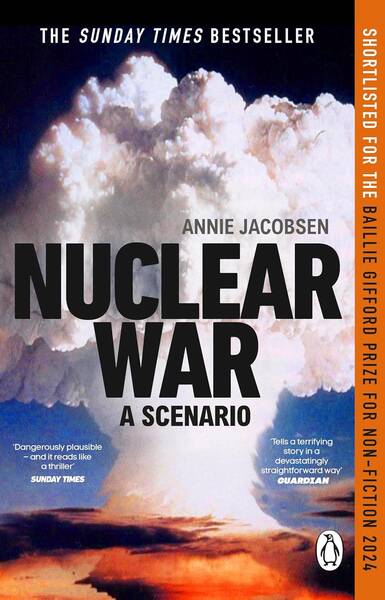
The book does what it says on the cover: It presents a well-researched fictional scenario based on actual reality, of what would happen if one of the Nuclear Powers would start a war by sending the first warhead to an enemy nation’s political center. In this case, North Korea is the one who brings down Washington D.C. and send the cascade of events off, which ends after just over an hour with the destruction of most of the Northern Hemisphere and deaths of billions of humans, subsequently starting a decades long Nuclear Winter. The book is a bit over three hundred pages long and tells it all in realtime, second by second. It is separated into three big parts, each covering around 24 minutes, landing at 72 minutes after that initial firing of the missile, with most of humanity dead.
The author, Annie Jacobsen, has a history of military books which received lots of acclaim. She was a Pulitzer finalist and has been published in all the major outlets. Her sources for this particular book are lots of interviews with military personell who were or are actually involved. As outrageous as the whole scenario sounds, it’s credible.
The opening chapter alone is super scary, even though in it she just talks about the history of the thermonuclear bomb’s development after Hiroshima and Nagasaki—not even speculating here, just laying down the facts. To give you an idea, the power of those two historic bombs which were used to devastating effect and caused the deaths of hundreds of thousands of innocent people, was at just 15 and 21 kilotons, respectively, while a typical modern warhead has a destructive power of 300–500 kilotons. Some exceptionally large ones, such as the so-called Tsar Bomba, even goes way into the megatons. A single modern atomic bomb is therefore dozens and sometimes hundreds of times more powerful than those ancient World War 2 ones.
And there are not just two of the bombs on the planet as back then. During the Cold War, mainly Russia and the US stocked up and built thousands of warheads each. It is actual insanity how much destructive potential has been created during those years. And just how dumb it all is. Those politicians in charge are like children envying their peers.
And when Jacobsen starts with her fictional scenario, the book becomes addictive really fast. It’s written in the present tense, as if you’re watching a high-action Netflix movie. There are fast cuts between all the major players and centers of power. And whenever it is needed, she provides the historical context for a certain aspect of the defense operations, for example. You never feel like there are questions left open. And how fast it all escalates!
I found it hard to believe that an hour after the first nuclear bomb would be sent into the air, half the world’s population would be dead, but after finishing the book I can see that this is actually a likely outcome of it. There are several points that make it clear. One of them is the so-called “Launch on Warning” policy that many nuclear countries have established as a defense mechanism. It basically means that as soon as their radars and satellites have confirmed a foreign missile is on its way to strike inside their home country, they will send off their own nuclear response. They won’t wait for it to arrive and hit first. There’s no time for nuance and decisions have to be made so fast they usually are way over the top.
One nuclear missile is on its way here? Immediately send 50 of them back!
Another thing I wasn’t really aware of is how quickly the ICBMs (Intercontinental Ballistic Missiles) can reach any spot on the planet by just leaving the atmosphere. In just around 30 minutes they can easily go halfway around Earth from launch to impact.
Then, while it’s possible for the most powerful countries to find out quickly if such a missile has just been launched and where it is headed by using advanced observational technology, it is next to impossible to do anything against the missile before its impact. There are several defense mechanisms in place, but they all have a very low chance of success. It’s like trying to hit a bullet with a bullet, they say. So basically, there’s no defense except to retaliate immediately to bring the country of origin down as well.
Jacobsen has crafted the scenario in a way that presents sort of a worst-case scenario here. She lets a bunch of things go deliberately wrong to show how the maximum devastation would go. This isn’t necessarily what would actually happen if that one nuclear bomb would be sent off to destroy Washington D.C., but it shows what would be possible. Some less-than believable reactions include how the Russian officials just can’t be reached via established communications channels by the US military to talk over and prevent further escalation. Yes, it could be happening, but it doesn’t seem that likely. Then, the Russians falsely interpret their radar imagery of the US retaliation against North Korea as an offense aimed at the Russians and therefore enter the conflict immediately. Really? Well, maybe. And also, that first North Korean bomb actually making it through re-entry and hitting Washington D.C. without failure is a big IF.
The author has a way of making sure you will at some points doubt that this is actually how it’ll play out, right before telling you about another thing that makes the whole situation even more extreme, such as the existence of nuclear-armed and nuclear-powered submarines. Those are apparently everywhere, which makes the time from launch to impact incredibly short, and no one has the technology to locate them and tell which country they belong to after they launched a missile. It’s pure chaos. At this point it goes without saying that the power of the warheads in nuclear submarines is just as huge as that of the stationary ones. If one is launched a few hundred kilometers off the Californian coast, there are just a few minutes left until the impact annihilates it all. No chance to react at all.
Jacobsen takes this scenario to show what would happen if a hydrogen bomb would be shot into a nuclear power plant. It’s called the “Devil’s Scenario”—and while being banned by the Geneva Convention, nobody really thinks that would stop any nation from doing that anyways under certain circumstances. Apparently the impact would release so much radiation, the whole area would remain uninhabitable for decades, even centuries.
Surprising to me was as well how such a conflict would be really difficult to contain between just two nations. Sure, there are all the defense pacts between countries that make it harder to separate, but also the geographical situation complicates things a lot. If the USA were to answer North Korea’s attack by sending back dozens of nuclear bombs all over the country of North Korea, it would be inevitable that millions of Chinese and Russian citizens would die as well, because they live in the border regions. And millions more would be affected by the fallout. Interpreting that as an act of war against themselves would be highly logical from the point of view of Russia and China. How could you just “let that slide”?
From a pure Game Theory point of view, the response to an attack is already a mistake. No one can win here. But it’s certain that the military responses are all so well-planned and rehearsed with so much personell ready to go at any point that not responding is the unlikeliest scenario of them all. It seems to me that it’s an ego problem on a global scale.
The book is not stating an opinion here. It’s just presenting what is likely to happen and not commenting on it much. That’s for you, the reader, to do. At lots of points I caught myself thinking that as dumb as us humans are, we wouldn’t deserve any better than to all die by our own stupidity in such a situation. How we all could have allowed for the nuclear arms race to have gone so far in the first place. That now just a handful of power-hungry and emotionally unstable old white men hold in their hands the keys to kill us all at any moment without us being able to do anything against it. How dumb are we. We should immediately storm the government centers and make them tear apart those thousands of warheads everywhere, all of them. But will we do that? Probably not even after such a conflict has killed half of us.
I was thinking about the parts of the world which are seemingly not in the line of conflict here. Africa, for example. South America, largely. All the Pacific nations. But even if you moved to New Zealand, where surviving such a nuclear war would initially be likely, the decades after would be a lot more horrifying. All the devastation of the bombs would create a Nuclear Winter by darkening the skies all over the planet with all the debris blasted into the atmosphere, making it 10-15C colder everywhere for decades. This would mess with vegetation and animals so much that food insecurity would be the main issue. Crops which can survive those circumstances are rare, although being actively cultivated in laboratories right now for exactly that reason. The point is, you can’t find a place on Earth that would be unaffected by it. And from what I’ve understood, it might be better to get hit by one of those bombs so it’ll just be over quickly.
There are several other side notes, such as the effect a nuclear electromagnetic pulse could have when detonated a few hundred kilometers above Earth. It could completely and irrevocably destroy the electrical grid of a country as big as the United States with just that one blow.
Or the documented Russian operation called “Dead Hand,” which has been designed to send off all remaining nuclear bombs even after Russia has been utterly destroyed and no one would be alive to manually push the buttons to do so, just to ensure Russia won’t be the only loser in the end.
The last 30% of the book consist of citations and sources. It’s all super well researched. There’s not much ambiguity left, and in those situations where Jacobsen couldn’t find a clear and reliable reason for stating something, she openly says so.
So what is the positive feeling that Marcel and I have taken from this horrifying tale?
It’s like Freddy Mercury said, “nothing really matters.”
It would all be over in such a short time and there’s nothing we can do about it. That feeling of powerlessness can also be calming. It would be far more atrocious if such a conflict would play out over months, years, or even decades, with everyone living in constant fear amid the destruction and death. For it to realistically just last about an hour, we would be grateful.
But yeah, if you and I see any opportunity to partake in a movement for the dismantlement of nuclear weapons, we should definitely join. Let’s try and not have the story of humankind end in this extremely stupid way. Just think about if this would happen to an alien civilization and we would observe it from afar, we would all bury our faces in our palms. Such stupidity.
The book is definitely worth a read.
📔 Highlights
Part II: The First 24 Minutes
There is a myth among Americans that the U.S. can easily shoot down an incoming, attacking ICBM. Presidents, congresspeople, defense officials, and countless others in the military-industrial complex have all said as much. This is simply not true.
The incoming North Korean warhead will be traveling at speeds of around 14,000 miles per hour, while the interceptor’s kill vehicle will be traveling at speeds of around 20,000 miles per hour, making this action, if successful, “akin to shooting a bullet with a bullet,” according to the Missile Defense Agency’s spokesperson.
When a nuclear bomb hits Washington, D.C., chaos will grip the nation. Without a functioning government, there will be no rule of law. Democracy will be replaced by anarchy. Moral constructs will disappear. Murder, mayhem, and madness will prevail. In the words of Nikita Khrushchev, “The survivors will envy the dead.”
Radiation let loose in the atmosphere dissipates over time, rising into the troposphere and moving with the wind. But attacking a nuclear reactor with a nuclear missile all but guarantees a core reactor meltdown that in turn results in a thousands-of-years-long nuclear catastrophe.
Part III: The Next 24 Minutes
Over the course of two weeks, in every simulated scenario—and despite whatever particularly triggering event started the war game—nuclear war always ended the same way. With the same outcome. There is no way to win a nuclear war once it starts. There is no such thing as de-escalation.
A 2020 computer simulation by nuclear weapons scholars with Princeton University’s Program on Science and Global Security found that a nuclear exchange between Russia and NATO would almost certainly escalate quickly, leading to the death and injury of nearly 100 million people in the first few hours.
And to think, just a few months prior, Manhattan Project chief General Leslie Groves had assured the public and Congress that death by radiation poisoning was “a very pleasant way to die.”
the Soviets developed a system known as the Dead Hand. A system to ensure that if Moscow gets preemptively attacked, nuclear war will not end until Russia’s entire arsenal is emptied—to zero.
Part IV: The Next (and Final) 24 Minutes
The idea that nuclear strategies like “tailored deterrence” and “flexible retaliation”—policies that promised nuclear war could be stopped after it began—are as full of folly as deterrence itself.
That just because hundreds of millions of innocent Americans are about to die, maybe the other half of humanity—full of so many innocents—does not have to die. His suggestion gets dismissed without consideration. In the words of complex systems expert Thomas Schelling, the “rationality of irrationality” has already taken hold.
To strike a nuclear reactor with any explosive weapon violates Rule 42 of the International Committee of the Red Cross. But nuclear war has no rules. If you win, you need not have to explain.
“The entire nation must be made into a fortress,” Supreme Leader Kim Il Sung publicly proclaimed in 1963. “We must dig into the ground to protect ourselves.”
Ambassador Henry Cooper, former director of the U.S. Missile Defense Agency, went on record with his worst-case-scenario fears regarding a high-altitude electromagnetic pulse detonated over the United States: “The result could be to shut down the U.S. electric power grid for an indefinite period, leading to the death within a year of up to 90 percent of all Americans.”
Part V: The Next 24 Months and Beyond (Or, Where We Are Headed after a Nuclear Exchange)
Temperatures plunge. Severe and prolonged low temperatures grip the Earth. The region worst affected is the midlatitudes, the part of the Northern Hemisphere between 30 and 60 degrees latitude.
As the postwar weeks and months pass, survivors fighting the bitter cold become sick with radiation poisoning. Strontium-90, iodine-131, tritium, cesium-137, plutonium-239, and other radioactive products swept up into the mushroom clouds and dispersed around the earth as fallout continue to contaminate the environment.
That after a nuclear war, even the heartiest of survivors would have great difficulty navigating a world poisoned by radiation, malnourished and disease-ridden, while living mostly underground, riding out the cold and the dark. “The population size of Homo sapiens conceivably could be reduced to prehistoric levels or below,” Sagan wrote.
Leave a Comment