🎨 Impressions
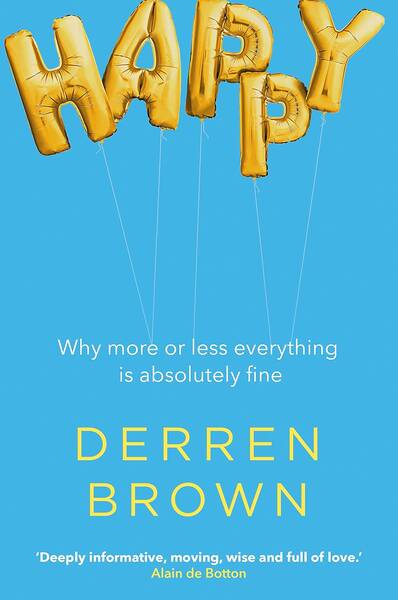
Before I finally decided to read this book, it had been on my list for many years. It first entered my radar when it was recommended by Ali Abdaal, the productivity YouTuber. I heard about it a few more times in different contexts and now felt like it was time. It’s a long book with way over 500 pages, which made me hesitate. Apparently, in the UK the author Derren Brown is a household name who had a few successful television shows to his name. He started out as a performance magician but his shows were mostly about social experiments, as far as I understood. He has an unusual approach to thinking about the human psyche, for that reason.
He’s coming from that background and then decided to make Happiness the topic of his book, which I thought was an interesting new angle. I have read many of the popular and traditional books about happiness because the topic seemed to me to have been on many people’s minds in recent years.
The book begins strongly with him retelling a segment of a show he once produced. He and his team managed to get into one of those fake churches in the United States in order to explore how the criminals who run those for profit work the minds of the gullible people in the congregation. It’s a tense page-turner of an entry to the book, because Derren and the team fear to be found out during it and just narrowly escape in the end. Sorry, spoilers: they survived. The idea of course was that the head of the church was exploiting the poor people’s longing for happiness while they partly intentionally turned a blind eye to the signs that this was a scam, because they were all so desperate.
After that chapter I was hooked, but the rest of the book was completely different. The next chapters went over the well-known historic figures who famously explored happiness, reaching their own theories. Those are of course always the same: Socrates, Aristotle, and Plato kicked if off. Then there was basically nothing for a long time until Kant, Marx, Freud, and some others joined the discussion. Many other philosophical ideas and also religions weren’t really focussing on increasing happiness among humans, sadly. Especially the religions were and still are mostly about controlling people, with maybe the exception of Buddhism. Successful strategies, yes, but just not with happiness of the people in mind — most religions’ advantages revolve around survival, and that doesn’t require happiness, as we know.
It’s actually quite nice to read about what the philosophers had to say about happiness especially, because it wasn’t their main topic mostly. Brown really looked into this specific thing. A bit dry at times, but still useful.
But I have to say that his style of writing wasn’t for me. He uses lots of words I’m not familiar with and based on the media consumption in the English language I’ve done over the past decades I’m quite sure not many native speakers know. Sometimes several unusual words are right behind each other so it’s hard to even get the gist of the sentences without looking up words. Of course I love to learn new words, but this was a bit excessive for my taste. I’m curious if native speakers thought the same. Towards the end of the book this becomes less of an issue, for some reason. I was a bit confused about his stylistic choice though, because I’ve learned that it’s better style in English to write in a way that makes sure to convey your message to the reader as the first priority, which means using language that won’t get misinterpreted, or simply not understood. This is different in German, my teachers said. Here, it’s actually considered to be better style, the more complicated your writing is. I very much align with the English way, but Brown seemed to have disagreed.
Is this book just a theoretical exercise or is it meant to help people become happier or at least understand the concept of happiness better? I’m not so sure.
I had to fight through the first 25% of the book to overcome this. For me personally, the style was a particularly strong barrier, because I usually read in the evenings when I’m tired from the long days with my family and it’s getting harder to focus on difficult texts. Sometimes I could only make it through a couple pages before drifting off and stopping in favor of getting more sleep that night. But that’s just me. If I would have read the book during my most awake hours, which are between 9 and 11 in the mornings, I would’ve had no problem I think. But that would have meant that I wouldn’t have been able to get the actual stuff done which I need to be awake for! Anyways.
But then, surprisingly or not, Brown finally lands at the ancient philosophy of Stoicism. This is about 30% into the book, after having talked about all the other approaches to living a happy life. Of course, I’m already very familiar with Stoicism and have read many books on it, and I’m also somewhat convinced that lots of the ideas are good ones. This was a bit of a break-through in the book which made it a lot easier for me to read it.
Over the second half of the book, Brown goes over a bunch of different factors in life which seem to stand in the way of achieving happiness and looks upon them all from several different perspectives, trying to form a round image of them. Always with Stoicism as the main guiding philosophy. Every chapter is getting a bit more serious in terms of negative impact on happiness, and my two favorites were those on anger and death.
The book is getting stronger and stronger. Towards the end I especially enjoyed a few thought experiments he presented, such as the “Infertile Next Generation” one. Ask yourself: how would your own behavior change if you knew for sure that the coming generation — your children — were all incapable of producing offspring? Meaning, humankind would meet its end, but in a non-violent way at some point into the future, not actually affecting your own life, only maybe your choices because of it. What would you change? It makes us realize that so many things we do on a day-to-day basis are just to keep traditions alive which we subconsciously think will ensure the survival of our genes and our species. So much so that our own individual selves don’t really seem to play such a big role. It’s fun to think about these ideas and see life in a totally different way.
He also talks about terminally ill people and their thoughts, as well as people who live with massive grief weighing down on their shoulders. He makes us wonder if the “Pursuit of Happiness,” in the way it’s even manifested in the US constitution, even is the most important goal in life. I’ve had the thought before, too. Seems to me that we’ve reached a point in human history where a majority of the people on the planet have reached a level of comfort including no food-scarcity and solid medical care, as well as safety and a roof over their heads and a job that pays for surviving, that we’ve started wondering if that’s all there is to it. Of course, I don’t want to dismiss the hundreds of millions of people around the world who struggle because circumstances are different for them. But as we can all witness, a huge amount of people seem to be looking for something and feel like it’s missing. Is it happiness? Working towards achieving happiness doesn’t really seem to work, though. It’s something that happens along the way, while doing other things. So what should the main goal be? Community? A stable society? Preparing everything as well as possible for future generations? I do think so. Less individualism, more support for others.
📔 Highlights
Part One: Beginnings
Yet our entire past, which we feel (in many ways correctly) is responsible for how we behave today, is itself just a story we are telling ourselves in the here and now.
‘The greatest burden a child must bear is the unlived life of the parents,’ wrote the legendary psychoanalyst Carl Jung.
Schopenhauer wrote, ‘Every man takes the limits of his own field of vision for the limits of the world.’ Of course, then, we mistake that story we’ve constructed of our lives as the truth.
if you are prone to unhappiness when poor, you are very likely to be prone to unhappiness when rich.
Events and our chief aims can be in most cases compared to two forces that pull in different directions, their resultant diagonal being the course of our life.
In the accumulation of material things, no deep satisfaction is to be found, other than fleeting pleasure and the temporary delight of impressing others.
Part Two: Solutions
The greatest burden a child must bear, we remember from Jung, is the unlived lives of its parents.
When an activity allows us to steer an x=y diagonal, we find ourselves happily in this ‘flow’ state, avoiding the tedium that arises when our skills outweigh the challenges we face, as well as the anxiety that follows when our obstacles become too great for us.
To escape the cycle of pain and boredom, then, we need to take control of our stories. ‘Ordinary men,’ Schopenhauer wrote (and we can include the ladies too), ‘are intent merely on how to spend their time; a man with any talent is interested in how to use his time.’
The sign of the true expert is his modest awareness of how much more there is to know; how complex and nuanced the subject at hand insists on remaining.
Here are the four stages, set out by Evans, and upon which any presumption of change through philosophical consideration is based. 1. Humans can know themselves. We can use our reason to examine our unconscious beliefs and values. 2. Humans can change themselves. We can use our reason to change our beliefs. This will change our emotions, because our emotions follow our beliefs. 3. Humans can consciously create new habits of thinking, feeling and acting. 4. If we follow philosophy as a way of life, we can live more flourishing lives.
And it seems to come so undeniably from within, that it’s a shock to find out that our understanding of happiness is a social and historical construct, akin to many other questions of ethics and morality.
A certain amount of anger when, for example, a loved one is threatened, would be a sign of virtue: too much would be excessive, and to show none at all would suggest an effeminacy or spinelessness that was not a part of the noble life.
The Stoics were, however, far more engaged in society than the Epicureans. The latter removed themselves from civil life and lived communally in walled ‘gardens’, whereas Stoics by contrast were active, politically engaged and far more concerned with being effective members of society.
Original sin is a profoundly toxic picture; I cannot imagine a more damaging story for a culture to create for itself than the idea that every one of its members is inherently evil.
Nazism, along with other movements that favour the strong over the weak (such as eugenics, racism, fascism and imperialism), are products of what became known by its opponents as social Darwinism, namely the profoundly questionable application of the biological theory to sociology and politics.
And then, rather than falling for that old fallacy of entering into a relationship thinking you will ‘change’ the other person to more comfortably reflect your values, you might see the qualities that separate them from you as precisely the features to celebrate. These qualities can complement our own: our laid-back approach to life can be challenged by the more active, dynamic ambition we might see in a partner, or vice versa.
A more primitive life, on the other hand, leads to fewer desires, which means less frustration and therefore more happiness. Rousseau’s solution to our unfortunate state of being was his Social Contract, which set out a means of reshaping society that would reduce egoism, restrain wealth and limit desires. Unable to regain our primitive state of happiness, though, we must be remade as a new type of social animal.
Because of the popular dissemination of this extraordinary man’s ideas (and, a little later, Carl Jung’s) we feel we can grasp something of the human condition, and this connects us with the rest of humanity. Perhaps then, above all, Freud’s legacy is one of empathy.
Chemicals are available to numb the hollow ache of emptiness, while the communal tales we once lived by to suffuse our lives with a sense of meaning are no longer accessible. Unhappiness is seen as a sign of failure, not a healthy symptom of our natural condition.
Noam Chomsky’s words: ‘The smart way to keep people passive and obedient is to strictly limit the spectrum of acceptable opinion, but allow very lively debate within that spectrum.’
If we were the last person on Earth, we wouldn’t bother with buffetless ventilators or ironic iPhone cases. When the desire to impress others is removed, we live a more authentically Epicurean existence.
‘The tranquil man,’ Epicurus tells us, ‘is not troublesome to himself or to another’ and should ‘live unseen’. This is likely to appeal to those of us who tend towards introversion,
‘A human being has virtue when he exercises his capacity for reason.’ A Stoic would also have said, ‘A house has virtue when it is well built and does its unique job as a house very well.’
Our unique quality is our capacity for reason, and if we exercise that well, the Stoics argued, we gain a psychological strength that protects us from disturbance.
If you are pained by external things, it is not they that disturb you, but your own judgement of them. And it is in your power to wipe out that judgement now.
Problems are created, Marcus is saying with the Stoics, not by events in the world but rather by how we interpret those events.
We each react in our own way, and we do so according to a quality we all share, which takes us back to the beginning of this book. We tell ourselves stories.
So let’s acknowledge that when we find ourselves infuriated with people, irritated by our partners, annoyed, embarrassed, sad or scared, those feelings are in truth provoked by an exhausting little voice inside our head, and/or from the exaggerated pictures we show ourselves.
This school of thought says that intellect is of the mind and emotions are of the body. We are born with our capacity for grief and anger and despair in place, whereas we learn reasoning through the society in which we live.
Whether or not Chrysippus’s logic strikes us now as quaint, modern psychotherapeutic thinking has in a sense caught up with the presumptions of the ancients, and it is to the Stoics more than any other school that the debt is owed.
We know of it today as the Serenity Prayer, attributed to the American theologian Reinhold Niebuhr, from a 1943 sermon: God, grant me the serenity to accept the things I cannot change, The courage to change the things I can, And wisdom to know the difference.
We should not exacerbate things by ruminating on their behaviour or, for that matter, tell others how much they annoy us because they are always like that. We need to let that feeling of it’s fine sink in.
Seneca recommended that we mentally rehearse losing everything we have – family and property – to learn to value them more and be ready for when fortune strikes and they are taken from us.
To align ourselves with fortune; to cease trying to control it. This is the love of fate – amor fati. Neither philosopher would discourage improving our lot – ‘Become who you are’ was Nietzsche’s rallying cry – or trying to ensure social change where it mattered.
But take that thought – ‘it’s fine’ – and let it drop into our stirred-up and agitated feelings. It’s fine. It truly is. Feel what happens as you let it permeate through the story you have been telling yourself. Anything on the other side of the line – anything other than our thoughts and actions – we can safely decide is fine.
Since the pre-Socratic days of Pythagoras, they knew the value of a helpful formula. This technique, a kind of auto-suggestion, has continued famously through our times in the work of Émile Coué, the French psychologist who gave us the daily mantra, ‘Every day, in every way, I am getting better and better.’ This particular modern example is not especially helpful, for it falls foul of the problems of fetishising positive thinking and can therefore leave us feeling like a failure (when things patently don’t get better every day).
We can benefit from remembering the words of the novelist David Foster Wallace: ‘You will become way less concerned with what other people think of you when you realise how seldom they do.’
Epictetus is saying that we need to practise. If we don’t do something for a long time, it is difficult to then do it when we need to. And, likewise, failure is not important (for everyone will fail as life and fortune sometimes prove too much for us to virtuously handle); tenacity is the key.
Eastern philosophy mediated through the Persian Empire, seems to have influenced ancient Western thought (and therefore our own today). Stoicism could be seen as a kind of quarantine of Eastern spiritual ideas, systemised and intellectualised for Western tastes, until they later came to inform early Christianity.
Any number of modern treatises on self-improvement make the same point: small changes lead to bigger ones. One step at a time.
Regardless of our temperament, it clearly serves us to be less bothered by irritants, displays of disrespect and transgressions of perceived rules. Being disturbed less leaves us happier.
Thus factors such as our beliefs, moods, and our levels of tiredness and hunger, impact greatly upon that sequence of trigger > judgement > inhibition > behaviour.
The valued opinions of a few friends who know us well could be of enormous benefit. Given the importance we tend to ascribe to how we come across to other people, it is astonishing that we are so hostile to honest feedback. Criticisms make us defensive or upset, and flattery sinks in too deeply.
It may be that mourners eliminate a lot of their grief as well as their tears in the release of crying and weeping; but anger is made considerably more intense by the behaviour and speech of people in an angry state.
We make two common mistakes when we try to be liked: we either try to impress or we try to be like the other person. Yet we know, from every day of our own experience of liking and disliking other people, that status and similarity are not especially attractive traits.
Possibly, with a resurgence of interest in the lessons of ancient philosophy, we might one day realise that a large part of improving the ‘self’ is to shift the focus from ‘self’ to ‘other’. As I have written elsewhere, the heart of true self-improvement surely lies in becoming kinder (from a place of strength).
We can’t blame others for doing what we would most likely have done if we found ourselves in the same circumstances.
But don’t ultimately emotionally commit yourself to the outcome. That’s out of your hands. You are not playing to necessarily win; you’re just playing as well as you possibly can.
This is a brilliant bit of thinking. We can aim high, seek to change the world, yet always be satisfied with the outcome.
Anger is just proof of how unrealistic your expectations were.
The point, to repeat, of Stoic teaching is not to shut oneself off from life and other people by extirpating all emotions from one’s existence.
You can have all the talent in the world, but if you don’t show it to a public and get it ‘out there’, it’ll do you little good. Likewise, you can have all the self-promotional energy anyone could hope for, but if you have no real talent to back it up it won’t get you very far.
Part Three: Happy Endings
Consider the following, whatever stage of life you might be at. You are going to die. You know this, but consider for a moment what that means.
Many atheists might proudly proclaim that our lives have no ultimate meaning, yet the business of finding significance in one’s life is perhaps the most important part of being human.
Religions sprang from highly charged moments in history that, at the time, connected people with a powerful sense of the transcendent.
The nexus of belief is institutionalised to preserve itself at all costs. Powerful and political, it needs to defend itself against rival faiths and perspectives. It employs fear to maintain its normative authority, and thus reduces and infantilises its followers, instead of doing its original job of connecting them to something large and mysterious.
Defenders of the after-life want to have it both ways: on the one hand, they wish to describe a fundamental reality that operates beneath the everyday world we perceive. On the other, they wish to retain the everyday world’s organisational language (and use ideas such as ‘after’) to describe it, as if such spatial or temporal concepts have any relevance to the world beyond what we perceive through space and time.
Everything worthwhile in your life draws its meaning from the fact you will die. We need death in order to live. ‘The meaning of life,’ wrote Kafka, reputedly, ‘is that it stops.’
It is felt that ‘positive thinking’ may be appropriate as one of many successful coping strategies. To attribute more to it or, worse, to insist that patients believe in its power to cure may be courting emotional disaster.
If you are facing your own death, and have the clarity of mind and opportunity to make such choices, then realise that for you to own your death, to author it and to shape it, is tremendously important. You are the protagonist and the author.
Our goals and aspirations only form half of the equation, only one axis of the graph. The other force at work is fortune, life, fate: everything that happens outside of our control. To try to control those things through indiscriminate self-belief or sheer aggression is likely to lead to failure and pain. And nowhere is this more evident than when a person is dying.
I wish I’d had the courage to live a life true to myself, not the life others expected of me. I wish I hadn’t worked so hard. I wish I’d had the courage to express my feelings. I wish I had stayed in touch with my friends. I wish that I had let myself be happier.
The present moment, on the other hand, can be a more productive place to focus our attention. The here and now, we have seen, rarely contains problems; it is released from the tyranny of our imposing narratives. We might feel bad about events in the past or dread those yet to come, but rarely in the present – rarely right now – do we find ourselves in the middle of a serious difficulty.
Neuroscientist and author Sam Harris describes a greater engagement with the present moment as the antidote to a fear of death.
Even ‘we’ might be said to live on after our deaths in the sense that those who know us now will carry around their memory of us after we’ve gone. And what that will mean depends on how we affect others now while we are alive.
It is not merely enough that we have in place the temporal finitude provided by our own death to ensure our lives have meaning. It is not enough that we die. We also need others to live on after us and without us. We need to die and others need to live. Which means ultimately that the continuing lives of others matter more to us than do our own.
It may seem an odd question to ask at this point in the book, but is happiness truly what we should seek? And if so, is it in its richest form synonymous with an avoidance of disturbance?
Concepts fall prey to our projections, which reduce rich ideas to what we’d like them to be; these projections are often illuminated by our fears. Happiness is one of those concepts.
Paying attention to the present moment is our most effective means of undoing the harmful and perpetuating narratives by which we live, by challenging them with the counter-evidence we notice around us.
A good relationship, like a good parent or a good death, need only be ‘good enough’, consisting of two people navigating each other’s inadequacies with kindness and sympathy. At its best, the poet Rainer Maria Rilke tells us, it ‘consists in two solitudes protecting, defining, and welcoming one another’.
The final call, then, is not to merely seek tranquillity but, from its strong shores, to welcome its opposite. It is a strong society that encourages dialogue with its enemies, and a fearful one that promulgates reductive nouns and categories (such as ‘Terror’) to demonise and avoid the unsettling complexities of active, untidy reality. We, too, must seek the same conversation within ourselves. And do so before the forces we repress rage against us.

Leave a Comment