🎨 Impressions
I came across Mike Monteiro about ten years ago, when a talk of his on design principles made the rounds. At the time, what he said was pure gold for me at my company. He ran a digital design shop in San Francisco and was quite successful at it while still staying true to the small business ideal he had cultivated. He’s an opinionated guy, not afraid to speak his mind at all. On the political spectrum he clearly is on the left side, trying to make things better for normal people instead of the billionaire oligarchy class the US cultivated.
His attitude is powerful and in his talks he swears a lot — as he does in his books. Back when I found out about him I immediately bought his books “You’re My Favorite Client” and “Design Is a Job” and read them. They contained very helpful advice for running a web design shop as I did at the time. And they also were really funny! He is quite the character. Later on I read his book “Ruined By Design”, too, which leans much more into the ethical realm of design, taking the topic to the meta level. His point in it was that everything humans build is designed, and quite often the horrible things on the planet are also working exactly as they were intended. On the cover there’s a photo of a nuclear bomb exploding. That’s something humans decided to design.
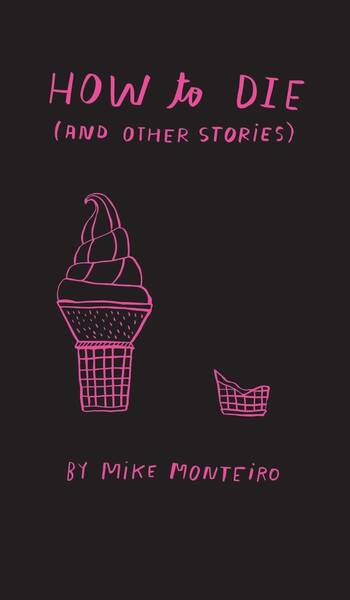
Years went by and Mike started to write a newsletter in which he answered questions from readers, fans, or other interested people. I’ve been following that newsletter and really enjoyed his matured writing which is now very political and still as angry and emotional as ever. Engaging in a good way. Thought-provoking. This book here, “How to Die”, is a curated collection of his newsletters, published by his company Mule Design. I think it’s great and necessary today.
Many of the chapters in the book are autobiographical in order to provide colorful answers to the readers’ questions, which often are philosophical in nature. He tells stories about his awful childhood with an oppressive monster as a father, being Portuguese immigrants in the United States, but also about current habits of his. One of my favorite chapters which didn’t seem that deep but actually was, answers the question “How do I make the best grilled cheese sandwich?” What seemed like cooking advice at first sight really went all in. It’s about being in the moment, celebrating life, and crying to your favorite songs. Quite the journey. I made myself grilled cheese’s right after reading it — that’s how inspiring it was.
His worldview is strong but ambiguous at the same time. He flips back and forth between feeling defeated in this anxiety-inducing state of the world, and ambitious to change things for the better. The book’s title is misleading, although the final chapter sort of answers this question in a more hopeful way. On the other hand the first line of the book is “Everything is Shit.” I think he is at his best when he’s really angry about some injustice and tries to rally us up to stick together as humans in each of our neighborhoods. It’s a strong and important message. We need to start caring more for one another on the local level. I completely agree with him on that.
There are a lot of smart takes. One of them that stood out to me is his opinion that the word “hobby” is stupid. It makes it sound like you need an excuse for loving something which doesn’t earn its place in capitalist society. That’s exactly how I unfortunately feel when I use the word. As if the fact that hobbies are unproductive in the economical sense makes them something to get rid of. There are a growing number of people in my social circle who don’t have hobbies for that reason and I find that so sad. We need to stand tall and love what we love once more. Things that bring us joy shouldn’t make us feel guilty for not contributing to society 24/7.
His points on the loneliness epidemic are catchy, too. He blames the media, and rightfully so, for making it seem like the outside has become terrifying. He encourages us to get outside more, and don’t have food delivered but spend time at the restaurant next to real humans again. Enjoy walking on sidewalks with other people you don’t know yet. Ride a bike and not exclude yourself from everything in that hermetically sealed box that is your car. Be part of the city not just alone in your bubble. It’s a decision we can all easily make. Also, never make work your life, especially if companies design work in a way to keep you there. Life and community outside of work is super important. Don’t let them tie your complete social circle to your job.
He talks openly about his experiences with having a therapist. And while he doesn’t say anything about being clinically depressed, you sometimes feel like he might have suffered from it but has it under control thanks to her. There is a lot of advice for people who have borderline depression in the book, without ever calling it that. Advice like setting little tasks just for tomorrow instead of planning long term into the future when everything feels overwhelming.
He also often criticizes AI, but doesn’t really provide strong arguments unfortunately. Him being an artist at heart I can assume what his main argument is, and it probably has to do with the new opportunities to just create art with a prompt, taking all the joy of creativity out of the process. I absolutely agree that this is the wrong use of the new technology. But personally I also see immense advantages to AI and feel like he doesn’t weigh those against each other in a smart way.
One of the strongest chapters is about dealing with your racist uncle at Thanksgiving. For me this is very relatable. Friends and family with differing politics are good, disagreeing is good, arguments about it are good. But you have to draw the line somewhere, he says. Friends who want your neighbor deported are not good friends. Friends who think we should just keep quiet when injustice happens are not good friends. We are defined not just by our actions but also by the actions we tolerate.
Another amazing chapter is the one where he’s on the transatlantic flight to attend his abusive father’s funeral. So emotional. So well written.
And right after he’s lightening up the mood by talking about how to give and receive compliments. Here’s the gist, because I think it’s worth sharing: give more compliments. They are free and make people feel good. Say when you liked something. Regarding receiving compliments: don’t make the people work by asking follow-ups, just say thanks and appreciate that they’ve overcome their fear just to tell you.
In the end he talks about how humans are held together by each other’s stories. We crave the telling and the hearing of stories. We love when someone is invested in something and wants to share. I fully agree. This is why I write my blog and these book reviews. And why I read those sorts of things from others. The connection between all of us is based on stories.
This book is a strong recommendation. You can also just sign up to Mike’s newsletter and get new “chapters” for free on it. Because sharing is caring.
Leave a Comment