🎨 Impressions
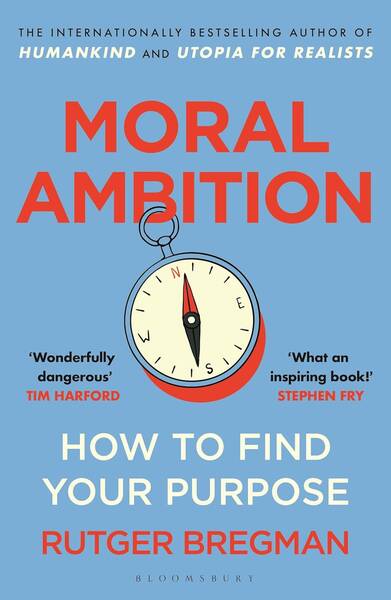
I followed Michael Schur’s book “How to Be Perfect” with this one, because they pair well. First I learned about moral philosophy in the small setting from Schur before moving to the big picture questions with this book. In the end its all related, of course. How you deal with the people around you in an ethically sound way is closely connected to how we should deal with each other in a larger societal picture. Many ideas and influential people are mentioned in both books.
Rutger Bregman is a relatively young philosophy professor and author from the Netherlands who has already published two bestsellers before this one, one of them I’ve read. It’s called Utopia for Realists has made it into my favorite’s list quite easily. His vision seems to be to just improve living conditions worldwide for everyone. I can get behind that. But the books differ a lot. The Utopia book deals with how we should aim to establish a universal basic income, because it’s possible and we have reached a degree of automation in society that allows for it. Right now, the wealth which is created mainly by machines is unfairly distributed.
In this book, Bregman turns up the dial. By a lot.
His main point here is that we all have a moral obligation to help improve the world. We can choose the way, but we must do all that’s in our power to make living conditions for humanity better everywhere. No excuses.
It feels like an attack but deep down I think we all know he’s right. We can’t just sit here, scroll TikTok, keep consuming, and maybe sometimes get a little angry at the state the world is in. We have to do something about it.
He acknowledges that his words sound harsh, but he really wants to get the message across. And he even doubles down on it: We not only have the obligation to do something about the issues, we have the obligation to succeed at it. Nobody needs what he calls “Noble Losers.”
After establishing this goal in the first few chapters, he talks about how others have succeeded in the past so we can learn from them. His two main examples are the Abolitionist and Suffragettes movements. The point is that these were started by very small groups of people, against a backdrop that was very much opposed to change, even economically completely reliant on keeping it the way it is, but still they were the right things to pursue and people intrinsically knew this. There are countless examples in today’s world where everyone deep down agrees we’re behaving in the wrong way and should change. Abolishing slavery and ensuring women’s participation in society have come a long way since the two movements were started by a handful of people. Today’s issues include the horrible way we treat animals by factory farming them, and the way we dig up fossilized CO₂ in order to burn it and destroy our own climate even though it’s necessary for our survival to keep it stable.
Bregman brings up the “Effective Altruism” movement which holds a similar vision of improving the living conditions for the most amount of people possible, but has recently come under scrutiny. One of the main people in the movement is called Peter Singer. He behaves so selflessly that it’s unclear if he has maybe taken it too far. But one of his thought experiments is interesting:
Imagine you come by a little pond and see a small child in it about to drown. No one is there except you. Of course your intuitive reaction would be to set foot into the shallow water and save the child. Now imagine you are wearing your new very expensive shoes and could be sure they would be ruined when you save the child. Still, almost everyone would agree that it’s worth it.
Now, we know that there are many ways to significantly improve the life of a person somewhere on earth, or even save their life, by spending the amount of money our new shoes have cost. So shouldn’t we feel the moral obligation to spend that money to save as many people as possible?
The problem is that you can take this experiment too far and it’s tough to find a balance. Some people inside the movement have apparently given everything they’ve got, including their own kidney’s to any stranger who needed one, and when asked about their own feelings screamed back “My own happiness is not the point here!”—it’s a difficult thing to balance.
A group inside of the movement of Effective Altruism has taken the idea into a different direction. They went into finance and tried to make as much money as possible first in order to be able to give away as much as possible. You might have heard of a man named Sam Bankman-Fried, who went into Crypto and scammed his way to billions of dollars. He eventually lost sight of his vision, but gave around US$100–200 million to charity before being thrown in jail.
The question is, is taking money from the poor in order to give to the poorest a good thing?
Thomas Clarkson, a guy from England who was the first to really make a dent in turning public opinion against slavery in the late 18th century, was so invested into the idea when still a young man that after traveling the country and convincing people one by one for about ten years without a break, he fell victim to burnout. He wasn’t able to continue. Slavery was finally abolished in the UK when he was in his 80s. Had he gone about it more sustainably and taken care of himself along the way, the result might have happened decades earlier, sparing the lives of millions of enslaved people.
Bregman ends the book by going a little bit easy on us and making sure we should all take the first steps but still keep our efforts sustainable so we can be in it for the long run, because it’s necessary.
He is the co-founder of what is called the “School of Moral Ambition”—a type of community that has already spread around the world and aims to bring people together who share this vision and feel the imperative to do something to improve the world. It’s not a political thing, but it seeks to gain influence and actually bring about change. I’m going to give your the seven founding principles of the group.
- Action: We think awareness is overrated
- Impact: We want to make a big difference
- Radical compassion: We work to expand our moral circle
- Open-mindedness: We cultivate a curious mindset
- Kindness: We believe in the good in people
- Zest for life: We want to live full, rich, well-rounded lives
- Perseverance: We’re determined not to give up
I think this is a great idea and have signed up immediately after finishing the book. There’s a little group in all the major cities including my hometown of Hamburg.
Please check out moralambition.org.
📔 Highlights
1 No, you’re not fine just the way you are
But there’s also a class of not-so-useful jobs. A class of influencers and marketeers, of lobbyists and managers, of consultants and corporate lawyers – all people who could go on strike and the world would be just fine.
Some jobs are outright harmful and fall into what are sometimes called the ‘sin industries.’ Here we find accountants helping the rich avoid taxes, marketers promoting addictive meds, brokers peddling dubious financial products, and anyone working for the gambling industry or Big Tobacco.
The dream is to make the transition from office serf to person of independent means, so you can delegate all the annoying work and no longer have to contribute to society.
A corporate lawyer, for instance, does some $30,000 of damage to society each year, a commercial banker more than $100,000.
just think how much better shape our world would be in if these bright people had done something useful with their lives.
In some circles, you’d think the highest good is not to have any impact at all. A good life is then primarily defined by what you don’t do. Don’t fly. Don’t eat meat. Don’t have kids. And whatever you do, don’t even think about using a plastic straw. Reduce! Reduce! Reduce! The aim is to have the smallest footprint possible, with your little vegetable garden and your tiny house. Best-case scenario? Your impact on the planet is so negligible, you could just as well not have existed.
But surely a good life consists of more than what you don’t do?
Kill the patriarchy! Defund the police! Tax the rich! But what happens next? Having lots of followers on Instagram isn’t the same as building an effective organisation. Going viral isn’t the same as winning a majority in the legislature. Modern protest sometimes seems little more than a collection of clicks and likes, in the hope that someone higher up will take notice.
So ask yourself the question: What’s the ‘great honour and glory’ of your life? What do you hope one day to look back on? ‘A person of honour cares first of all not about being respected,’ writes the philosopher Kwame Anthony Appiah, ‘but about being worthy of respect.’
2 Lower your threshold for taking action
There’s a quote from the anthropologist Margaret Mead that I think of often. ‘Never doubt that a small group of thoughtful, committed citizens can change the world. Indeed, it’s the only thing that ever has.’
History, meanwhile, is full of people without deep pockets who still manage to have a lasting impact. What about abolitionists fighting to end slavery, or the suffragettes working for women’s right to vote? Were they the richest or most powerful groups of their time? Hardly. But they changed the world. The statistician Nassim Nicholas Taleb speaks of an ‘intransigent minority.’ The world is shaped by stubborn, obstinate, headstrong, hell-bent, wilful, relentless advocates. ‘The most intolerant wins,’ Taleb dryly observes.
A new analysis of data gathered by the Oliners showed that when this condition was met, nearly everyone took action – 96 per cent to be precise. And what was that condition? Simple: you had to be asked. Those who were asked to help someone in danger almost always said yes.
‘After staring at my data for long enough,’ he writes, ‘I began to notice a pattern.’ Time and again, people would only innovate after being inspired by other inventors – be it a coworker, teacher, or friend, a neighbour, family member, or acquaintance. It was as if they were ‘infected’ by a belief in progress.
It’s not about who you are; it’s about who you can become. You don’t do good things because you’re a good person. You become a good person by doing good things.
3 Join a cult (or start your own)
In many cases, nerds and hair-splitters make the difference. What’s tragic is that lots of nerds and hair-splitters are stuck in relatively useless jobs. The best solicitors, consultants, programmers, accountants, and bankers seldom work on solutions to big problems – whether that’s human trafficking or a lack of clean drinking water, antibiotic resistance or climate change. All too often, in fact, they’re part of the problem.
And so the UK officially banned the slave trade in 1807 – at a time of peak profits, no less. The British then forced other countries out. The Royal Navy launched a campaign called the ‘blockade of Africa’, where they captured some 2,000 slaving vessels and freed those aboard.
Silicon Valley has countless startup incubators who measure success not in terms of beauty, wisdom, or justice, but in dollars, dollars, and dollars.
While the abolitionist movement in France was led by writers and intellectuals (and didn’t get much done), the British movement was powered by merchants and businessmen.
4 See winning as your moral duty
Effective idealists, on the other hand, may be pie-in-the-sky when it comes to their goals, but they’re pragmatic in making them happen. If they need to hobnob with wealthy types to raise money for a good cause, then hobnob they will.
The only kind of person we can’t use in this fight is the fool who thinks good intentions are enough. Someone whose clear-eyed convictions put them squarely on the right side of history, but who achieves little in the here and now. Let’s call this figure the Noble Loser.
But Rosa Parks was much more than the woman-who-wouldn’t-give-up-her-seat. Often portrayed as a kindly seamstress, Parks had long been a committed activist. By the time she got on that bus, she’d been involved with the civil rights movement for years.
She knew she couldn’t come across as too radical, or white Americans would turn against the movement. ‘Strategically,’ a historian later wrote, ‘the success of Parks as the symbol of the boycott turned, in part, on obscuring her longstanding political activity.’
Women like Rosa Parks and Jo Ann Robinson were convinced of a simple truth: in the fight against injustice, winning is a moral duty.
All too often, politics is treated as entertainment. A political scientist at Tufts University speaks of ‘political hobbyism’. Most news junkies who consider themselves ‘politically engaged’ don’t do anything remotely resembling true political activity. Sure, they vote every few years, maybe sign a petition every now and then, but that’s about it.
Intersectionality means we can’t study different forms of discrimination and oppression separately, but only as interrelated phenomena. That’s without a doubt an important insight.
‘In the past,’ she writes, ‘a truly big march was the culmination of long-term organizing, an exclamation mark at the end of a sentence.’ Today’s protests more often stem from an impulse – a surge of outrage that can sweep across the globe in no time.
It’s not about what you think or say; it’s about what you do to move that Overton window and win the fight against injustice.
‘The idealists are not usually realistic,’ he said, ‘and the realists are not usually idealistic.’ What we need is some realistic idealism.
6 Enrol at a Hogwarts for do-gooders
What do all these problems have in common? They’re sizeable, they’re often super-solvable, and they’re sorely overlooked – the three S’s, if you will.
there’s still a tremendous amount of suffering and oppression in the world today. We still have fundamental choices to make, and you can still be part of the resistance in one form or another. Why weren’t we grappling with that at school every day?
7 Find out what the world needs and make it happen
‘Not a single good deed goes unpunished,’ was Zhdanov’s ironic comment on the insult. He then added, with a flair for understatement: ‘… but good deeds are still cost-effective.’
‘The team that brings clean and abundant energy to the world,’ writes the psychologist Steven Pinker, ‘will benefit humanity more than all of history’s saints, heroes, prophets, martyrs, and laureates combined.’
In the meantime, we have to stop with the fossil fuels – a scarce, dirty, and deadly source of energy that keeps many a dictator in power. At some point, we’ll look back and think burning coal, gas, and oil was as primitive as burning peat.
In the years that followed, the Germans pumped a crazy amount of money – over 200 billion euros – into subsidies for solar panels. The world market increased thirty-fold, and in some years Germany bore more than half of all the costs.
8 Save a life. Now only $4,999!
So don’t start out by asking, ‘What’s my passion?’ Ask instead, ‘How can I contribute most?’ And then choose the role that suits you best.
His later work is also interesting, but perhaps Einstein was on to something when he said geniuses do their best work before the age of thirty, when people still dare to do what later they’re too wise to try.
There’s really only one convincing objection to the philosophy of Peter Singer. It asks too much of us. People aren’t capable of being constantly preoccupied with all the misery in the world.
That is, the best charities are fifty times (!) more effective than the median charity and a whopping 10,000 times more effective than the worst ones. Seems the economics of altruism is also subject to a power law, with at least 80 per cent of results attained by just 20 per cent of what we do.
The truth is that money and moral ambition need each other. Philanthropy doesn’t have to get stuck in vanity and paternalism. It can lead to real systemic change, as long as you prioritise wisely and keep an eye out for damaging side effects.
9 Expand your moral circle
Throughout history, people seen as enlightened or progressive often upheld practices we now consider absolutely abhorrent. Makes you wonder: What practices of ours will future generations think barbaric?
it would be quite the coincidence if we’re the first civilisation ever that’s got it all figured out. Isn’t it far more likely that in some ways we’re still doing things wrong?
The big question is how we figure out what we’re still doing today that will seem clearly wrong down the road. No one has a time machine, and there’s no way we can look into the hearts of generations to come.
The second alarm bell goes off when people don’t defend their practices, but instead say things like, ‘That’s how it’s always been’, ‘That’s human nature for you’, or ‘We don’t have a choice’. Social psychologist Melanie Joy speaks of the three N’s: we normalise wrongful acts by calling them normal, natural, and necessary.
That brings us to the fourth alarm bell: the angry response that moral pioneers face. Time and again, they’re hated, harangued, harassed.
‘Every society honors its live conformists and its dead troublemakers.’
And finally, it pays to zoom out, so you can spot that sixth warning sign. After the civil rights movement, the movements for women’s rights, gay rights, and children’s rights, standing up for animal rights seems a logical next step.
And while idealists like to state that the arc of history ‘bends toward justice’, I’m afraid that’s a sixth illusion of the Noble Loser. History doesn’t do things; people do things. If there’s fairness in this world, it has to come from us.
‘Sometimes we just want to scream loudly at injustice,’ wrote psychologist Herbert Simon, ‘but any serious revolutionist must often deprive himself of the pleasures of self-expression. He must judge his actions by their ultimate effects.’
10 Make future historians proud
I’m a historian by training, and historians speak disdainfully of chronocentrism, the naive idea that the times you happen to live in also happen to be especially important.
As I write this, over 3,000 nuclear weapons stand ready to be fired within minutes. A hundred or so are all it takes to cause a nuclear winter, the apocalyptic scenario where there’s so much dust in the atmosphere it blocks out the sun, the temperature on earth plummets, harvests fail, and billions of people starve to death.
Artificial intelligence can be used for propaganda, censorship, and surveillance, and can make it easier to build a weapon of mass destruction. Worst-case scenario? AI gets away from us and we lose control.
And then there’s a third existential threat to humankind: pathogens that escape from a laboratory. The technological advances seen in biological labs can be weaponised, and that’s deeply worrying.
Trained as a biologist or engineer? You can make a difference in the fight against the next pandemic. Schooled in mathematics or computer science? You can help with the safe development of artificial intelligence. Working as an artist or in marketing? You can mobilise as many people as possible, by calling attention to things still under the radar.
Polluted air claims more victims worldwide than fire, heat, traffic, homicide, war, drugs, alcohol, drownings, natural disasters, malaria, and tuberculosis combined. (Yet another good reason to stop with the fossil fuels!)
Healthy drinking water contains no lead, or only tiny amounts, so in many countries we’ve got laws in place to regulate that. As a result, the brains of children develop better and crime rates have even dropped (because, research shows, less lead means less brain damage means less crime).
Just as with the malaria vaccine and the rise of solar energy, there’s no law of nature ensuring everything turns out alright. It’s up to us.
Covid-19 killed more than 20 million people worldwide, but you could perhaps better say that 20 million times, one person died. We must continue to try to let these kinds of figures get through to us. That’s 20 million times that a father or mother, brother or sister, friend or lover lost someone dear to them.
Epilogue
The fact of the matter is that it’s never enough. There’s always a new hill to climb, a new mission to complete, a new mountain to move. There will always be toddlers in ponds who need saving. There’s no end to what you can do to help. But that’s also the danger. Moral ambition can take over your life.
Carry the weight of the world on your shoulders, and sooner or later, you’ll buckle. And that doesn’t help anyone.
Gandhi, thought Orwell, hadn’t understood what life was about. Most people don’t want to be saints – and rightly so. We’re on this earth to wonder and to wander, to seek and to sin. We’re here to live life. And it seems saints, in their all-encompassing love for humankind, understand little of what it is to be human.
In any case, don’t let yourself be fuelled by a sense of guilt or shame, but rather by enthusiasm and a lust for life. Be ambitious, not perfect. There comes a point when you’re fine just the way you are.
There’s one last thing I’d like to emphasise: this book is written for you and no one else. Don’t wield it as a weapon, but to whip yourself into shape. See the good in others; demand more of yourself.
‘If wealth was the inevitable result of hard work and enterprise,’ writes the journalist George Monbiot, ‘every woman in Africa would be a millionaire.’
Leave a Comment