Challenge Roth 2026: Chasing Sub-10 and Setting a Massive Personal Best
Nine full years after my first go at this wonderful long distance triathlon event in southern Germany, I now came here with a mission in mind: Finishing it in less than ten hours. Find out how I prepared for that and what the outcome was in the end.
Published on 1st of September, 2026
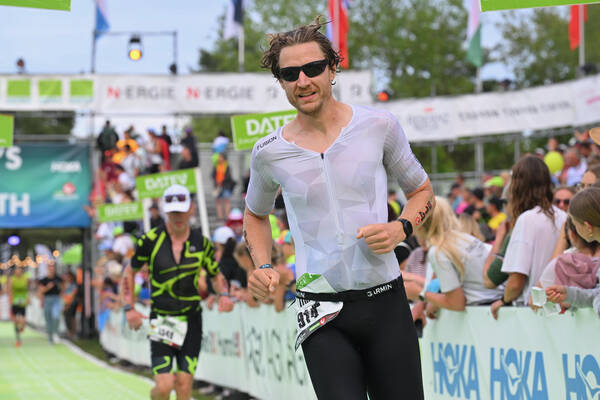
Finally, my return to the home of triathlon, Roth. 🥰
In the past, I have completed four full distance triathlon races. The goal has always been just to make it to the end in one piece. The races ended up taking me between 11:51 and 11:26. The most recent one happened in 2019, seven years ago. During those years I moved away from long triathlons, towards ultra running as well as faster marathon racing without the swim and bike combination before it.
But then, in 2024, my friend and training companion Mathias decided to give his first long-distance triathlon a go and chose the best race in the world for it, the little town in Franconia which regularly draws over 300,000 spectators to the annual event. I came along to support him. On the weekend I ran one of the marathons together with Jonas Deichmann, who was in the middle of completing 120 long-distance triathlons on the course of Roth in 120 consecutive days. Legend. Following Mathias along the hotspots two days later, including world-famous Solarer Berg with its Tour de France-like excitement reignited my love for the sport of triathlon, but most of all, my longing to experience this particular race, Challenge Roth, once more.
Mathias was keen to repeat the race, too, and so we talked about it and came to the conclusion that skipping one year and going for the 2026 edition instead of the 2025 one would feel best for us both. It’s a lot of work to get ready for such a race. Well, it can be, but it doesn’t have to be. For my previous go at Challenge Roth back in 2017 I trained minimally. For example, I spent less than 500 km on the bike before that race. So I was clearly far away from reaching my full potential back then.
The progress I made in marathon running during the seven years since my previous long-distance triathlon made me think. I’m sure I can easily run the marathon at the end at least half an hour faster than I used to. What if I used my virtual Zwift bike setup to actually train well for the bike split as well? It must be possible to reduce my time on the bike quite significantly, too!
Going over the numbers of what I thought could be realistic, I ended up convinced that going sub-10 hours is a goal worth chasing.
As great as Roth is, “just” finishing another long-distance triathlon didn’t feel exciting to me. But moving down to 9:59 from 11:26 was suddenly a motivator. It seems like a big jump for sure, a big audacious goal. In the past I have proven I can achieve big goals. My multi-year chase of the sub-3-hour marathon was successful, too. I moved up the difficulty of the ultra races in pursuit of a ticket for the Western States 100 Endurance Run as well and so far I have made good progress by finishing real tough ones, including the massive CCC in Chamonix, France. Those achievements gave me the confidence to give it a go.
Extrapolating from the seemingly realistic idea of going sub-10, I even got the next idea into my head that I might be able to get this down a few more minutes over the coming years and maybe qualify for a Hawaii slot. When, in a few years, I’ll enter the male age group of the 45–50 year-olds, the required finishing time to be allowed into Hawaii hovers around 9:30–9:45. Doesn’t seem impossible, right? If it’s worth all the money and struggle to actually go there, I don’t know. But still I feel like someday standing on dig-me beach and jumping into the Pacific would be cool. The idea fills me with excitement.
Back to Roth.
For the structure of this blog post, I’m going to switch it up a little and break it apart into three big chapters: Swim, Bike, and Run. Training, equipment, and outcome on race day for each of them.
But first I want to tell you about the weekend in Roth to try to convey what an exceptional race it is.
🥳 The Weekend in Roth
From my previous visits in 2017 and 2024 I knew what to expect, but it has been turned up to eleven this year. Everything was even better than I could ever have hoped for. The love for the sport and its community is so apparent in the whole organization the Walchshöfer family puts together and it brings out the best in every volunteer, professional, and hobby athlete as well. Good vibes are off the charts.
I traveled to Roth with Mathias and we also had some luck unrelated to the plan. Ruben Best, a Hamburg-based triathlete who has been in the top 20 at Roth three times before, runs along our usual Elbe river course to train sometimes. We met and he wanted to come to Roth as a spectator but needed a space to stay. From two years ago, Mathias and I had again made use of our good connection to a family based in southern Nuremberg who were willing to host us. They have enough room for everyone, so Ruben asked his friend Nils Goerke, another Hamburg-based triathlete, who once came 22nd at the IRONMAN World Championship in Hawaii as a professional back in 2003 and now is a coaching legend, hosting Germany’s most successful Triathlon Podcast called Pushing Limits. They brought their entourage and so Mathias and I found ourselves living together with German triathlon royalty during this Roth weekend. Nils came along for my daily streak run and we chatted a lot about everything triathlon. It was super surreal for me to hear Nils’ voice in real life after having listened to him talk on the Pushing Limits podcast for hundreds of hours. His significant laugh, for example. It was great.
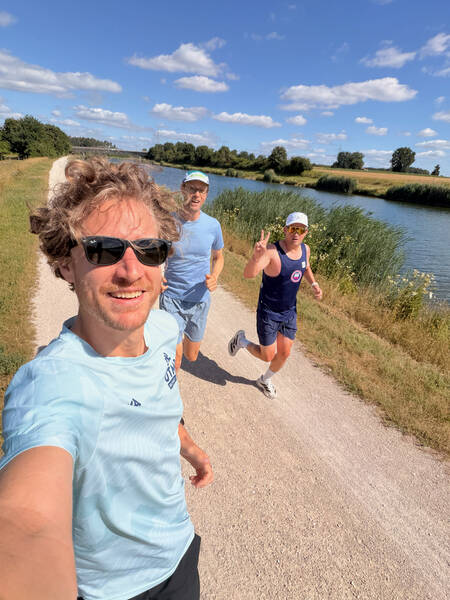
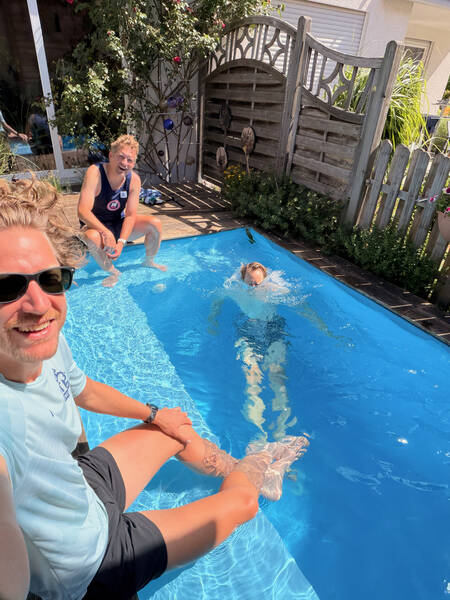
One of the big questions I have about professional endurance sports is “How can a small guy like Tadej Pogacar, five-time winner of the Tour de France, push like 450 W on an uphill for an hour straight?” – his legs are muscular, but tiny. And Watts are absolute, not relative to his weight. You might have wondered about this before, too? Here, with a professional coach available in Nils Goerke, I posed that question. And he didn’t disappoint: his answer came immediately and was just one word:
“Mitochondria.”
And that basically boils down to: training. Who would have thought. You might know the mitochondria to be described as the powerhouse of the cell. They are the bits which convert carbs and fats using oxygen into actual usable energy called ATP, or adenosine triphosphate. That’s what contracts the muscles and pushes the pedals at the end.
- The more energy they can convert, the faster you go.
- The denser the mitochondria in your body, the more energy you can convert.
- The more you train, the denser they get.
Of course, genetics play a role here, too, but this is the basic gist.
Spending time in Roth on the holy festival grounds, the triathlete’s Mecca, is just the best. Our roommates Ruben and Nils had work to do today, Ruben was leading a Canyon group ride together with T100 vice champion Mika Noodt, Nils had to appear in his Pushing Limits live podcast on stage. By the way, Nils mentioned a few numbers about the financial side of running the biggest triathlon podcast in Germany. And it’s wild! I was surprised by how well that seems to work.
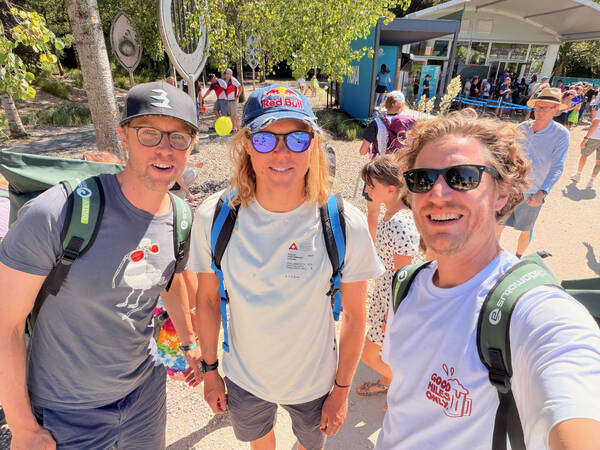
While they were working, Mathias and I wandered these holy grounds.
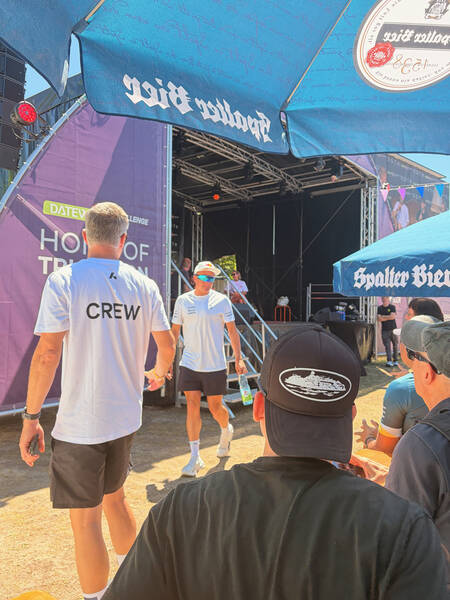
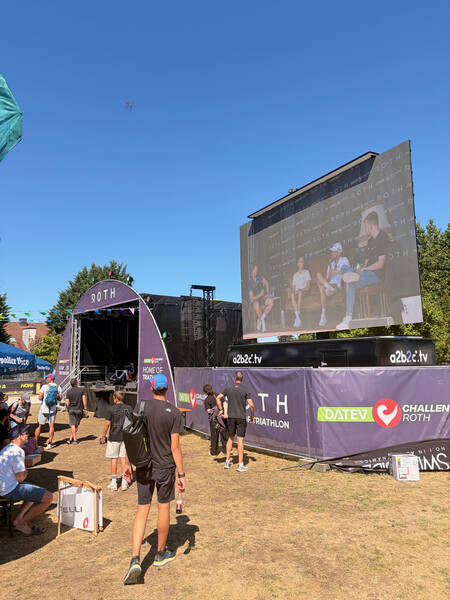
It’s the biggest triathlon expo in the world. Every booth has something of interest to offer for someone who’s into triathlon. All the major brands are here, showing off their most recent developments. The newest Canyon Speedmax, arguably the fastest triathlon bike right now, was released here. French running shoe company HOKA had a three-story tall booth set up with DJ and lounge area as well as all their shoes.
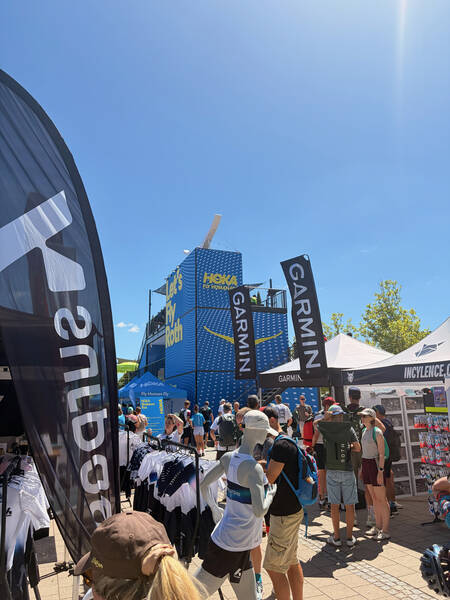
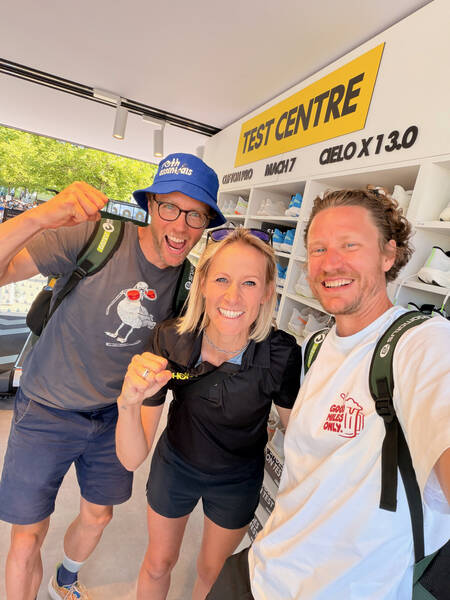
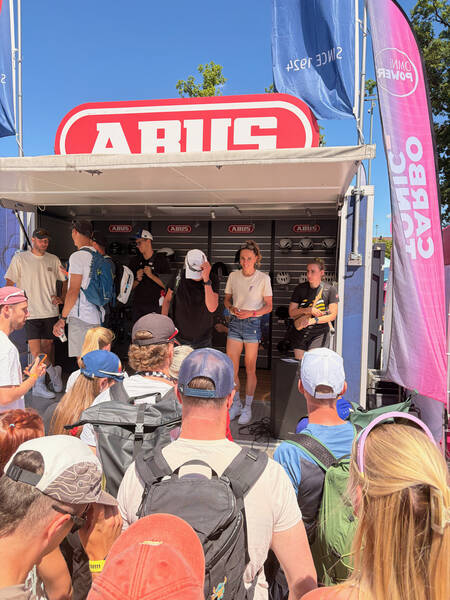
We got to wear the newest aerodynamic helmets and taste-test so many new nutrition products. And all the legends of the sport were just walking around here as well! Right after arriving, 2014 Hawaii World Champion and former Challenge Roth winner Sebastian Kienle just appeared and handed us a new MNSTRY iced gel to try. As if that’s normal! The guy is to me what Taylor Swift is to a 14-year-old girl. He is also doing the English-language livestream commentary of Challenge Roth, together with fellow previous winner, Belinda Granger, who herself has some kind of saint status in the scene.
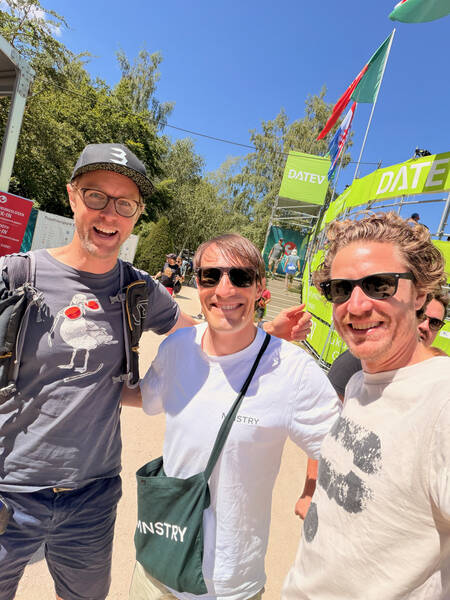
It didn’t end there, we met the full who’s who of the international triathlon scene. I walked by Anne Haug, Hawaii champion and currently world’s best time holder in the long-distance, achieved here at Roth. World Champion Laura Philipp did a signing at one of her sponsor’s booths, Olympic gold medalist and fittest person on Earth with a VO₂max of just above 100, Kristian Blummenfelt, just walked by and was called on stage during a live podcast of The Triathlon Hour which he joined for some wonderful banter, and Mathias kind of flirted with IRONMAN Pro Series winner Kat Matthews who was just coming back from her shake-out bike ride.
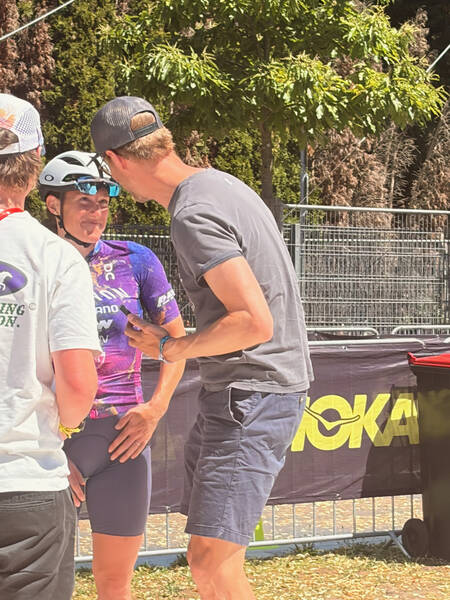
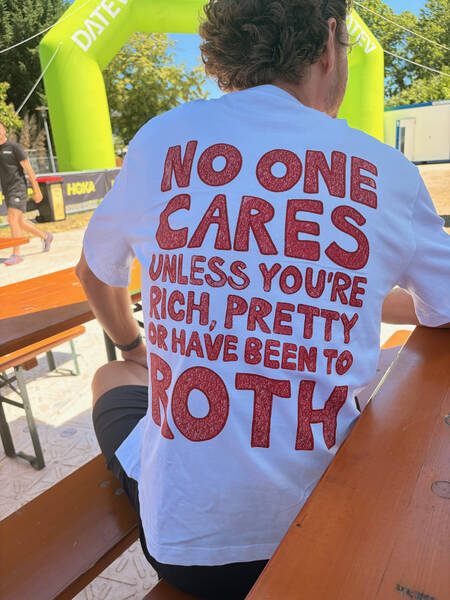
It was absolutely crazy and I couldn’t stop smiling. Especially since I managed to grab one of the last remaining shirts that Sam Laidlow created and brought here. He’s the previous year’s winner of Roth and also an IRONMAN World Champion, in fact the youngest ever.
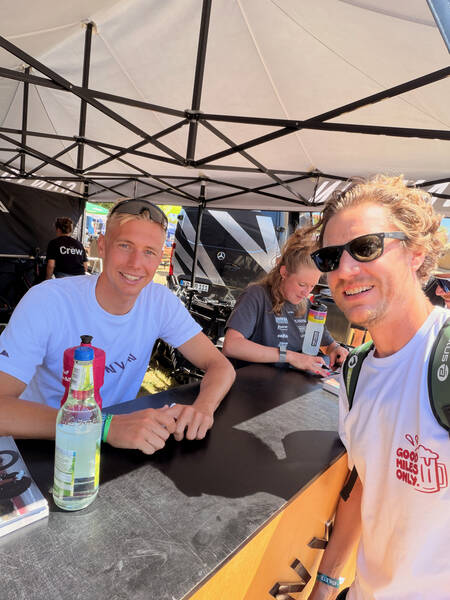
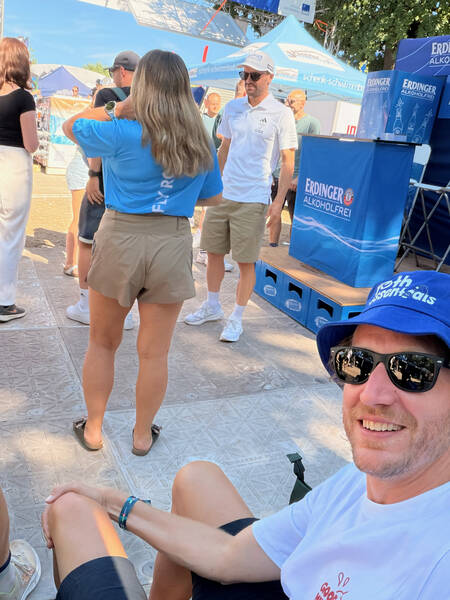
After a few hours, Mathias and I sat down at one of the booths because they had free non-alcoholic beers and nice chairs, and suddenly three-time world champion Patrick Lange appears. He stood there, a few meters in front of us, and of course a long line of people who wanted selfies with him formed immediately.
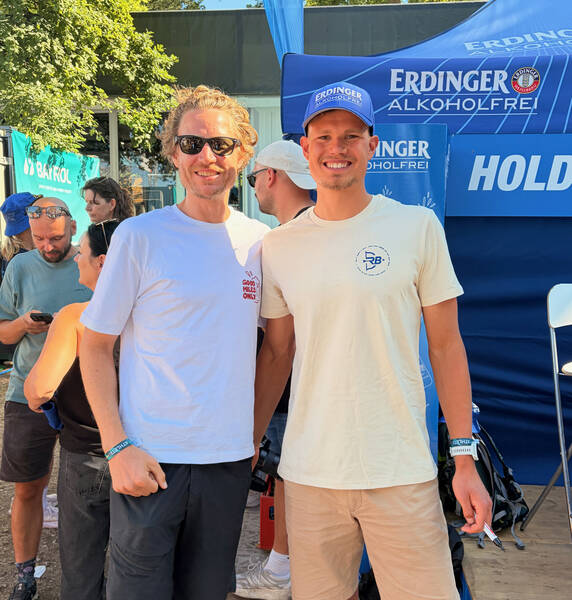
Patrick Lange won Hawaii three times and is current course record holder there. He’s also a former Roth champion, but has just entered his final season as a pro, turning 40 years old. Next to him stood up-and-coming Rico Bogen, the youngest world champion on the middle-distance a couple of years back, who just a few weeks ago impressively won the San Francisco T100 edition, another prestigious middle-distance triathlon. We watched the livestream back then with a bunch of friends and everyone became a fan of his. And now he’s here in person, about to do his debut on the long-distance, which most professionals do a bit later in their career, after having collected enough experience. But to me it felt like he was ready.
This Friday ended on yet another high, because we made use of the chance to have some free dinner provided to all registered athletes. It was a buffet and absolutely delicious. Nothing like what you usually get at pasta parties. Lots of carbs, all vegetarian, but with some extra grilled chicken for those who wanted animal protein, and vegan options were available, too.
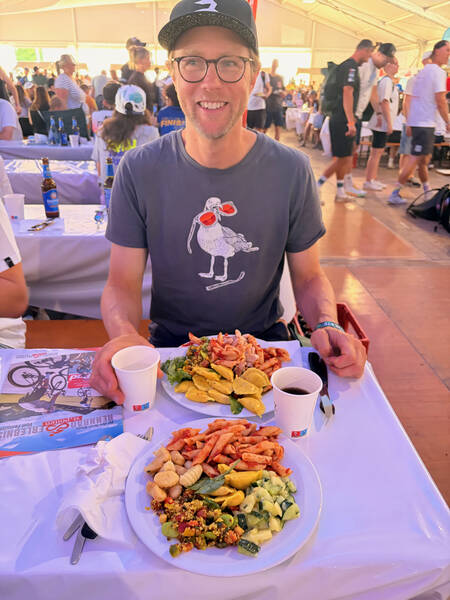
At least by now I was just over the moon. This is what Christmas and birthdays feel like as a child if you’re living in a loving family.
Arriving back at our homestay close to the start of the night, the roommates were about to head out for some ice cream and asked us to join. Absolutely! They are super chaotic, but the stories they told during the short trip didn’t disappoint. All of them had raced the IRONMAN World Championship in Hawaii before or at least been there and experienced it. My favorite story was from Hawaii 2024, a crazy race with Sam Laidlow first smashing the bike course record and being the first to go below 4:00 hours on this challenging course in the heat, before falling apart on the run and ending up finishing in 18th place. The race was then won by Patrick Lange, who killed it with an amazing marathon and destroyed the full course record during it, becoming world champion for the third time. Our friends here were guests at the afterparty with all the VIPs and pros and said that when Sam Laidlow entered the room in his fashionable outfit, heads turned in awe because of his star aura. Despite his disappointing result, people are just fascinated by the young guy. They made it seem like the room split apart with everyone starting to swarm around him, while Patrick Lange was standing in the corner, accompanied by only his manager. No one cared for him, who had actually won the race!
There’s a difference between Lange and Laidlow you can’t put numbers on.
🥰 This Is Roth
Saturday is the day before the race. So usually you would rest and relax, as well as eat lots of carbs but without bloating yourself. Instead, Mathias and I decided to take everything in we can get and compromised a bit on energy expenditure. Of course, the race result was important to me, but not as important as having the best possible weekend here.
Also, some things needed to be taken care of regardless: the race briefing is mandatory and it’s really smart to be there and listen carefully, so we did that while eating pasta we brought in tupper ware. Efficient! It was concise, full of useful information, and I especially noticed that the lady spoke perfectly articulately. Not a single mistake. The race chief everyone loves so much, Felix Walchshöfer, made a short appearance welcoming everyone to big applause and mentioning the 7,500 volunteers who have already been part of the experience and will play a huge role during the race tomorrow, of course, too. He ended by expressing his heartfelt gratitude for all of us athletes choosing this race especially and coming here to be part of it. What sounds like a standard platitude on paper, was actually so deeply felt by him that he teared up while saying those words, provoking another huge round of grateful applause from everyone.
🥹 This race is just so special, it’s hard to put into words.
So much of what Challenge Roth offers to us hobby triathletes is optional. You could put together a race with much less effort and athletes would in general probably be okay with it. The big competitor company, IRONMAN, does exactly that. Challenge Roth, on the other hand, goes above and beyond — and it’s all in the details. For example, every year they publish a list of the 20 items they improved from the previous edition’s learnings. The livestream is in English and with international insider commentators Sebastian Kienle and Belinda Granger, two previous champions who enjoy tremendous respect from amateurs and pros alike. Even the American legend Bob Babbitt is flown in to do interviews with the professionals before the race. The volunteer ratio of 7,500 to ~3,000 athletes is unheard of, and there’s even a waiting list for volunteering because the people who live in the area are just so fond of the event they want to be part of it that much. Every Monday after race day, there’s a huge volunteers’ party hosted at the festival area with the pros joining in for fun activities. The food quality. The aid stations. The help you receive in the transition tents. Everything is just a 10/10. And not even necessary! That’s how you get a happy returning customer like me.
Mathias’ GPS watch died during the day before and he naturally required it for the race, so a little trip to the Garmin booth and getting in touch with one of the friendly guys there ended up with him being able to borrow a functional one for race day. Great service, for sure, but it would have been better if the watch didn’t require being replaced in the first place, right? I think I’ve now nearly convinced him to finally switch to COROS.
The next mandatory task is to go to the bike check-in. Because of the early race start on Sunday, you are required to bring your bike on Saturday afternoon. After we did a last short ride of about 8 km to test everything, volunteers were checking if our helmets fit well and the bikes were up to regulations. All brakes need to be functional, for example. The size of my rear bottle holders was measured, and it was within the allowed limits. My helmet was slightly too loose, so I had to adjust it on the spot.
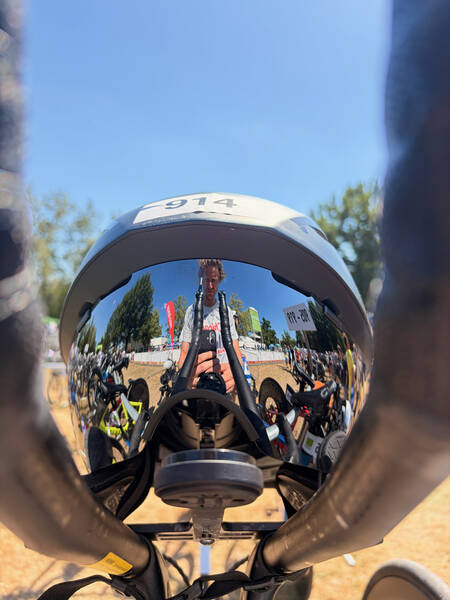
The two transition zone bags containing our bike gear and run gear need to be packed and handed off here, as well. And then comes the cool part of being able to take a look at what bikes the pros have checked in. A commentator was hanging in the pro area and interviewing them as they dropped by to put their gear on their racks, too.
Not gonna lie, the bike envy is real. But I reminded myself I made the best decision by getting a used 2018 Speedmax last year for cheap. Still a very fast bike, more on it later. The engine still sits on top of the bike, that’s what counts for most.
Mathias’ brother Gabriel arrived with his older son in the afternoon to watch the craziness of tomorrow’s race in person and be of support to Mathias, so we had our final pasta party as a group of four, near the site of Solarer Berg, the legendary climb that’s part of the bike course twice and draws crowds exceeding those at a bunch of Tour de France climbs.
Gabriel and his son were sleeping in tents among a lot of athletes. Roth creates camping grounds next to the swim start for those who want to wake up right there without needing the early-morning transfer from Roth here to Hilpolstein, where the swim will begin. He told us about an encounter he had with someone on the camping grounds who was from the area. When he said to her he was from Hamburg, she questioned him in utter confusion about how it could have happened that we just recently voted “NO” on trying to get the Olympic Games to happen in Hamburg one day, and also because of the recent IRONMAN Hamburg scandal which involved some protestors throwing metal splinters on the bike course, causing hundreds of flat tires on the athletes’ bikes. He described this like she was looking at him like an alien. Complete disbelief about how us Hamburgers could be so opposed to sports if it causes us an inconvenience. It shows the different mentality people have here and it’s good to hear this outside perspective sometimes. Being in the middle of both of these situations in Hamburg, talking and thinking a lot about it, I found myself making lots of excuses for the nay-sayers, trying to understand their perspectives and maybe even moving towards theirs a bit, too. Hearing this story, I was reminded again about how great enthusiasm for sporting events is. The way it brings people together in a positive way definitely is one of the major upsides of it.
It has been a very hot day. I tried to hydrate well but quite possibly failed a bit at that. The sun of yesterday and today took some energy out of all of us for sure.
The last task of the evening is to prepare all the carbohydrate-rich drinks to carry on our bikes and then hopefully get some sufficient sleep. The latter proved tricky, but that’s hard to avoid.
🌅 Race Day, July 5, 2026
The alarm clock rings at 3:45 in the morning. I hardly slept at all, but not because of nervousness. Nothing to be done about that. Coffee and honey toasts will have to solve it.
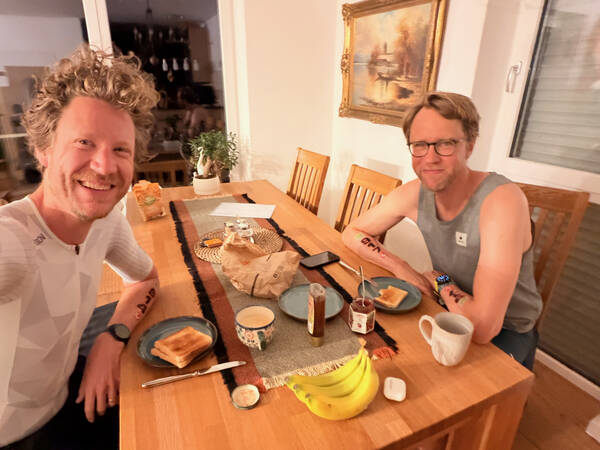
We’re driving over to the new area to park our car not too far from the finish line, and look forward to entering the new shuttle buses to the start in Hilpoltstein. Shuttle buses are a very welcome addition, because last time I remember the huge traffic jams on the small roads leading to the village. This is the only thing that was worthy of criticism though. So many people wanted to make use of the shuttle buses that queues formed, leading to us having to wait in line for about 45 minutes until we got on a bus. Stress levels are on the rise. Many people had to wait even longer. I really hope everyone made it to the start on time. Mathias and I did, but the remaining buffer time we calculated just shrank significantly. By the way, right on the next day, race chief Felix proactively posted a video acknowledging the unexpectedly huge demand for these buses and promised to improve that for next year even before we were able to fill out any suggestions forms they provided. This is how you handle problems.
We’re walking into the first transition zone and put our full bottles on the bikes. Don’t forget the bike computers. Checking the tire pressure quickly because there’s not much time with the delays, it feels okay.
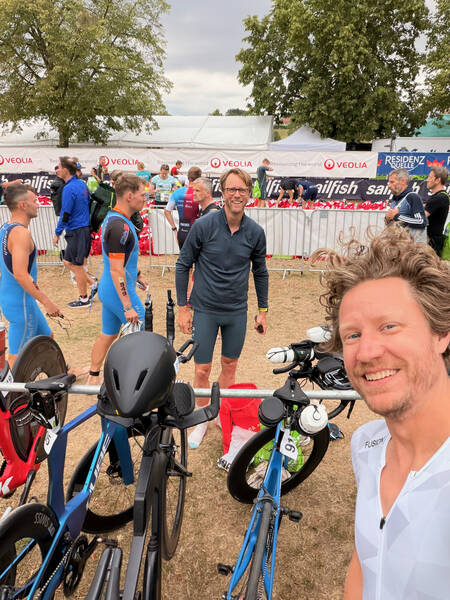
🏜️ It’s just too warm!
By now it’s official: the water temperature in the canal is 25.0 °C, meaning, it will be a non-wetsuit swim. It looked like this was about to happen, so it didn’t come as a surprise. But it’s a downer for most of us — average swimmers like us lose about 9:30 minutes on the 3.86 km swim distance when comparing it to swimming wearing a wetsuit. Just a few weeks ago, German Triathlon Magazin came out with a comprehensive analysis of those times, comparing thousands of results (sorry, partially behind a paywall). And from my own experience I knew this to be roughly correct for me as well.
So, right off the bat, my sub-10-hour goal became a lot harder to achieve.
The bike and run would need to be absolutely flawless.
By the way, 2025 and 2026 were the only years in the 40-year history of Challenge Roth when the water temperature was so high it required wetsuits to be prohibited. Is this a sign of the climate change dominated years ahead?
My phone goes into the finish line bag, there won’t be much screen time in the coming hours. Caffeine gel, one last pitstop at the porta-potties, and we’re off to mingle with the guys in our 7:10 AM starting block. The professionals have already left at 6:30, which we were aware of but couldn’t really pay attention to due to the stress of the bus delay. Up until now, it’s all been quite a stressful few hours, but that’s about to change here in the pre-start group.
Just before we enter the water, Felix shows up, standing there for many minutes, waving at all of us, tears in his eyes again. He just exudes genuine gratitude. I’m sure his feelings are also influenced by thoughts about his late father, Herbert, who created the race back in the day but died a few years ago. A very beloved character, too. I feel a strong connection towards both of those sentiments and start crying into my swim goggles as well. I think what overwhelms me most is the pure emotional intensity of it all at this particular moment. All the months of training leading up to it, the stress of the past few days, the final bike adjustments, carb calculations, all the details. That’s over right this instant. From here on, I feel like there’s not much I can influence anymore except for executing the plan. Add to that the sight of thankful Felix Walchshöfer, and it moves me over the top of what I can handle. The guy is just amazing. How he lives for this event with all his heart. How he’s leading his company to make the race genuinely better each year and works with all these stakeholders in such a respectful way, allowing every single one a spot at the table. In this moment, he represents to me all the good in humans. The selflessness. Working towards a shared goal. Helping each other, showing unity, discipline, and good will.
This is getting so rare it’s really nice to feel this connection to everyone else here, triggered by Felix’s behavior. A role-model in leadership.
But then, it gets real. The steps made of stone lead us into the water. Mathias and I say goodbye to each other because we have to do our own individual race today, of course. Treading water for about five minutes which felt like two seconds. The traditional hot air balloons have already moved away with the wind a bit. And then there’s our cannonball signal. Point of no return.
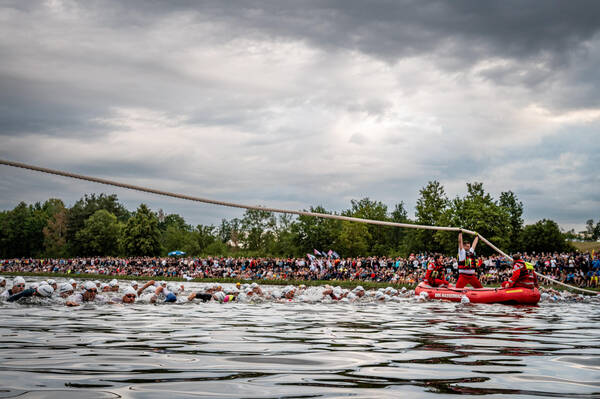
🏊♂️ Challenge Roth 2026: THE SWIM
Here we are, the race has started. Here’s everything about this discipline.
Let’s start with the shortest part, the gear. It’s very important to me to not feel like it’s holding me back, but I’m also not the guy who’s just throwing money around here. Each bit I look at with lots of care and try to find out the cost-to-benefit ratio before making a purchase decision.
That being said, over the past 15 years I’ve done triathlons, I mostly used rather cheap gear. For my project of breaking 10 hours, I gave myself permission to get some upgrades.
🥽 Swim Gear
The basis for everything is a good triathlon suit. My old one had started flapping in the wind, costing me many minutes on the bike especially. I tested a suit made by Castelli, one by surpas, and two models from the company Fusion. Fusion’s TEMPO! ONE Tri Suit model was the one I chose in the end. Not a cheap one, coming in at around €400, but its features were exactly right for me. It’s one of the few models available in the Medium/Tall sizing, which fits me best. There’s room for gels and the fit around the shoulders is tight so it’s very aerodynamic on my body.
During last year’s short distance Hamburg triathlon, I accidentally tore apart my old neoprene wetsuit, so I had to get a new one, too. Of course, I wasn’t allowed to wear it today, which is a shame, because I landed on one I’m super happy with. It’s the Orca Apex Float v2. I watched the market for a few weeks and found a deal at a regional shop to get it for €455 instead of the official €569. Being patient pays off! I used it a few times in the open water and it’s great. A shame that it’s sitting in my transition one bag right now.
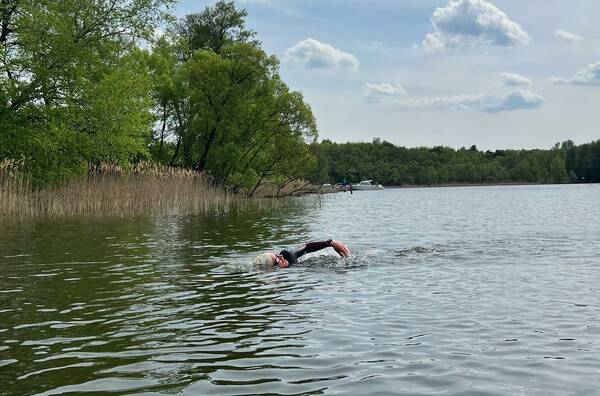
Pairing that with an Orca Killa 180 pair of goggles and the mandatory Challenge Roth swim cap, the gear list for this discipline is already done.
🐟 Swim Training
Swim training is tricky. It eats up lots of hours and the room for improvement is quite small. That’s mainly because the swim is a comparatively short part of the long-distance triathlon. You spend 4–5 times as much time on the bike and maybe 3–4 times as much time running during the race. So it becomes a question of efficiency: 2 hours on a bike will do more than 30 minutes in the pool. But of course, no swim training at all would be very dumb, too. Finding a good balance is the key.
From my experience I knew that with a handful of swim sessions I could get back to my level to complete the 3.86 km in around 1:15. That’s my low-effort baseline. I can then exit the water feeling ready for the next two disciplines.
When beginning the swim training back in the winter, about half a year ago, I estimated that with some improved training techniques I might be able to get this down to 1:10 without too much of an effort. One or two sessions per week must suffice. The reality looked very different, though. The ice and snow of the long winter made me skip so many swim sessions, I completed only 16 swim sessions between October 2025 and race day. And only four of those had some intervals in them, so they could have been considered quality sessions. It’s been about 32 km total, or 12 hours of swimming. You can’t make jumps happen with that, but at least I think I got back up to the swim base I had in the years before.
A new problem had occurred, though. Calf cramping. This has been completely new to me and was super annoying. On two of the interval swim sessions I cramped so hard towards the end that I couldn’t move my legs for minutes and had pain in the muscles for a full week, each, making bike and run training very difficult. Once it happened in my right calf, once in my left calf. I tried to analyze and track down the cause, but it has proven difficult to say for sure what the cause was. I think it’s been a combination of the elevated bike and run training, leading to generally increased tension in my leg muscles, and probably overdoing it a bit during those swim sessions. My nutrition seemed fine, salt and electrolytes can’t have played a role because I took care of those — even mixing my own drinks and bringing them to the side of the pool. Stressful weeks because of a high administrative load in our family of six apparently can also cause cramps, so maybe that’s been a factor, too. I can’t really change that, though.
Both times I had these intense cramps it was highly annoying to me. Triathlon is so complex! So many different possible consequences for every little thing you change. So I started hoping that at least the new wetsuit will get me to go a few minutes faster than the usual 1:15. Well, tough luck today, no wetsuits allowed!
In the end I decided there’s nothing I can do to reliably prevent cramping in my calves during swimming, so I must take it really easy during the swim in order to not kill my whole race right there. Because the intensity of my cramps has been so high, it would definitely have been the end of the day in Roth for me.
🧪 Test Race: Vierlanden Triathlon SWIM
Two weeks before today at Roth, I had a middle-distance triathlon coming up I wanted to use as a test for my gear and the whole racing process. Unfortunately, it was also a super hot day which made wetsuits illegal. I still had some residual pain in one of my calves from cramping a couple weeks earlier, so I swam the 2,000 m super slowly and shook my legs a lot in order to loosen them up. The good news was that I made it through it without cramps, but the bad news was my swim split: a whopping 45 minutes for this short distance! I was usually swimming that in 35 minutes. Roughly doubling it would mean nearly 1:30 in Roth for the swim. That was a huge bummer. Nevertheless, this result placed me 89th of 173 male finishers of the test race. Right in the middle of them all, surprisingly. My guess is that everyone else was a lot slower than usual, too, because no wetsuits.
Needless to say, I went into the Roth swim with very low expectations. Especially now without the wetsuit — which, by the way, would have provided some compression on the calves, reducing the chances of cramping. My only goal is not to cramp and just make it to the transition zone, no matter the time. And who knows, maybe I get lucky with the tiny currents, or find someone suitable to draft behind in the water and will be positively surprised in the end.
🏊♂️ The Challenge Roth Swim Leg
While some hope for a good swim result remained, I estimated that my usual 1:15 plus the Triathlon Magazin-calculated 9:30 minutes due to the non-wetsuit rule would be the most likely outcome today. Somewhere in the area of 1:25 was therefore my best guess. A sub-10 finish would very likely be out of reach, but I was determined to still give it my best shot today.
Carefully I positioned myself towards the rear of my starting block. As soon as the gun went off, everyone started punching the water like crazy, as per usual. It felt a bit more intense than normal to me, though. The proverbial laundry machine. Many hands slapped me all over my body as I tried to relax and get into the groove. “Stay calm, relax, breathe,” is what I said to myself over and over again. I noticed my legs sinking down from the ideal horizontal position in the water every few minutes and had to make a conscious effort to get them up towards the surface again and again. That’s also something the wetsuit usually takes care of. Now the legs are just dragging behind, being a nuisance and slowing me down. I tried not to use my calf muscles at all, of course. Only to shake themselves loose every few minutes.
The most important bit is staying calm. Whatever happens, happens. I’ll deal with it. One stroke at a time, the swim exit will inevitably come closer.
The Roth swim course is a blessing and a curse: we’re never in real open water since the canal is narrow and quiet. It’s also mostly straight with just a small bend towards the turning point after about 1,500 m. You can see how far you have left. There are signposts on the banks of the canal with the elapsed meters. My goggles were fogged up so I could at no point read any of those, but I was able to see the big orange buoys which marked the turning point ahead. It took a seemingly endless time for me to get closer to it. But when I finally reached the point, it felt like quite the achievement. So far, so good! And after the U-turn, it took only a few minutes until the famous bridge with all the spectators came back into view. Every 500 m, my watch vibrated and I sometimes took a glance and managed to see my pace: well over 2:00 min/100 m. That’s what I thought. No miracles today.
I tried to make use of the minimal currents which are found in the canal. From what we learned, during the first 1,500 m it’s better to swim near the shoreline because we’re swimming upstream. After the turning point you’re apparently faster the more you move towards the center of the canal, to make use of the stronger currents here. Unfortunately, the starting block was packed and my orientation in the fogged-up goggles so weak, I couldn’t do much to influence my position. The whole swim is an exercise in patience. Sometimes I caught a glimpse of the spectators to the sides, and that was great, or I got to hear some of the party noises from the swim start getting louder as I moved towards the exit. But most of the time during the swim has to be spent within your own mind. Not much to see, not much to hear. Murky water and loud bubbles.
My average pace reaches a disappointing 2:10 min/100 m, but thankfully stays there. I don’t slow down much. The calves are holding up, which is the most important thing. The tapering of the past week helped, the tension has decreased. I still shake them out under water regularly just to make sure no cramping can occur. Sure, this increases the mental load, but what else can I do. I keep repeating the mantra that every stroke brings me closer.
Thinking about what I’m doing here right now, I realize I’m not having much fun. Being this slow for so long is frustrating. There are no swimmers available to draft behind, the opposite is true: some are hanging on my feet, hitting them. Or swimming curvy paths, blocking the way in front of me. I know my swim split will be bad and make my sub-10-hour goal nearly impossible, so keeping myself motivated is a big ask right now. If only I could have worn the wetsuit! I’m sure it would have been a whole different story.
At about 3 km in, we’re swimming underneath the crowded bridge from the start. Now it’s just 400 m towards the other canal lock followed by 400 m back. It seems doable and I’m longing to finally leave the stupid water and be done with this tedious part. The closer I get, the more euphoric I become. With just a few meters left I realize I have actually made it without cramping! My race continues! Also, I’m looking forward to finally being able to take in the race atmosphere and meet all the transition zone volunteers — one of the main attractions at Roth.
Literally grabbing the strong helping hands at the swim exit and standing on my own two feet again gives me so much relief I’m instantly back in the game, mentally.
I push the correct button on my watch but missed seeing the total swim split. I knew it would be around what I expected because I saw the 500 m split paces. And my feeling was confirmed.
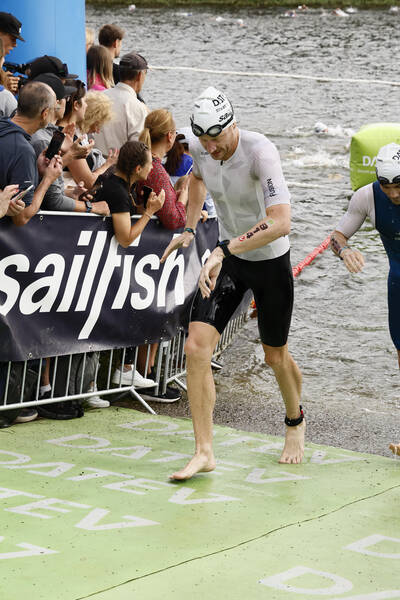
👉 Roth Swim Split: 1:24:26
It’s crazy how close this is to my 1:15:00 plus 9:30 minutes non-wetsuit penalty estimate. Just four seconds off. Was it a self-fulfilling prophecy? I don’t think so. With mixed feelings I leave the swim behind me. It wasn’t fun. I’m glad it’s over.
I’m often curious about how my result compares to the others at races. Am I near the front or more towards the end? In the swim, the answer surprised me. Taken from my personal impressions, I was sure I must be within the slowest quarter of the male field, at least. But looking over the result list afterwards, we found that the median male swam 1:23:30, which is just so slightly faster than I did! The median is the one who is right in the middle if you lay out all male results next to each other, sorted by time. My 1:24:26 result puts me among the fastest 52% of the male field. It was the 1,360th best time out of 2,608 male finishers.
Interestingly, in the previous year, which was also a non-wetsuit swim, the median male swam a 1:21:04, which is a couple minutes faster compared to today. Maybe that had to do with the conditions of the water. But in 2024, two years ago, wetsuits were legal. That led to the median male swimming a 1:13:21 — that’s more than 10 minutes faster compared to today’s median male! Crazy how much of a difference the suit makes for us average swimmers. By the way, it doesn’t affect the professionals’ times much because their technique and position in the water is just so good the wetsuit’s buoyancy doesn’t do much for them. The weaker a swimmer you are, the more benefit you’ll have from wearing a wetsuit.
🔄 Challenge Roth 2026: TRANSITION 1, Swim → Bike
The smiling and friendly volunteers as well as the noise of the crowds all around are a much-needed boost. My transition bag isn’t far from the exit, I find it immediately and notice without surprise that Mathias’ bag is gone. As expected, he has been swimming faster than me, which also means that he didn’t have any big issues. I’m happy for him, because coincidentally, he had also encountered calf cramping during swim training for the first time. It’s easy for me to check the bags because our bib numbers are so close to each other. Mine is 914, his 917. Already I’m looking forward to his race report, but I’m sure I won’t see him for a long time — because he is a far superior cyclist than I am. Maybe I can catch him on the marathon, but we’ll see.
Right now, I’m going into the transition tent with my red bag, find a spot to sit down, and immediately there’s a friendly volunteer running towards me. A very muscular young man. He empties out my bag and starts sorting the stuff as quickly as possible. The big wetsuit I had stored in it makes this slightly challenging, but he finds my socks between it. Those are important — during the Test Triathlon I did two weeks ago, I simply forgot and biked barefoot in my shoes. It went alright, but I didn’t want to risk anything on this twice-as-long course.
While I put the socks on, he sorts the rest of the contents. My bib number strap which I click around my waist. A gel which I eat right after being finished with the socks. A small towel I use to quickly dry off my face. And one of the new pickle juice cramp shots I packed just in case but never tested. Thankfully I didn’t need it today!
And that’s it, he takes care of packing everything I discard back into the bag and wishes me a good race while I run off on my socks towards my bike. Transitions in Roth really are something else — nowhere else will you have individual support like that. You’ll feel like a superhero whose special suit is put on you by assistants.
My bike is just around the corner, we got lucky with the position. As expected, Mathias’ bike is gone, too, so he’s apparently fine. I put on my helmet and check the COROS DURA bike computer. It has automatically switched on because the Bluetooth range of my COROS PACE Pro watch reached it and they work really well together. I use the watch to track the whole triathlon, but having all the data displayed on my bike computer is more comfortable for the bike leg. The DURA says I should confirm starting the bike ride on my watch as soon as it does. Then it’ll show all the connected sensor’s data. Super comfortable.
Pushing the bike out of the transition zone across the grass is a bit tricky with the pedal-mounted shoes, but I manage to not screw it up.
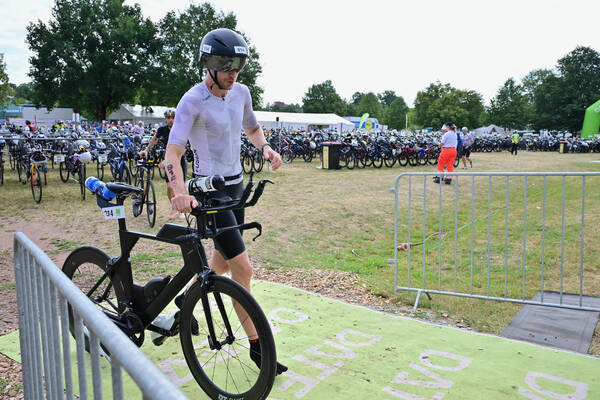
Despite the huge size of the field of participants here, it’s less than 100 m to the bike start. Suddenly, there’s the mounting line, I hop on it without falling over and transition number one is done!
👉 Roth Transition #1 Split: 2:57
Nothing went wrong. That’s the main thing. I didn’t accidentally break any rules, all my gear is good to go, my circulation is playing nicely with the switch from horizontally swimming to vertically running to sitting to running while pushing a bike. My mood has just improved some more. I’m ready to put all the training hours on my Zwift computer to the test now!
🚴♂️ Challenge Roth 2026: BIKE
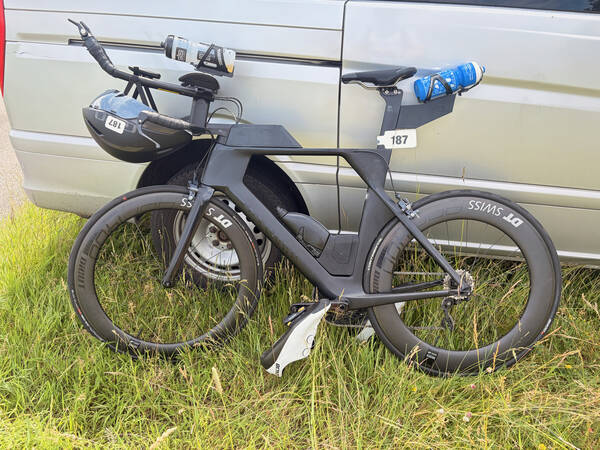
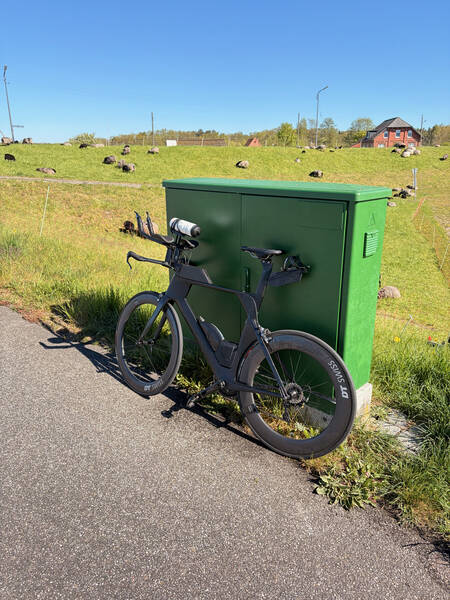
I’m really happy with the 2018 Canyon Speedmax CF 8.0 SL I bought second-hand last year. It feels so much better than the much older Scott Plasma 3 I had for the past 10 years and during the majority of my previous 36 triathlon races. Although the frame size Large might still be little bit too small for the 1.90 m guy I am, it fits better. I’m also positive I made a particularly good deal because I got it for €2,100 including the wheelset, which is a DT Swiss ARC 1400 DICUT carbon set, 80 mm rim at the back and 65 mm at the front. That set alone is worth this price and the naked frame originally cost twice as much. Meaning, I paid about a third of the original price of the setup. I hope the bike will last me for the next 5–10 years of triathlons since I’m not planning on giving up the hobby anytime soon.
While searching for a suitable bike I made the decision to go for neither electronic shifting nor disc brakes. While both definitely are superior to old-school mechanical shifting and rim brakes, they require more knowledge and maintenance. For me personally, those would have been two additional areas of worry and unfamiliarity. One step at a time for now.
It’s been fun to take a closer look at all the other peripherals needed to pull off a solid bike split and make improvements. Over the course of the past six months, I replaced and added quite a bunch of things. For posterity, here’s my full gear list including the money I paid for it all.
🪖 Bike Gear
| Item | Cost |
|---|---|
| 🚲 Canyon Speedmax CF 8.0 SL 2018 | 2,100 € |
| 🛞 DT Swiss ARC 1400 DICUT | incl. |
| 👟 Bont Riot cycling shoes | 200 € |
| 🦶 CURREX BikePro insoles | 50 € |
| ⛵ Rockerplates 3D-printed aero bottle cage adapter | 80 € |
| 🧰 Lasse Ibert 3D-printed aero toolbox and bottle | 200 € |
| ⚙️ 165 mm Shimano crankset | 180 € |
| 💺 Selle Italia WATT Superflow saddle | 130 € |
| 🍱 Hard shell bento box from Canyon | 30 € |
| ⛑️ Giro Aerohead MIPS helmet | 200 € |
| 💨 Aerogogo Giga electronic pump | 60 € |
| 📐 Profile Design aero extensions | 50 € |
| 🛠️ Assembly and fitting of extensions | 80 € |
| 🛞 Tires (Continental and Schwalbe) | 200 € |
| ⭕ Latex and TPU inner tubes and valve extenders | 150 € |
| 🥤 TriRig BTA bottle cage adapter | 130 € |
| 🕯️ SILCA chain-waxing system | 120 € |
| ⛓️ Two spare chains | 60 € |
| 🔧 Spare derailleur hanger | 30 € |
| 🖥️ Bike computer mount | 15 € |
As you can tell, this is a lot of stuff! I was surprised myself. And I might even have forgotten a few items. What happened is that over the course of the six months of training, I noticed little things coming up here and there all the time. Little items to improve. Some broken parts in need of replacement. Some ergonomic upgrades. The truth is, I could have done the race without the majority of these add-ons, but it’s just more comfortable and fun this way and I should also mention that I just didn’t notice the total amount creeping up because I ordered all these items spread out over many months.
Added together, all these spare parts and add-ons cost me €1,965, nearly as much as the bike! Crazy. But, I’ve added in everything — including the items not fully tied to this specific bike, like the chain-waxing system, or the helmet and bike shoes, which were in dire need of replacement because mine were both over 10 years old and especially the helmet wasn’t up to regulations anymore.
The main question now, is, of course: was I happy with the full setup? And I can answer that with a strong yes. I still see areas I could improve for the future, such as larger armrest pads, or maybe finally finding some cockpit spacers which lean a bit more forward. But everything here on the list had its purpose and fulfilled it.
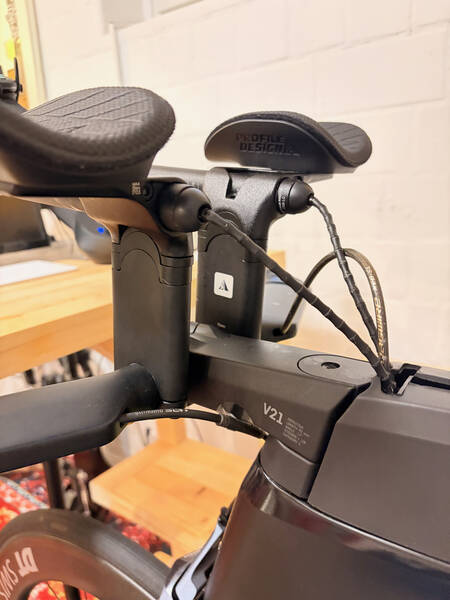
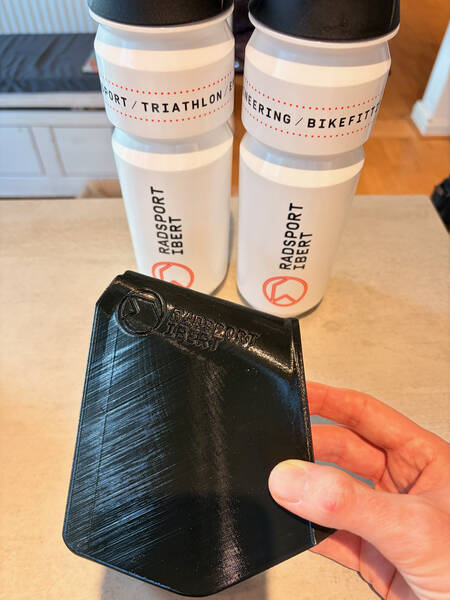
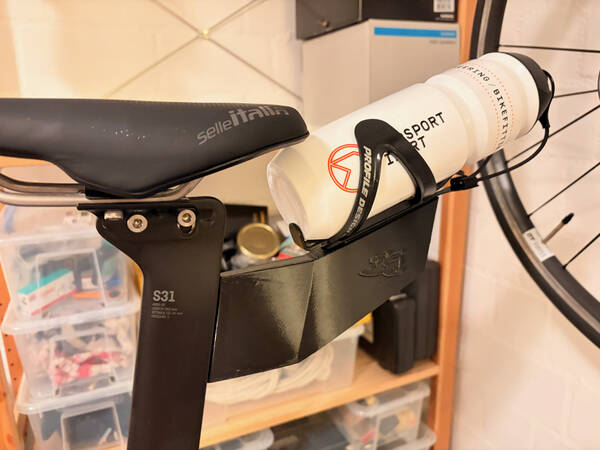
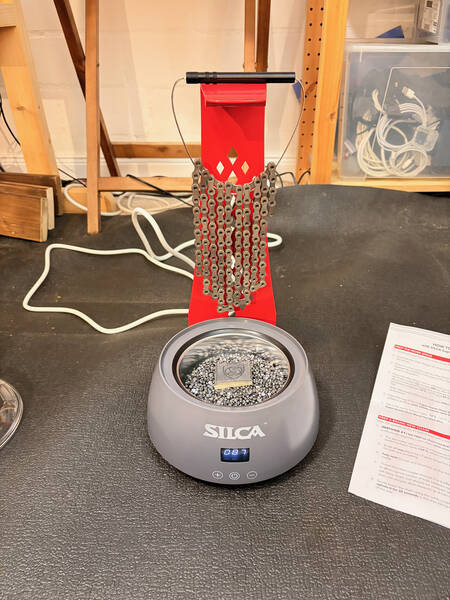
What were the most powerful upgrades? The most bang for buck?
Apart from the ergonomic things like the longer arm extensions and shorter crankset, which played a significant role in reducing pain in my neck, lower back, and hips, I’m sure it’s the waxing of the chain and the new inner tubes made of TPU inside the wider 28 mm tires.
People have measured the impact of both a waxed chain and wider tires and it’s huge, because it reduces friction at low cost without any downsides. And at the same time, riding the bike feels a lot better: the waxed chain is extremely quiet and the large tires with TPU tubes feel light and fast while providing more cushioning of impacts and a more secure feel in sharp corners.
I had to learn a lot of new stuff to make this all happen, though. I tried inner tubes made of Latex first, but couldn’t get them to not lose air when attached to the valve extensions for my high rims. No matter what technique and tools I tried. The slightly more expensive but also more fragile TPU tubes worked great, but required me to switch from CO₂ cartridges to an electronic pump in my repair kit in order to not destroy the tubes with the decompression cold the cartridges cause. And the wider tires were a challenge, too, because while they would fit well on the back wheel’s rim, they didn’t on the front one’s. I tried a few tires and finally found one that fit, now having to ride Continental on the back and Schwalbe on the front wheel.
You really need the time and mind space for bike maintenance, and I struggled with both. I’m glad I didn’t go for disc brakes or electronic shifting yet, because those two upgrades would have opened yet another Pandora’s box with all the braking fluid and battery pack issues and whatnot.
By the way, I haven’t done a proper “bike fitting” with a professional yet. They are expensive and I felt like I got the job done well enough myself with the experience I have. I tried some of the new apps which record a video of you on the bike and tell you about the position, but the results were disappointing. As was my humble request in the Reddit r/bikefit community. I might in the coming years contact a professional for it. There’s always room for improvement.
One more thing. The final upgrade for the bike leg of Challenge Roth literally has to do with my bike legs.
🦵 Things are getting real now.
I shaved my legs, for the first time ever in my life 😱! It took ages to do and felt super weird at first, but I kind of grew to like the style. Apparently, all the hair on especially the lower legs presents a real drag and shaving them costs about €10 for a shaver and some shaving cream while getting you an advantage of between 8–10 W at 35–40 km/h, even more at higher speeds or with headwinds. So that’s an easy gain, especially since my time on the bike over 180 km will be long, adding to the effect to a total of about 4–5 minutes saved. I decided I won’t say no to those free minutes anymore just to preserve my naturally hairy legs and I’m not looking back!
🛤️ Bike Training
Now, your bike can be the best in the world and your legs as cleanly shaved as possible, in the end you’re still going to have to put the power to the pedals using your own body.
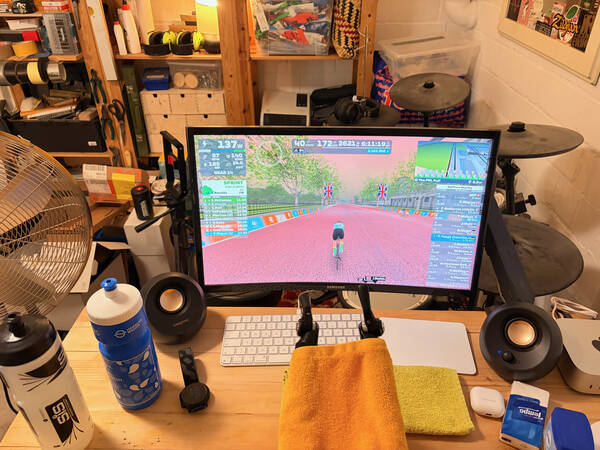
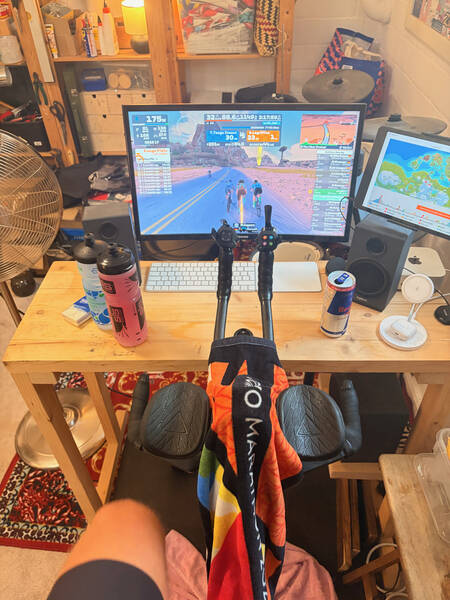
I saw the most room for improvement for my own ambitions at a sub-10 finish here in the bike part. My aerobic base is great due to all the running, but my ability to put that to use on a bike has to be trained for, specifically. My stationary bike setup in my basement has been perfect for it. I don’t love riding outside because of the dangers of the big city I’m living in the middle of and also the annoying weather, so putting my pretty Speedmax bike on a Wahoo KICKR CORE 2 and booting up Zwift for some virtual riding has been my go-to workout. The gamification of the app is really working for me. In November I started with a week-long block intended to increase my general VO₂max across 5 tough sessions. That worked partially. My FTP went up to between 260–270 W during the winter, a solid base to build on.
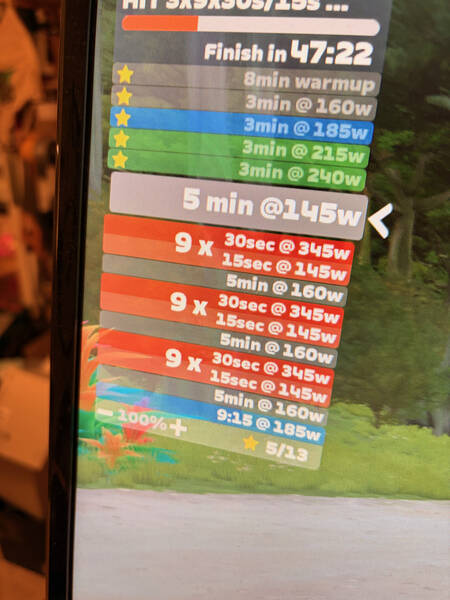
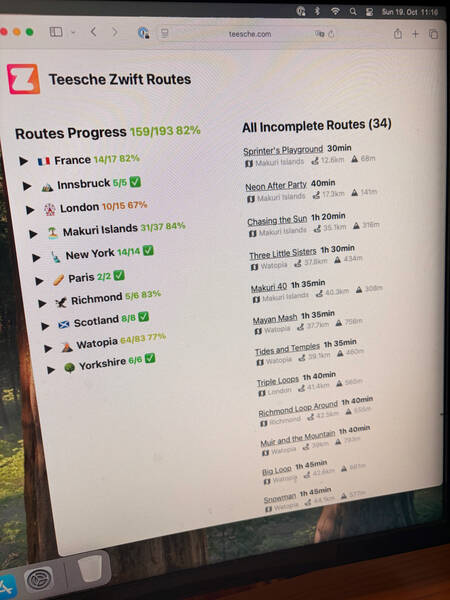
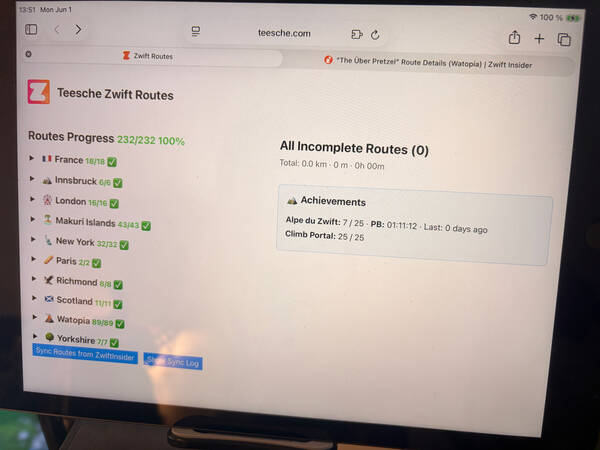
But the most motivation for me came from trying to complete all the available routes on the platform of Zwift. The problem is, Zwift expands the routes all the time. Well, it’s not really a problem — in fact, it’s awesome that they do. When I started preparing for Roth, Zwift had 193 routes available, and at the time of race week, there were 232. I think I already was at about 150 of them completed before really going after it, because I’ve been Zwifting here and there over the past five or more years, basically since the pandemic.
In December I put in a massive workout by cycling the longest available route, the PRL Full, which is about 172 km long. Of course I added the remaining eight to it for a full 180 km, the distance at Roth. It took a long time and lots of my self-mixed carbohydrate drinks.
Afterwards I got the idea to put together a little web dashboard for myself using the powers of AI so I don’t have to code everything myself anymore like I used to back in the dark ages. That way I was always up-to-date on my progress. The Zwift app provides only a very raw and dumbed-down version of the list.
One route after the other, mostly done in medium heart rate zones without any specific workouts. I enjoyed that and I’m sure this worked in my favor, too. I could have trained better I’m sure, but it was hard for me to only see the training and not the fun while doing it. This is supposed to be fun, after all!
A favorite of mine was Zwifting down some routes while watching race livestreams. With the Winter Olympics and lots of early-in-the-year triathlon races, there were plenty of good opportunities.
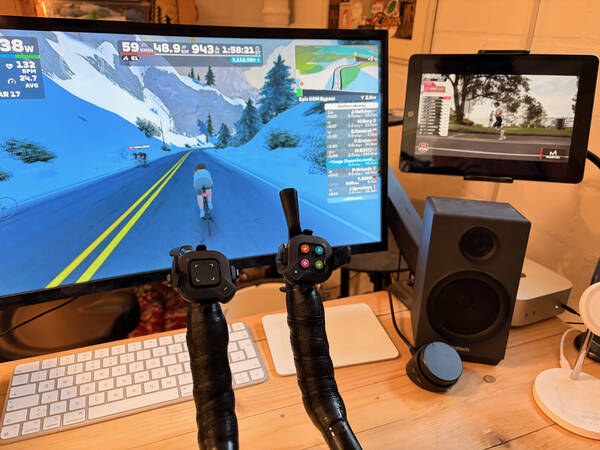
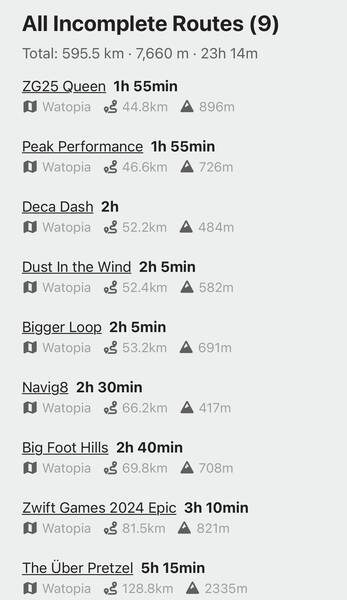
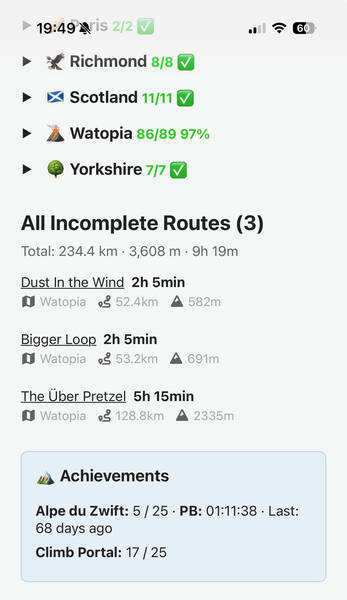
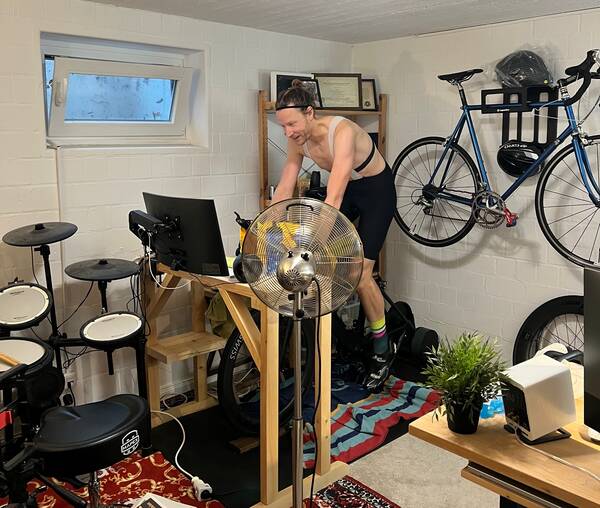
Some of the training sessions I did together with my friend Mathias, who just sat on his own Zwift setup in his basement, cycling while we had a continuous call going, sometimes watching any sports livestreams and commenting on it. That way, time flies! He was also on the quest to check off all Zwift routes, so we both decided to leave the biggest one, the so-called Über Pretzel, for last and ride it together. We had to reschedule a bunch of times and finally completed the 129 km long route with its 2,335 m of elevation gain including the massive Alpe du Zwift climb at the end on June 1st. It took over 5 hours and countless bottles of water with maltodextrin mixed into it. But it worked!
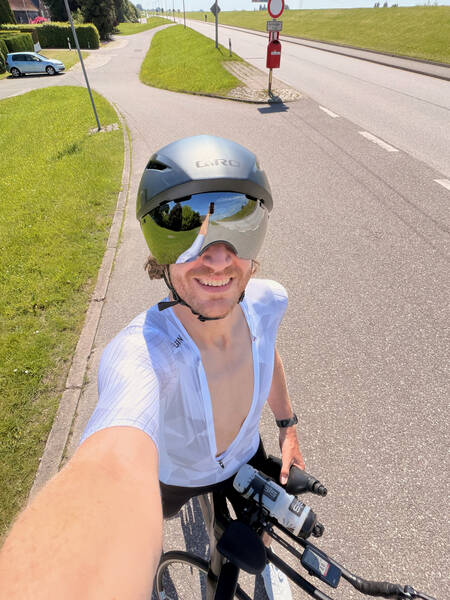
I decided that it would be a smart move to test my setup in the real world at least a few times to see if it’ll all work out as intended on actual roads instead of on Zwift machinery. And I’m really glad I did, even though it’s not my favorite thing ever.
📋 The training stats
Putting everything I did for my bike split between November 1st and Challenge Roth on July 5th together, I came out with roughly 4500 km over 150 hours of riding, achieving nearly 50,000 m of vertical gain. These were split into 134 rides on 110 separate days. More activities than active days because sometimes I did a few short activities to check off the shorter routes one after another. Over these months I averaged 125 km per week, but that’s not including all my bike commuting.
I did about 4100 km on Zwift and just 400 km outside, including the Vierlanden Triathlon test race. My biggest month was November with the FTP upgrade sessions, 765 km in 25 hours total during the month. From January to June I trained on the bike around half of all days, hovering at 20 hours per month, between 400 km and 600 km.
🧪 Test Race: Vierlanden Triathlon BIKE
You can’t know for sure how well you did the training until you put it to the test under race conditions. The Vierlanden Triathlon was perfect for it. By the time I had completed all final adjustments on my setup, adjusted the drink mix I put into my bottles for maximum energy during the hours on the bike, I was just really looking forward to feeling the speed on the asphalt.
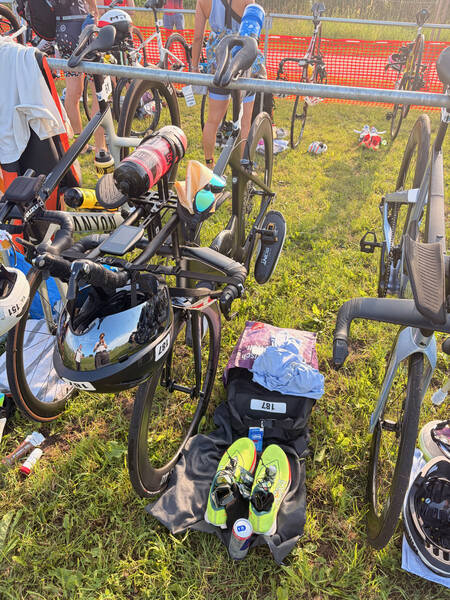
This race in the southeast of Hamburg has a bike leg that’s 80 km long and leads up and down the same 10 km stretch famous from IRONMAN Hamburg a couple weeks ago. Unfortunately the part is famous for the wrong reasons: people living in the area were so annoyed with all the cyclists blocking their roads here they resorted to drastic measures of protest by throwing down metal splinters at various points during the IRONMAN race, causing hundreds of flat tires. It was all over the international triathlon news and just super embarrassing from my point of view. Also, clearly a failure of communication between the people, the local politicians, and the IRONMAN corporation. Hopefully some sort of solution can be found in the future. For now, the solution has just involved lots of street sweeper trucks as well as a bunch of police blocking the crossings of this race course. Oh well.
I planned to go at roughly the effort I wanted to do in Roth in two weeks, maybe 33–34 km/h on average. It’s super flat here as opposed to Roth, so I guessed I would end up at the faster end of that.
After the horrendous swim at Vierlanden and a transition during which I accidentally forgot to put on my socks I hopped on the bike during the heat of the day, ready to push some power. And it felt absolutely amazing. The flat and clean street, almost no wind, my great new bike, everything was so good. I felt aero like I never did before. My position seems to be good, causing no real problems apart from the occasional numbness us men are all familiar with on the bike. Nothing a slight adjustment can’t fix. I flew up and down the road, taking in a solid 200 g of carbs from my prepared drinks and ended up with a time of 2:21 for the 80 km, 35.2 km/h on average. Absolutely crazy for me! This is the fastest I’ve ever been on such a distance.
It was a big confidence boost to arrive in T2 this fast, two weeks before Roth. All the months of Zwift training in the basement clearly have made a big impact.
I also learned a few things, for example that some caffeine might help towards the end of the bike, because I was just starting to yawn and getting tired. Also, slightly reducing the amount of carbs per hour would probably be easier on my stomach. But the most important bit is the bike setup and my position on it, and I was confident that I would be able to hold that aero position without pain for a few more hours than today. No real issues occurred. And thanks to my comfy new bike shoes, forgetting the socks in T1 didn’t do any harm either. Thumbs up for Roth!
🚴♂️ The Challenge Roth Bike Leg
Back to Franconia. The long swim and fast transition behind me, hopping on the bike after the mounting line worked without me accidentally kicking off all frame-mounted bottles as is often seen at the race livestreams. It wasn’t super elegant either, but I managed. Finally on the bike! Now let’s see if I can find my Vierlanden Triathlon legs and make up some time lost in the swim.
Right at the start we’re crossing that famously crowded bridge which holds thousands of spectators right now. They’re all cheering for everyone and this is a much-needed boost for me after the disappointment of the water. An additional adrenaline boost is caused by my friend Marcel from Lake Constance surprisingly popping up right here, shouting my name! The triathlon community is huge and small at the same time.
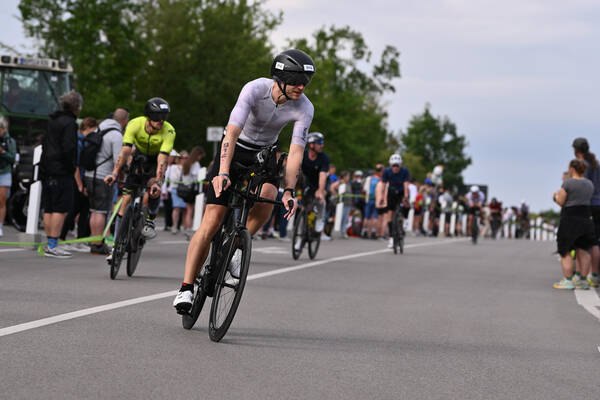
The important bit now is to not get too excited with the Watts. I need to remember I’ll have to do this for more than 5 hours. My estimate was that I can end up here with a bike split of 5:20 to 5:30, depending on my legs and the conditions. I calculated this using a mix of AI and my experience. Still, a lot can and will happen to make even the best estimate invalid, but having a plan helps.
Looking at the bike computer I made sure not to overpace, especially when it came to my heart rate. My cadence sensor needs to show something in between 80–90 turns per minute for me to be happy. Don’t waste any energy unnecessarily. On the first downhills I was especially careful not to fall or lose any equipment, because that would have made things a lot harder. The first 10–20 km are going well, but they are hillier than I remembered. This made me try really hard to remember how hilly the later bits are in order to find out if the worst is out of the way or if I misjudged the difficulty of the elevation profile.
For my ambitions of going sub-10 hours, I would need to cycle closer to 5:20, because the swim took so much longer than expected. That corresponds to a 33.5 km/h average. Seems fine when compared to my easy 35.2 km/h average over 80 km two weeks ago, but you have to factor in the hills here. Roth’s bike course has about 1,500 m of elevation gain, while the Hamburg course had maybe 50 m. Also, importantly, the fatigue over the long duration will accumulate and make everyone slightly slower. But so far I’m optimistic. The average is okay considering the hilly beginning of the route, so I breathe and repeat my mantra:
“Leichte Beine, runder Tritt. Leichte Beine, runder Tritt. Leichte Beine, runder Tritt.”
Light legs, smooth pedaling.
This helps me calm down and remember to take it easy, and lift the legs up during the upwards motion, so I won’t pedal against the weight of my own legs.
😮 While I’m settling in, suddenly something completely unexpected happens.
I see Mathias in front of me during a sharp little uphill section. How can this be? We have talked about possible outcomes of the race a lot and this scenario had never occurred to either of us. It seemed most likely to us that I might catch him during the second half of the marathon, because he swims and cycles faster than I do, but I’m the better runner. When I saw his T1 bag missing in the transition zone after the swim, everything seemed to play out as expected, but I never thought I’d catch him on the bike, and especially not this early, just 20 km into the long 180 km ride.
My immediate thought was that something must have gone wrong. Maybe he had a flat he needed to repair, or even crashed? Hopefully not. Or maybe I have overpaced way too much during these initial hills? I don’t think so, but it’s possible. While I’m overtaking we can’t talk this over because the road is of course packed with other athletes and it’s also very much frowned upon behavior during a race. But we manage to exchange two half sentences and I gather that nothing unusual has happened except that he had a little calf cramp during the final bits of the swim, which he was able to overcome. It doesn’t fully explain what’s going on with him on the bike now, though. But no time to find out. So I move ahead, keeping my own pace. Seems like now I’m the one who is hunted, and not the other way around! Our fun little internal competition is of some benefit to my performance for sure.
Kilometers 20–35 feel really good. So good, in fact, that I manage to bump the average speed up by quite a lot, up into the 34 km/h mark. During the 18 km from Heideck to Greding I do a 38.7 km/h average, unthinkable to me before taking up the Zwift training. It’s only later that I found out this was the only section with some good tailwinds. That’s a good opportunity to put more maltodextrin into my stomach. I’ve got 300 g in the bottle between my arms and 200 g in my frame-mounted bottle. The third bottle I’m carrying behind my back has plain water.
During the aid stations which are located at about every 17–20 km, I only grab water bottles to spray them on my upper and lower legs as well as my neck and to clean my sugary mouth a bit. I don’t drink much plain water — which is the biggest mistake I’ve made today. But that won’t be a problem until hours later — foreshadowing!
Right now, I feel good and soak in the atmosphere.
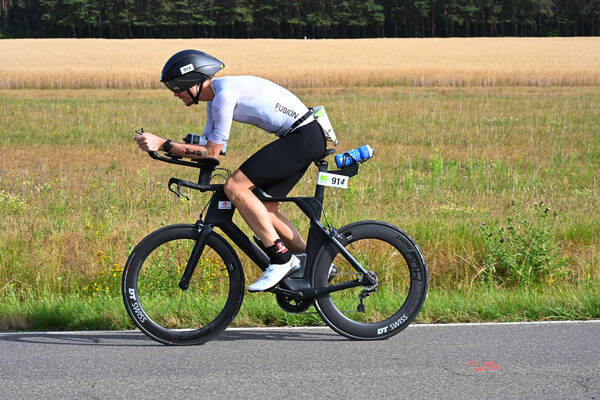
Just before the 40 km mark, one of the famous big climbs is on the menu. The hill leading through the town of Greding, named Kalvarienberg. Within a couple short kilometers, we’re going up 150 m. The crowds are incredible here, even though this isn’t the famous Solarer Berg yet. There’s a stage with an emcee firing up the people and everyone is cheering for all the athletes. This is a lot more fun than cycling up a steep hill on your own for sure!
Unfortunately though, it’s here that I realize that my gear shifter isn’t properly aligned and won’t move the chain to the two easiest gears. This isn’t great on these hills, because it means I will have to cycle with a lot more power than planned, getting my heart rate up and wasting energy. With an electronic shifter, this wouldn’t have been a problem. On the other hand, I should have checked all my gears on the final bike ride yesterday — the mechanics at the check-in would’ve taken care of that immediately. Another lesson learned. Triathlon really is quite complex and requires focus on all the little details that might come back to bite you later.
Right now, I first make use of the aid station here at the hill, using some more plain water to cool down my legs and neck. As the crowds clear once we’re above the hill I contemplate stopping at one of the three bike mechanic stations along the route to have them fix the shifting, but decide against it. I figure it might cost me more time than to just ignore the problem and do the hills on the big gears instead.
Shortly after the Greding uphill, there’s the famous switchback downhill towards the town of Obermässing. There are just three 180-degree turns, but I’m reaching over 60 km/h on these, which feels way too fast for me to not brake. Volunteers are waving flags before each turn to signal to slow down. With all the Zwift riding and nearly no outdoors bike-handling skills on steep downhills on my TT bike, this part seems really dangerous to me. I slow down a lot to make sure I avoid an accident. People are overtaking me. At the same time it worries me that my rim brakes might heat up the carbon so close to the new TPU tubes, which are famously bad with extreme temperatures and might explode. An exploding tire during a really fast downhill U-turn may even be the end. This makes my adrenaline go through the roof as I need to decide between the two: braking to avoid crashing, or not braking to avoid exploding the tires and crashing.
🛍️ Did I try to save money at the wrong end?
With disc brakes, this wouldn’t have been a problem. It’s somehow funny that the two bike improvements I decided against are now both becoming a problem. An electronic gear shifter would have solved the uphill problem, and disc brakes would have solved the downhill fear.
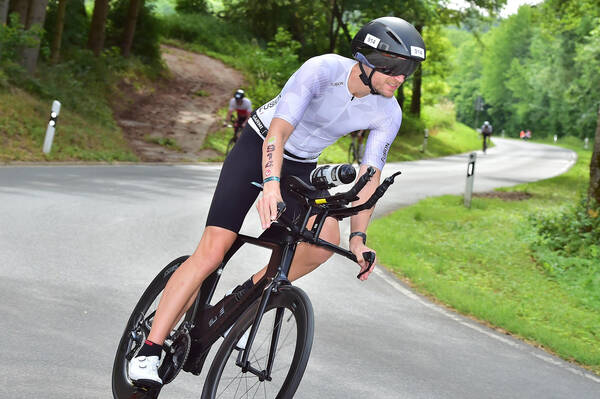
I’m really glad once I’ve reached the bottom of the hill with my bike and body still in one piece. But it’s here that I realize that the brake pads on my front wheel are continuously touching the rim. Right, I remember that I just put new ones on them a couple weeks ago, but forgot to adjust the spacing due to the bigger size of those. Again, such a little detail that now annoys me because I hear the sound of the brake braking a little bit at all times, slowing me down. Maybe a stop at the mechanic would make more sense now? No, I still decide against it.
The part between Obermässing and Hilpoltstein is quite alright from my point of view. I don’t need the easier gears and the brake pad friction doesn’t really make a huge difference. Still, my average goes down on this part and I’m not sure why. Of course, I suspect that I overpaced earlier, or that it might be hillier here than it looks, but both I cannot change now. It’s quite windy, but I don’t feel like that has a huge impact. But afterwards I find out, the wind really was a problem today, slowing everyone down, especially on this stretch between roughly 45 km and 70 km, because the route leads north-west here. I had some slight problems to keep the bike straight on long stretches due to the crosswinds, but I guess my big new aero-helmet made it feel like the headwinds weren’t as strong as they actually were.
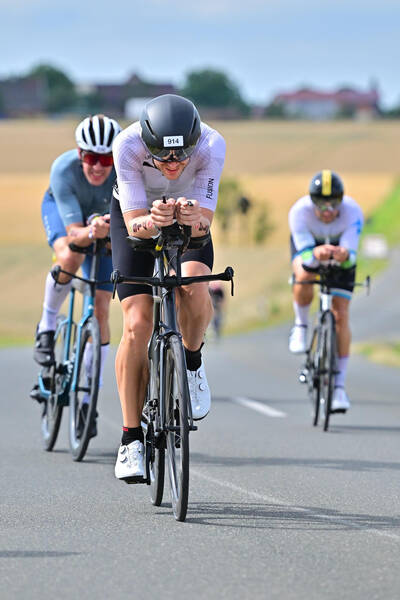
💖 Meeting the professionals
At about 60 km into the bike leg, a motorbike overtakes me on a long straight road. Nothing unusual so far, there are quite a few race marshals around. But I notice this one, since the guy on the backseat is wearing a special high-visibility vest with a big name printed on it: “FELIX.”
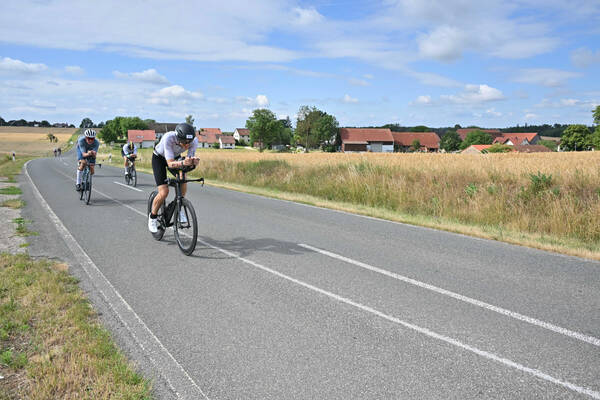
Felix Walchshöfer himself, there he is again. It really feels like he’s with us all on this day. His appearance right now can only mean one thing, though. The leading pros must be close! And that’s what it is. Shortly after, I see Sam Laidlow cycle past me. I know the bikes and racing kits of most professionals here so I know immediately it’s him. It’s not a surprise, he is probably the best cyclist currently. Later, in the livestream, I found the exact moment caught on camera when he passes me. And here it is:
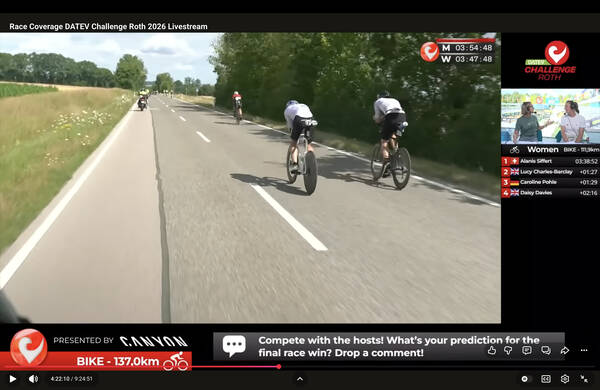
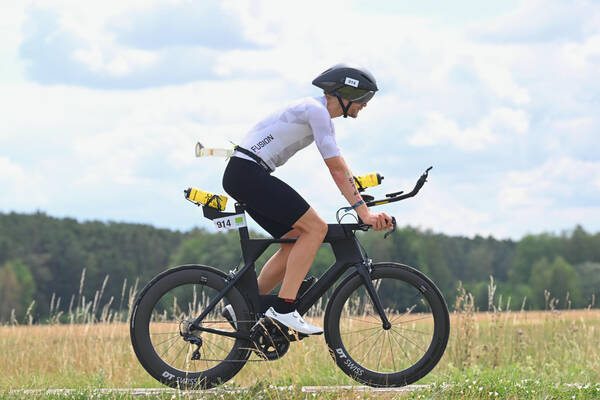
You can find the moment here in the YouTube video that Challenge Roth put up for free for everyone to look at. It’s funny to me how there’s not much of a visual difference between Sam and me at first sight. The closer you look, though, the more the differences become apparent. His bike position is a lot more aggressive with his upper body further down compared to mine. This makes him a lot more aero. Our race suits and bikes are by the same brands, so they of course look similar. And the small differences include his disc wheel at the back compared to my 80 mm rim, his fully horizontally mounted double bottle behind the seat compared to my less aero solution, and last but not least his bib number which he crammed into the space between his behind and the two bottles, while mine is flapping away on my lower back, disturbing the air.
Other than that, not a huge difference, right? We’re about the same height, too, by the way. The one big difference is the speed. He’s going a little over 10 km/h faster than me.
Right behind him, Rico Bogen is following. I am very happy to see that, because young Rico is doing his long-distance triathlon debut here today and I am a bit of a fan of his. I think he might become one of the greats in a few more years. Seeing him using his crazy good cycling skills to keep up with Sam here at the front is great. Hopefully he’ll be able to do a good marathon afterwards, too. After those two, there’s a long gap, though.
But why are they here at all, lapping me right now?
Mathias had calculated before that this shouldn’t have happened. The way we estimated, we should have been on the second lap of the bike leg already when they came by at this spot. So it looks like we are a lot slower than anticipated.
When you think about it, it’s clear why. The first big difference is the non-wetsuit swim. Professionals swim almost identically fast, regardless of whether they are wearing a wetsuit or not. It’s just that it makes a huge difference to weaker swimmers. Today we already lost nearly 10 minutes because of that effect. And on the bike, the more aero you are, the less the headwinds are affecting you — so here, the penalty is felt stronger for us age-group athletes as well. This, as well as them having started the race 40 minutes earlier than us, led to them cruising past us this early. It’s 145 km into the bike for them while we’re here at just about 60–65 km.
As I reach the next aid station maybe a quarter of an hour later, third male Jonas Schomburg passes me. I accidentally block him from grabbing the first water bottle, but I wasn’t able to see him coming from behind. I immediately recognized him, too, and felt bad because I want him to do well, too — his racing style and cool demeanor is really impressive to me, so I’m happy to see he easily manages to grab one of the later bottles.
Just before the famous Solarer Berg, or Solar Hill, as the English-speaking community is calling it, there’s another little hill that has become a crowd hotspot in recent years. Kränzleinsberg is its name. Lots of people are roaming the sides and I see the gang from our homestay. Shortly after, Mathias’ brother Gabriel and his son are on the left side and cheer for me. This always feels great, someone knowing you personally being happy for you.
I know Solar Hill is right around the next corner and I also know that it’s quite likely that a few more professionals will shortly overtake me. This worries me, because Solar Hill is famous for its very high density of people, leaving just a tiny space in between for us to cycle through. It’s amazing, but overtaking is nearly impossible that way. And I’ve heard many pros complain about that. They can be stuck behind a slow age-group athlete here for a couple minutes, losing precious time on the competition. Then again, it’s the same situation for every pro, so that levels the field again.
Still, I don’t want to be that guy blocking Kristian Blummenfelt or some other hero of mine!
This makes me pedal way harder than necessary. I’m trying to flee the scene, clear out the way. When I finally reach the corner, this right-hand turn that presents you with the incredible view of the crowds right after it, the goosebumps run wild. I am smiling so much it hurts my face.
No tears for me this time, just the purest of joy. There’s space in front and behind me, so the emcee, who can see the names of the athletes coming through here because of the tracker we’re wearing, calls me out especially and says over the massive PA:
“Jetzt peitscht Tim hier mal hoch!” — “Let’s make some noise to drive Tim up this hill!”
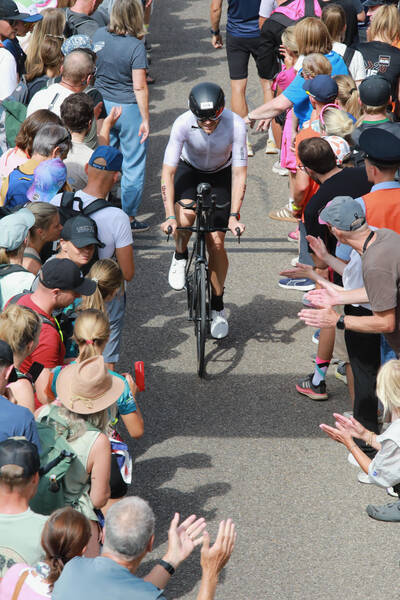
Towards the second half of the hill I hear him say that Kristian Blummenfelt is now at Kränzleinsberg, not far behind. This makes me really push the pedals. The heart rate is up at 175, not good. On the other hand, it’s Solar Hill. If the heart rate goes through the roof at some point, it should be right here. And what can I do, I’m still missing my easiest two gears. I have to push for several reasons.
The data revealed that I was averaging my functional threshold power for three minutes here, going up the hill at 18 km/h. Tough! But I made it up long before Blummenfelt came by. Now it’s time for some more maltodextrin from my bottles to refuel. I’m going through the 500 g pretty well.
The next 13 km between Solar and the swim start feel good to me, and my average speed climbed up a bit again. Somewhere during that stretch, Blummenfelt and Magnus Ditlev passed me by, but it took a lot longer for them to appear than I thought. Thinking about it some more, it makes sense. They average 45 km/h, my own speed is at maybe 33 km/h. That’s a difference of just 12 km/h — roughly the speed of an average runner who slowly gets closer to some defined point. When Blummenfelt passes me, he quickly whistles three high notes to warn me he’s coming. Interesting! Does he do this for everyone he passes, or only those who swerve dangerously, like I might be doing right now without realizing? Maybe I was going too far to the left side of the road. Ditlev, who won this race three times before, was alright with my style of riding and just flew by.
As I’m coming back into Hilpoltstein from the other side this time, passing Bäckerei Schmidt — the bakery everyone loves, I notice the crowds going bigger again. A tiny uphill leads towards the bridge we crossed before, the one from the swim.
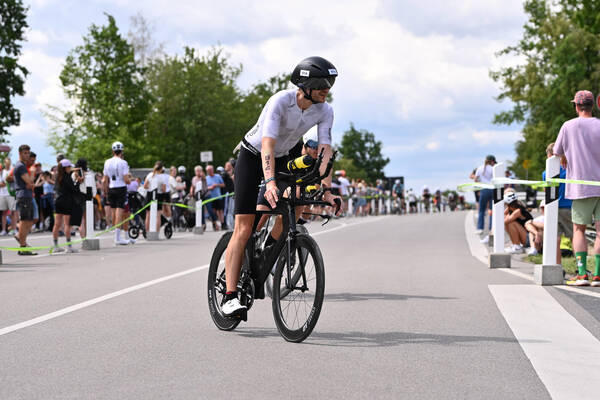
After crossing the canal via bridge, there’s a second crossing we’ve also done before, going over the gates of a lock. At that point, Frederik Funk passes me. He’s another one of the Germans here to make a splash: Rico Bogen, Jonas Schomburg, and Freddy Funk. Of course there’s also three-time world champion Patrick Lange somewhere behind us, but since he’s almost 40 years old now, the young guys are honestly just more interesting these days. Freddy Funk with his special bike and kit even has his own live camera following him on a motorbike, even though he’s placing sixth at this point if I haven’t made a mistake counting. I’m at 86 km, he’s at 170 km.
There are two more pros who pass me before the fork in the road that leads them to the run start and me onto the second lap. Menno Koolhaas as well as Kristian Høgenhaug. I also recognize them right away, being a fan of the sport. Høgenhaug turns to look me in the eyes right after passing me during a narrow passage through a village, maybe also because I was going too far to the left? It makes me wonder. I was under the impression I did pretty well taking care about riders coming by. Now I’m insecure. Must make sure to ride on the right edge in a predictable straight line. I though I was, but maybe not.
For a moment I’m envying the guys now being able to turn right towards the run while I have to go on another lap of the bike course. Still it’s cool to reach that spot, it’s a significant milestone. One lap done, halfway through the bike.
🔁 The windy second bike lap
So far, the stats say I’m averaging 32.4 km/h. This is not the worst, but it’s the lower end of what I had planned for. I know I’m not going to get faster on the second identical lap, and even if I somehow manage to hold that average, I’ll land at a 5:30 bike split. Combined with the slow swim, this means I need to run the marathon in under three hours. I know that’s impossible for me after the swim and bike. Maybe 3:05 on an exceptionally good day. So my chances of going under 10 hours today have decreased to under 5% at this point, I sadly realize.
It’s fine though. I knew this was going to be a possibility and made my peace with it even before starting the race. Besides, there’s another goal still on the table: beating Mathias! I still have no idea what’s happened to him, but so far he hasn’t caught me again. So of course I’m keeping at it, because as far as I’m concerned he could suddenly be passing me by like the pros.
And also, I want to deliver a result today that’s as good as I can possibly do. I trained for that, so I’m not throwing in the towel because of a few hiccups.
When looking at the numbers afterwards, I also noticed how for that 32.4 km/h average on the first lap I had to push 191 W, calculated by Strava. This is more than all the tools I used came up with. It’s hard to tell what happened exactly, but my best guess is the headwinds. Strava knows the weather conditions and factors them into the power calculation. It could also be a miscalculation of my individual CdA, of course. Maybe I’m just less aero than I thought, despite even the shaved legs!
Either way, it’s helpful to have this new reference point for future estimations.
Nutrition-wise, I feel alright so far. I have put the whole front-mounted bottle into my stomach containing 300 g of maltodextrin carbs. There has been enough salt in it, too.
This second lap is a bit boring compared to the first one. Everything is familiar. This is also an upside, because it makes it easier to decide how much power to use on a particular climb. There are more athletes now, the course is full. And the pros are all gone. I’m still comfortable enough in my aero position to hold it.
Nothing much happened otherwise, I’m just pedaling away using the power my body can output. It’s still warm and cloudy, but the wind has increased noticeably. The slight downhill & tailwind section from Heideck to Greding, 103 km to 121 km, felt really good again, I’m averaging 37 km/h over those 18 km. The Greding climb was especially hard without the easy gears, just like before, but with legs that are tired. The U-turns on the downhill I took even more carefully this time because I noticed how my focus drifted away after all these hours. Better safe than sorry.
At the aid stations I only took the water bottles and used them to spray cold water on my thighs, calves, as well as neck. A tiny sip here and there. In hindsight, this was my biggest mistake. Because as the second lap went on, this was starting to become a problem.
🍭 Getting the nutrition right
Suddenly, my stomach just feels very full. So full, I can’t imagine putting any more of my maltodextrin into it. At this point, I must be at around 400–450 g of it. I remember that this can just be a sensation that’s not grounded in the actual situation in my stomach, and it might be better to keep getting nutrition in, so I try to continue as well as I can. During all my Zwift rides and also on long runs, I had tested and refined this type of carb-intake over thousands of kilometers, literally. Why would it now fail? What’s going on?
At the time I thought it might have to do with something I ate the day before. Maybe a stomach bug or so. But now I’m sure that’s not it. The most likely thing I did wrong was not getting in enough water relative to the large amount of carbs.
Carbs can only be absorbed well by the gut when the body is provided with enough water at the same time. At some point this just doesn’t work well anymore, leading to the maltodextrin just remaining there in the stomach, unused. This has multiple downsides, but the biggest ones are that it feels like carrying a blocking weight around with you in the stomach, and that none of the nutrition can reach the muscles anymore, providing much-needed energy.
The result? I slowed down.
In addition to that, the winds had increased by quite a lot on the second lap. The pros weren’t affected by that at all, because they’re all on the run course already. But several others I talked to afterwards mentioned the same thing. Looking at the data later we also noticed a bigger drop compared to the past editions of Challenge Roth. Challenging conditions!
Regarding the GI issues I just told myself to make it through the bike, trying some other options at the aid stations now such as their electrolyte mix, and hopefully during the run all the problems will shake themselves off. It has happened before. The horizontal position on the bike isn’t the best one to get nutrition down, after all.
Cycling up Solar Hill for the second time is of course quite nice, there are still some crowds around. But nothing beats the first lap. And my speed had by now gone down quite a lot. I had to stand up to get up the hill with the hard gears and lowered energy. On the time trial bike with the bottles mounted so high up from the ground this is a shaky endeavor!
✊ The mental situation
Shortly after, it started raining for a while. I remembered that when looking at the rain radar earlier today, Mathias and I calculated that we would be on the marathon course when that happens already — a bit of rain during the run isn’t a bad thing, its cooling effect could be appreciated. But on the bike it’s annoying because it makes the road slippery and the hands freeze with the water evaporating in the wind.
Adding everything up, I was now dealing with a rim brake pad permanently rubbing against my front wheel, my two easiest gears not working, my stomach rebelling, and wet roads. All the while, my sub-10-hour goal had long since gone out the window.
A real test of patience!
And now here’s the final kicker. Exactly eight weeks after today’s race I realized my big bike pump’s pressure indicator has been way off for years. Comparing it with a professional’s tool because Mathias had a hunch when feeling my tires turned out that I was riding at 3.5 bars when I thought I had the recommended 5.0 bars in them. According to a rolling-resistance test I calculated that this mistake alone must have caused about 3–5 lost minutes over the whole course. And it’s been so easily avoidable!
So many things going wrong is unusual for me. Over about forty triathlons I’ve done in the past, I have obviously made quite a few mistakes, but I learned from them most of the time. These here were new. And all happening together. Despite my rigorous preparation — I’d argue this is the one triathlon race I paid most attention to of them all. Some days, you just get unlucky, it seems.
But on the other hand, I’m still here, Mathias has still not passed me, and I can still manage a good finish. At least I think I can. I might even be able to pull off a good marathon once the maltodextrin has gone through, who knows. And cycling over the famous bridge from the start for the last time really feels good now, it’s funny how much positive that can do to you when you’re in a dark spot.
A bit later we reach the fork in the road for the third time. The first two times I had to go to the left to go on the big loop, but now I’ve earned turning right towards the marathon start. This is also a moment that feels really rewarding to me. I haven’t crashed, had no flat tires, and in general I’m relatively well off, still sitting on top of the bike pedaling. Those mishaps I had feel small in comparison to what could have gone wrong.
The final 4 km from Eckersmühlen to Roth usually are an easy downhill, but we’re experiencing full-on headwinds here now, so it takes a while longer. Remember to remove the feet from the bike shoes in time and step off the bike before the official dismounting line in order to not get disqualified, and that’s it for the bike! I made it through!
👉 Roth Bike Split: 5:42:45
Some stats of the bike. The first 90 km took me 2:45, while the final 90 km took 2:57. That’s an average on the second lap of a disappointing 30.1 km/h. Much lower than what I trained for and would have been capable of given smarter water intake and more favorable conditions, mainly.
This is quite a bit off my ideal 5:20 goal, and also even below my worst-case 5:30 estimate. Naturally I don’t feel super happy, but on the other hand, I beat my personal best on the long-distance triathlon leg by over 17 minutes! That’s something to celebrate and put the result into perspective. But right now, that’s not the main thing I worry about. To be honest, I don’t worry much at all right now, so full of adrenaline. My state of mind revolves around the upcoming marathon and how I will just do the best I can to hopefully overcome the stomach pain.
🔄 Challenge Roth 2026: TRANSITION 2, Bike → Run
As was expected there are a lot of volunteers whose job is it to make this second transition as great as possible for us. And again, this works perfectly. Someone immediately steps up to catch my bike and rack it for me so I don’t need to waste any time having to do that myself. As I start awkwardly jogging on wobbly legs, another person shouts: “Nummer nach vorne!” – “Bib in front!” reminding me that they can’t see my bib number unless I turn it around my torso to the front. Right after I do that, someone shouts my number loudly to another volunteer as I take a turn running towards the changing tents. Shortly before arriving there, the other volunteer had grabbed my bag with the correct number and holds it up for me to take while running, again wasting no time at all. A few more meters and I sit down on the bench in the tent with yet another volunteer who takes the bag, empties it, and helps me go over the items I’ll need now.
As with the first transition, and unlike at any other triathlon race, this is super close to optimal planning. I can’t think of anything they could have done better for us, honestly. Transitioning from one sport to the other at Challenge Roth takes the crown, no question.
While I’m on the bench, collecting myself for a couple seconds, the volunteer lady sorts and holds up all my items one after the other for me to choose. Shoes are a no-brainer, they come first. With my special elastic ties I put my feet into them within just a few seconds. Helmet goes off, next to me on the bench. There’s my zip-lock bag containing all the gels — I’ve got five in there with 40 g of carbs each. I take them into my hand. Sunglasses on. I’ve got a few more extra things in the bag for rare situations, but I feel like I need none of them for the run. So that’s it, I can just leave while the lady puts the remnants back into my bag for me and stashes it with the other bags. Done and out of the tent!
👉 Roth Transition #2 Split: 1:36
This was a super fast transition. Before starting the race I pessimistically estimated around five minutes per transition, but I have halved that today. Both transitions taken together just took 4:33 minutes. According to the stats, this second transition of mine was the 175th best out of all 2,606 male finishers — now that’s something to be proud of! Bike to run transition king! But the race still goes on, there’s a marathon left on the table. Let’s do this.
🏃♂️ Challenge Roth 2026: THE RUN
👟 Running Gear
The choice of racing shoe has been on my mind for the past six months, at least. Finally, in March, I decided on a model I felt fully comfortable with and which I thought might give me a few saved minutes. It took a little while to decide and I seriously tried a few pairs, but the winner has been the HOKA Cielo X1 3.0. I bought it for a very good price during the days I spent in Tokyo for Tokyo Marathon — the big advantage for us Europeans is a currently quite weak Yen compared to the Euro, so the decision was made a bit easier. But who am I kidding here, the way I do endurance sports certainly isn’t the one that centers around saving money. I’m not even sure anymore if it’s still cheaper than therapy would have been.
On the plus side, the run gear list already ends here. Compared to the swim and especially the bike the cost of the run is a joke. Just shoes and that’s it. Which brings us to the next chapter.
📊 Run Training
This has been a bit of a mixed bag. My plan for the season has been to focus on run training during the first few months of the year and finish that off with a new personal best in the marathon in Barcelona in the middle of March. Afterwards I wanted to basically try to hold the good running fitness while focusing on and building up my cycling endurance.
So far for the plan. Originally, I wanted to run a straight 4:00 min/km pace in Barcelona, leading to a 2:48-hour marathon, but the long winter and icy roads made that very tricky. In the end I still got some good training on dry asphalt into my legs and achieved that PB, but not the big one I hoped: it was a 2:53-hour result in the end. Conditions in Barcelona were great, no excuses except for the long and cold Hamburg winter during training.
A few weeks later I also managed to do a new personal best in the half marathon, finishing after 1:21:05, missing my goal to go under 1:20 by not that much. Although both results were not exactly what I wanted to accomplish this year, I was still proud of the jump I’ve made compared to the previous year and the basic running fitness I accumulated.
Afterwards, my plan to focus on my Zwift bike worked to a degree. I did another two fun marathons towards the end of April and of course still ran every single day, because I’ve been on a running streak for over four years now. Adding bike intensity to my weeks inevitably led to my running form suffering. I noticed that during May and June, where I felt tired and had to deal with cramping during the swim training — possibly due to too much training load. Going from about 10 to 15 hours per week of sports is a jump that my body was able to do for a few weeks, but after a couple months it let me know that it might have been too much at once. I know that now.
At the time I also noticed the signs and dialed it back a bit by omitting intensity on the run — no intervals, no tempo runs, just easy zone 2 running. It prevented me from overloading and was a good solution.
⛰️ The Schinkelspark hero session
Three weeks before Roth I decided I wanted to do one big long run session in preparation for the marathon and went for a combination of some uphill and downhill intervals and a long race pace segment towards the end. It was supposed to give me a fitness boost as well as a boost in confidence.
This workout was a suggestion by Mathias, he did a very similar one. The idea is to look for a long-ish uphill stretch, at least 1 km in length but not too steep, run upwards as fast as possible, rest for a minute, run down as fast as possible, rest for a minute, repeat. I used that to build a long run. The hill I chose is about 1.5 km long and offers 45 m of gain, that’s an average gain of three percent. I ran up at 4:45 min/km pace and down at below 4:00 min/km each time. After five of those repeats and a minute of breathing at the bottom of the hill, I did 8 km flat at 4:25 min/km, which I hoped would become race pace in Roth. Including a 8 km warm-up to reach the hill from home and a short cool-down after the race pace interval, it came out as 30 km total.
It was a big day out but really triggered my body to go into super-compensation. See the workout here on Strava. I felt like if I can get this one done, I’ll do just fine on the hill up to Büchenbach near Roth!
🧪 Test Race: Vierlanden Triathlon RUN
My run during the test race in Hamburg two weeks before Roth was plain amazing. I came out of T2 feeling great, had just had another gel with a total of 220 g of mainly maltodextrin-based carbs during the bike, got into my previously forgotten socks and the HOKA race day shoes and stormed out onto the 4-loop course, 5 km each. A 20 km run, just short of a half marathon is on the menu here. My plan was to run at Roth effort, slightly below 4:30 min/km. But I decided to go by feel instead and not look at the watch at first. After a couple kilometers I had a look and found out I hit the pace spot on the nose, 4:27 min/km so far, while feeling like it’s nothing. So I decided to just have fun and not play it safe. Worst that can happen is I blow up later and learn the lesson. But going faster just feels so good I hit the gas pedal.
I went up to 4:15 min/km and then near the 4:00 min/km mark. This is an effort, but controllable. The shoes feel good, the calves aren’t cramping, the legs are fine. It’s super hot, but they have a mobile continuous cold shower at one of the aid stations I use three times to cool down. Water in the face, some also into the stomach, some coke and two more gels of 40 g of carbs each is all I need to keep it going. My heart rate moves from 160 to 165, about 82–85% of my max. Towards the end I reach 170, 87%. I need to breathe audibly, but it’s sustainable to keep the 4:15 min/km average. I went through the last 10 km of my Barcelona Marathon personal best earlier this year at a heart rate of over 180, which was insane but also worked out fine without me falling apart, so I was confident here to make it. In the end I finished after 1:25:22 for the 20 km run and 4:38:45 total for this test race consisting of a 2 km swim, an 80 km bike, and this final 20 km run. Today that was good enough to place 32nd of 169 male finishers, 5th in my age group. But my run was good enough to even be the 7th fastest of the day — very proud of that.
I learned a few things during this test. First of all, how great of an event this is! Next year, if it fits my schedule, I’ll be back. I also learned that I was able to significantly improve my bike power by Zwifting virtually for the past months. All those hours paid off. The swim was atrocious, sure, but that was partly due to circumstances I couldn’t control — the non-wetsuit rule. My bike and run combo is really powerful compared to what I’ve done in the past.
I also learned that the carbohydrate intake is tricky, especially on the bike. This worked really well on the Zwift bike, but in order to get in more carbs on the real bike, I needed to make sure not to drink too much water, because my stomach would otherwise overflow in this horizontal position. Of course, as you already know by now, this was the wrong conclusion. But this is where that idea came from — because I didn’t have any stomach issues during the run I figured I did this correctly. On the bike I had about 220 g of carbs and just a liter of water, despite the heat of the day. And I felt good. I guess because the race was so short compared to Roth, I didn’t run into any issues with that here. After all, 4:38 is just about when the stomach issues in Roth started. Here, the race was done by then.
So when I say ‘I learned a lot’ it also means I learned some things that turned out to be wrong.
But regarding my race setup, I was extremely happy. The aero position on the bike felt sustainable, the whole bike setup was super fast. Of course, on the flat roads here I never needed to use the easy mountain gears, so I falsely thought everything was well adjusted from a mechanical standpoint, too. The only adjustments I made after completing the test race were centering around nutrition. How much salt to add to the two carbs bottles I prepared, for example. How many gels to carry for the run. Everything else felt like I had it under control.
Now let’s see how that run went in my main race, two weeks after this test.
🏃♂️ The Challenge Roth Run Leg
I ran out of the transition zone on a little high. Mainly because I was happy about not crashing on the bike and finally being able to show my strength — the run. Of the three disciplines, it’s where I usually shine. The fast transition also felt really good and gave me another little boost. The first few hundred meters of the Roth run course are on a slight downhill, adding to that feeling.
Crowds are in high spirits, weather is nice, and a look at the watch reveals an effortless 4:30 min/km pace. Will this run work out well after suffering through all the troubles?
My stomach still really hurts and I can’t get myself to eat any more gels for fear of throwing up immediately. But the cramping isn’t painful enough to require me to stop or slow down right now, so I decide to keep up the pace. Hope is there that the problem will solve itself somehow during the run.
My pace is worth something here today. I notice how it allows me to pass many other athletes and not get passed by lots. Of course the question is: can I hold it? After about 4 km we’re reaching the canal at the industrial area called Lände. The canal will be the hero of the next 20 km. Yes, the course routing isn’t the most creative in Roth, but at least it’s easy to navigate. The first aid station that offers coke is great for me. The one drink that reliably can solve gastrointestinal issues. I have a couple cups and really hope it will mitigate the pain I still have. So far, nothing has changed. My pace remains stable, but I’m surprised about my low heart rate. It’s in the mid-140s. It should be at least ten beats higher. How is that possible? In hindsight, it’s probably because my whole body was focused on solving the stomach issues and not much energy was left over for the legs.
After a couple kilometers next to the canal, I notice the pain intensifying to the point that I feel the need to run hunched over. That’s unfortunate as it’s the exact opposite of what I had hoped would happen during the run. Close to the first U-turn there’s a porta-potty I try to make use of. I waste about a minute in it but there’s no relief. Continuing the run, the pain stays the same. I tell myself I might just need to stay patient, and at some point it’ll get better. My pace starts to suffer, I’m moving down to 4:50–5:00 min/km, the heart rate also moving slightly down towards 140 flat. This is odd, that’s usually my easy pace and heart rate and far from the effort I am capable of. The oddest thing is that it feels like there’s nothing I can do about it. It feels like I can’t increase the pace. This is just what I’m capable of.
My analysis is that the massive amount of carbs that was still stuck in my stomach just didn’t make it to my bloodstream and into my muscles, which is why my body had to go back to use fat as the main energy source. The heart rate and pace fit that theory very well. It’s my all-day easy pace. But definitely not what I came here for! Naturally this frustrates me. The run is supposed to be my strength! Two weeks ago I was the 7th fastest guy out of 169 males, I can’t be jogging like I’m on a Sunday stroll along the canal here today, this sucks!
Marathons are long, though. Maybe the ball of carbs will dissolve in time and I’ll finally get to show my real pace on the latter half. I tell myself that it’s not the worst that I’m still on my feet moving forward. I’ve heard so many stories from people who quit due to GI issues, but I’m determined to make it through despite those. As long as I can run, I will run. It’s just a pain, after all. Nothing serious like a broken leg or something.
After the U-turn we’re moving north for around 10–11 km and I notice we’re going into headwinds now. That adds up with the situation on the bike before. It’s not really an issue on the run, though. But then, a surprise.
🙌 Mathias! Finally!
He is giving me a big smile and we’re having a loud high-five as we pass each other. Because I know how far I am beyond the first U-turn, I can quickly guess that he must be about 15–20 minutes behind me. It’s great to see him and it definitely lifts my spirits, but I’m wondering how he can be this happy with the odd situation that I actually beat him on the bike course. We talked about it before and his stated goal was to enjoy the race today and not get stressed out by the numbers, but still it’s just been so unlikely that he was cycling even more slowly than I was.
I also see in his face how he must have already calculated that my sub-10-hour goal isn’t possible anymore now that he meets me here because he knows the numbers and the course. He asks me if I’m doing alright and I raise a shaky thumbs up without really believing it. On the other hand, I’m still in the race, making progress, this is better than a lot of other possible outcomes of today.
🧊 The crushed ice zip lock trick
Back at Lände aid station, about 13 km into the run, I finally use an ace up my sleeve. It’s been making the rounds that carrying a cheap kitchen zip lock bag with you on the run is a very helpful tool. The gels can go in it at first, making the transition easier. But when that’s all sorted, you’ve got an empty and sealable bag you can use for storing some ice! During the midday heat right now, that’s perfect. We’ve got high humidity and cloudy skies and around 25–28 °C, you can feel the atmospheric pressure weighing down. I get some crushed ice into the bag and put it on my neck, squeezing it between my skin and race suit.
This is a shock at first but I notice how it distracts my body really efficiently from the stomach pain! What a clever idea that was.
It works so well I decide to take a risk 1 km later. Eating my first gel of the run. This is way past what my planned rhythm would have been, but you know why. I go for a caffeinated MNSTRY Cherry gel which has 40 g of carbs. It goes down okay and I’m really glad about that. But will it work?
It doesn’t change anything, unfortunately. More coke at the aid station, some water. I also go for some salty little pretzels which just feel good and may help settle the stomach. I also carry a few salt pills with me, but I have a feeling that too little salt really isn’t the problem today.
The second turn-around is reached after 18.5 km. There’s loud party music and more spectators around than I remembered from the last time I ran this race nine years ago. The popularity of these events surely has jumped up a few levels. After turning back south I notice how we’ve had headwinds for the past hour and that it has now stopped. Very nice! The pace and heart rate are still stable at just under 5:00 min/km and 140 beats per minute. With every ongoing kilometer I find this more strange.
At about the halfway mark there’s another opportunity to step into a porta-potty. The issue is getting out of the tight race suit, but I manage. I lose another minute here but there’s some relief, finally. Stepping out of it, two volunteers are already waiting for me to help me get back into the sweaty race suit — one per arm. This is just amazing how much they are proactively helping here at Roth! I tell them so but they just laugh it off. Oh man, Roth. This really is the place. Of course during the past hour the thought of dropping out of the race crossed my mind a few times, but when experiencing these volunteers that’s another reason to keep going.
The mantra has become: As long as I can run, I will run.
I repeat it in my head whenever I’m at a particular low or feel the cramping in the stomach again.
About 1 km later I meet Mathias for the second time during the run. I lost one or two minutes because of the little break just now, and it feels like he has closed in and might be less than 15 minutes behind me now. Somehow, that’s additional motivation for me to keep it up. As I see him I shout “BÜCHENBACH!” at him — the famous little uphill section that’s coming up later. We told each other that in order to run a good marathon here, you will need to think about that part during the flat and easy canal in order to not get overexcited and waste energy before you’ll really need it.
It’s funny how close the positive and negative emotions are during these intense events. Not long after meeting Mathias I’m in a big low again. The heat, the high humidity, and now some more rain. The sky darkens fittingly. Of course some thoughts appear, such as “why I am doing these stupid things” — “how did I miscalculate so much” — “what exactly was it I did wrong” — “these stupid cramps aren’t worth it.” And some thoughts even go a bit further, when I remember the poor swim training with the calf cramps and the less than ideal bike split I did today. “I’ll never swim again and on Monday I’ll quit that stupid Zwift subscription! I’m never going to do a triathlon race ever again!”
A few days later, that reaction is really funny to me. It also shows how big emotions can cause very bad decisions. Never make big decisions while emotional!
🍺 Third time at Lände
After 25 km we’re about to leave the canal behind us. The Lände aid station is a big one with loud music and party people making noise. I like it. It’s sponsored by Erdinger, one of the two beer companies sponsoring Challenge Roth. I would have loved to have one right now, but unfortunately they are only offered at the finish line. Another big reason to keep going. Psychologically, reaching this point is really helpful, too. The next sections of the course are going to be a lot more interesting and we’re way over halfway through.
But then, some more rain. There’s a short out-and-back section just before re-entering Roth that’s about 1 km long. It’s in between big trees and the dark sky and rain make for an ominous feel while also soaking me to the point that I start to freeze for a bit. My pace has gone down a little to just over 5:00 min/km now, and the heart is also lower, just above 130. This is getting ridiculous. Of course if the heart rate is so low, it won’t be able to create enough heat to warm me up. Thankfully, the rain is over after five minutes and what’s left are a few puddles soaking my feet, but that’s really easy to deal with. After the rain has stopped, the warm temperatures manage to solve my lack of body-heat quickly.
This little event reminds me that stopping to DNF would be quite stupid. I would start freezing immediately, I think. Better to keep going to keep warm! Two and a half hours into the marathon, the stomach pain is still as present as it’s ever been, though. Occasionally I have to hunch over to make it through a cramp. I can’t get any more gels into my body and just keep relying on coke at the aid stations. Refilling the zip lock bag with crushed ice and putting that on my neck is good for 10 minutes each time, distracting from the stomach pain. So the improvement of my digestion issues is just not happening.
But now we’re entering Roth, and the crowds are crazy here. All the roads I know, the cobblestones, it’s just very cool to be here.
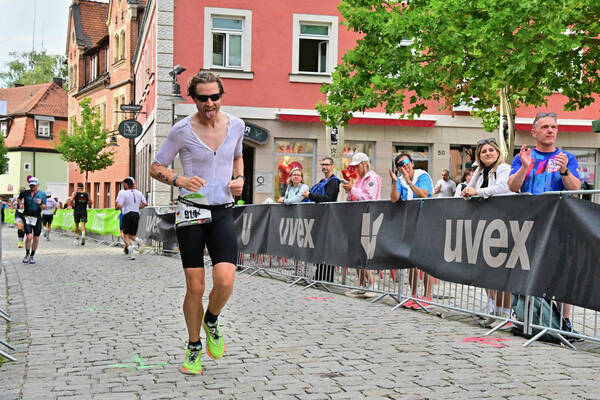
Just behind the city center, 33 km in, on the way to the uphill section towards Büchenbach, I stop for a third porta-potty break. Maybe now it’ll work. Two more minutes wasted, but no success. No other option than to keep fighting, I think. Let’s run up that hill!
⛰️ The Büchenbach section
The hill is a joke for someone who does trail ultras, of course. But it’s all about context. I’m doing alright here, my pace goes down to 5:30 min/km over these 2 km without any other issues. Many have to walk.
After the climb, the famous lap around the little Büchenbach lake is next. This is usually a great occasion and also right now a party hotspot, but I can’t really enjoy it due to the pain. But I’m still in the race, determined now to bring it home. It’s just 5 km remaining after the turn around the lake back to Roth. I know I’m probably about to see Mathias again soon because the road is the same up and down as well, just like before on the two U-turns along the canal. I expect him to have made up some time because I had three porta-potty breaks so far, adding up to at least five minutes.
We meet during the hilly section, as expected. He’s going up, I’m on the downhill. Seems to me like the distance hasn’t changed much. I have a feeling that he’s not going to catch me before the finish line, so that’s a motivational boost.
On the downhill I move back to below 5:00 min/km pace, keeping it stable. The final 3 km lead through the town of Roth again which still is the center of a huge party. And now that I’m confident I’ll make it, finally the hint of a smile appears on my face despite the pain and poor time. The noise coming from the finish line stadium can be heard all over town. Crossing the famous train tracks, onto the green carpet, passing one final guy during the entrance into the stadium and then I get to do the wonderful finishing lap.
Man, I feel like I’ve earned that one today!
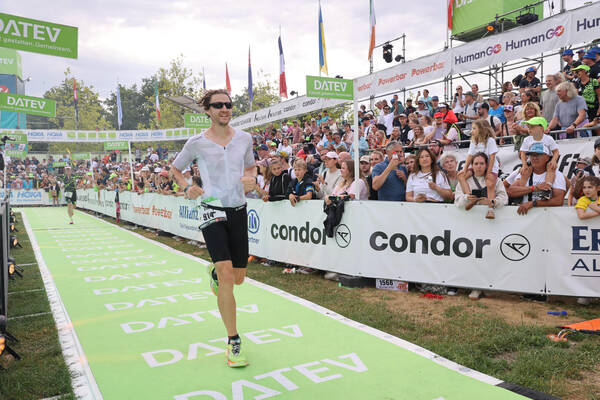

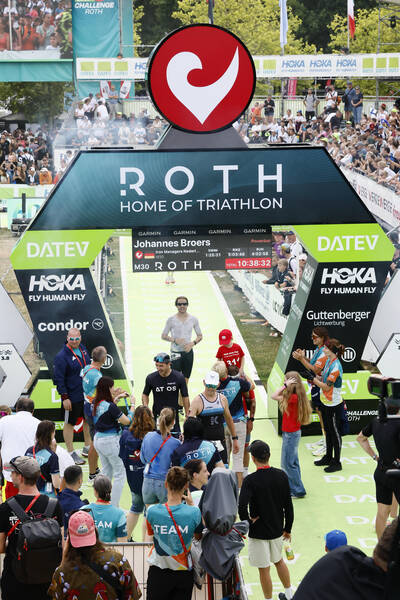
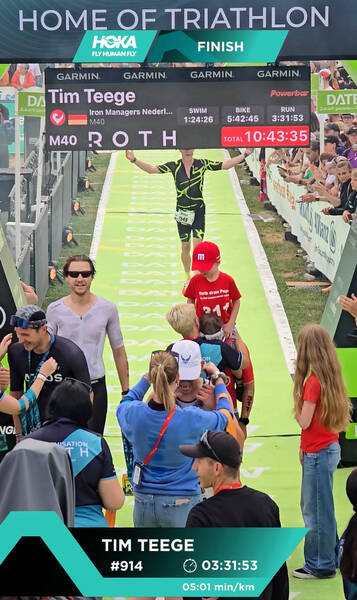
👉 Roth Run Split: 3:31:53
Right after crossing the line, the relief I feel is by far the biggest emotion. I’m not really proud or even that happy, just glad I made it through it on this terribly difficult day.
😔 The Post-Race Blues
The non-wetsuit swim and calf cramp anxiety, the mechanical issues and headwinds on the bike, and finally a marathon under continuous stomach cramping.
What a fight this was!
I’m so much slower than my realistic goal of 9:59. In the end I crossed the line after 10:43:35, nearly 45 minutes off. I underperformed on every single one of the three disciplines. This hits hard and makes me sad. There’s a tiny bit of pride about having made it through the full race despite all of the problems, and also about beating Mathias, but the sadness kills it. I’m mainly glad it’s over right now.
At that moment right after finishing, I wasn’t sure why the bike split was so slow and how the stomach issues were caused, so that just added to the confusion and disappointment. Now that I have compared the bike times to those of years with normal winds, I know better.
It has been a tough day for everyone, except for the professionals — they were already running when the real winds started on the bike course. By the way, during the last bit of the run I met Nils Goerke, cheering near the city center of Roth, and quickly asked him about the pro results. Sam Laidlow won in a dominant fashion, setting a new world’s best time for the long-distance triathlon, followed by Olympic champion and former holder of the world’s best time, Kristian Blummenfelt, and in third place — something I loved hearing — young Rico Bogen on his long-distance debut! Just a couple minutes behind the incredible Norwegian, KB. Rico is going to be the one to look out for in the future.
The women’s race also offered a slight upset. A very strong performance by Alanis Siffert, a young lady from Switzerland, secured her the win. She came in front of three Brits: former world champion Lucy Charles-Barclay, newcomer Daisy Davis, and the very strong Pro Series winner of the past year, Kat Matthews. In fifth place, I was happy to see Caroline Pohle on her long-distance debut. Also a promising start.
But right now, sitting down at the tables outside the huge festival tent wearing my new finisher shirt, the most important thing to me is getting my stomach in order.
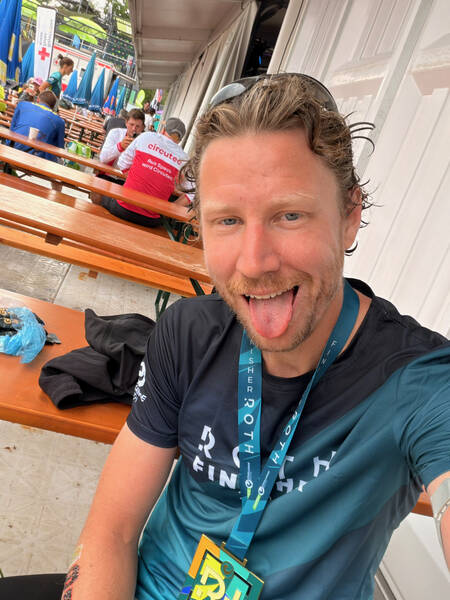
Fortunately, stopping the running brought some relief right away. Finally my body has the energy to focus on solving the problem. Oddly enough, I start getting hungry really quickly. The buffet here inside the tent is also something I have looked forward to for long periods — it’s notorious for offering every single thing you could want right now. For me, that’s some bread with cheese and sour pickles on top. Delicious. And of course, the Erdinger zero-alcohol beer I was longing for during the run. It hits the spot.
The guy sitting next to me looks at me and suddenly lights up: “Hey, aren’t you the guy who puts together Munich Breweries Ultra every year? I was there last year!” — he’s not wrong, I am that guy. It’s an 80 km run through Munich featuring the seven Munich beer breweries and a glass of each. My friend Nico and I started it six years ago and last time about fifty people joined, the guy sitting next to me at the Roth finish line among them. Small world.
Mathias is nowhere to be seen, but I’m not worried. He must be doing his thing, I figured. We’ll eventually run into each other somewhere around here, I’m not planning on leaving before I’ve used all the amenities and ate everything from the buffet. A shower does wonders, too, and I also go and get a free massage for my legs which is great, followed by some more cheese and yoghurt and beer. Wonderful. Life slowly starts to feel great again.
💉 Mathias appears from doping control
About an hour has passed when he finally showed up with a new story to tell. Roth is among the few races which also check amateur hobby athletes like us for using illegal performance-enhancing substances. He was randomly selected right at the finish line and had to sit in a room for 40 minutes and give the folks some of his clean blood. We were both joking about why they chose him and not one of the guys who actually performed well enough so it’s suspicious. His finishing time ended up just a few seconds under 11 hours, so I beat him by about a quarter of an hour, as expected from the impression I got when we saw each other on the course. It doesn’t feel like a win, though. But we’re both happy to have finished.
He couldn’t really tell what went wrong except for a small cramp during the last bit of the swim, and just not finding good legs today on the bike in addition to the winds that attacked us all. He said his legs just happened to feel empty and he wasn’t able to pinpoint any causes for that. It just wasn’t his day, either. But since his goal wasn’t time-based and instead he focused on enjoyment of the event, he got exactly what he wanted today. He wasn’t excited about the result, for sure, but very excited about having spent a nice day outside doing sports. That’s the way to look at it. He’s quite proud of his strong marathon, which was almost exactly as fast as mine today, 3:32:08. He didn’t need any bathroom breaks like I did and he didn’t suffer any GI issues, so I can understand how he’s happy!
I also eventually reached that point of just being grateful for a wonderful weekend and for being able to do long-distance triathlons at all, but it would be a few more hours until then.
🥳 Turning the Blues into a Eurodance Party
Before I’ll talk about my conclusions of today, here’s how the day ended. Mathias and I hung out for a while before doing the bike checkout and storing our gear in my car right when the sun went down. This was about the time when the finish line party really went off, and as exhausted as Mathias and I were, we were also determined to make the most out of everything this weekend had to offer. So we stayed for the full thing, and it was totally worth it.
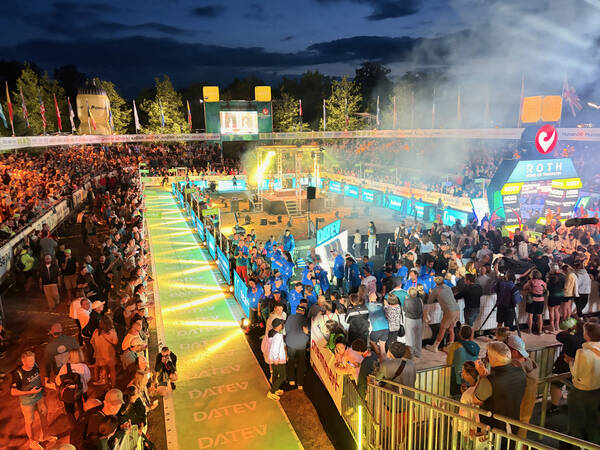
The majority of the professionals had also reappeared and greeted every finisher, hanging medals around their necks.
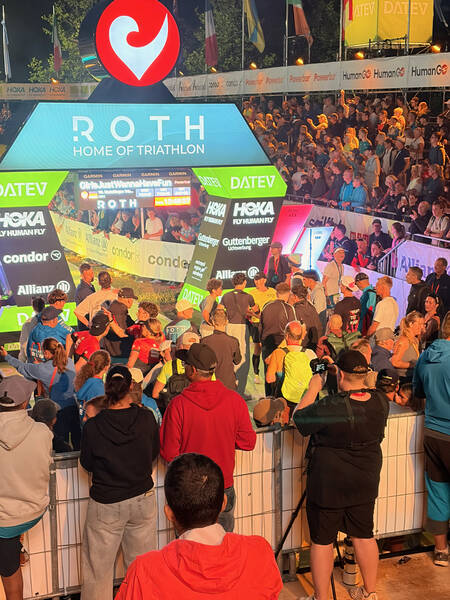
It is always quite surreal that we get to do the same race as all the athlete heroes of ours are doing here today. And they’re just hanging out here with us, as well. At one point, Kristian Blummenfelt, the absolute legend of the sport, just nonchalantly walked by us in the stadium.
The pyrotechnics, laser show, and party music created quite the vibe. But my favorite part was the final speech by Felix Walchshöfer, who climbed up the central stage together with his sister and mother and the about 15 people who work at the Challenge Roth company year-round to make this event happen. Needless to say, the crowds really showed their appreciation for this incredible team and what they do for us and there definitely were some tears involved. You really don’t get that at any other triathlon race I’m aware of. I wonder what it’s like at the IRONMAN World Championship in Hawaii though.
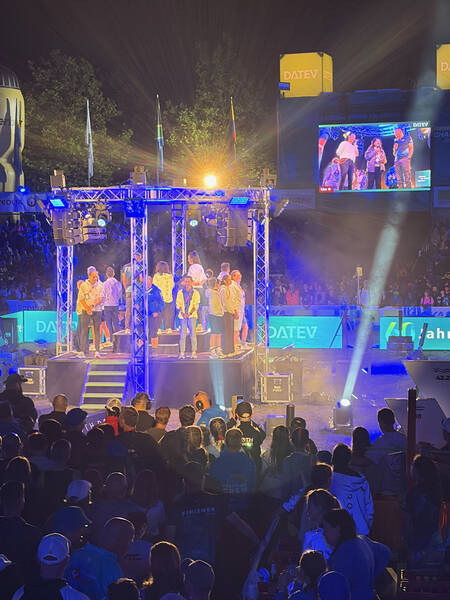
And the final big thing they added to the lasers and fireworks this year was a newly created drone show. The drones recreated some of the famous parts of the course, such as the swim start with the big bridge, the Solar Hill crowds parting, and the canal. I’ve never seen one before and I thought it was a great end to this intense day. All taken into account, it truly has been a remarkably positive day. I’m glad that this has been the feeling I took home.
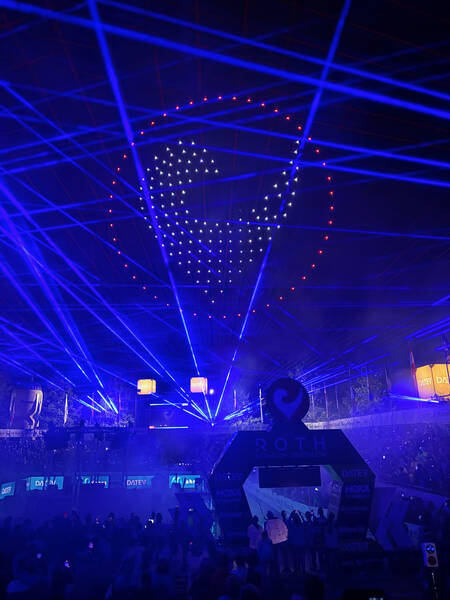
📊 The Stats, We Need the Stats!
First, here are my official split times.
Although missing my goal time, the result I got away with was arguably not a bad one. I improved my own personal best on the long-distance triathlon from 11:26 to 10:43, that’s 43 minutes faster, or about 5.6%.
Amongst all the 2,614 male finishers, that result was enough for placing 960th, a top-36% finish. Within my age group of M40–44 it was top-41% — comfortably within the top half.
My swim was bad, but the non-wetsuit situation made it a slow swim for everyone except the really good swimmers and pros. In the end, I was among the fastest 52% of the men in the swim, quite near the absolute middle.
My first transition was great, a top-17% result.
The bike was horrendous due to the cramps on the final hour and the missing gears and rubbing brake pads, but everyone else also suffered from the headwinds like I did. It was good for a top-56% time among all men who finished.
Now, the second transition was where I really took the crown. My 1:36 minute transition to the run was a top-5% result! So 95% of all the men switched from bike to run using more time than me.
And for what it’s worth, even though my marathon was terribly painful and only fueled by coke and pretzels instead of the high energy gels I carried, the 3:31 were good for a top-18% position in the field of men. To think what I could have done here without the nutritional mistakes I made!
By the way, only 16% of all men managed to come in below 10 hours today. It would have been a near-elite achievement to get this done under these conditions.
On the drive home the next day, Mathias worked his spreadsheet magic and compared the Roth race results of this year to those of the previous few. We wanted to know what caused the bad results because we both felt that we couldn’t really have been that bad. And the data confirmed it to a degree.
We found the following:
The swim was a lot slower than two years before. Last year, it was also too hot for wetsuits, so the results were comparable, but compared to the wetsuit-legal swim of 2024 when the median man swam 1:13:21, the median man swam 1:23:30 today. That’s just over 10 minutes slower due to the lack of neoprene. This is fairly close to the 9:30 minute non-wetsuit penalty the Triathlon Magazin had empirically researched.
The bike was also slower this year when you compare the median man’s result of the different years. Under wonderful conditions in 2024, that person in the middle biked a 5:25:20. In 2025 it had been very hot, but not windy, and the median man biked 5:30:50, five minutes slower. But this year, 2026, the median man’s result was a 5:35:58! That’s 10 minutes more compared to the favorable conditions of two years ago. It really does make a difference. So far we have lost 20 minutes total just because of the weather.
The run was fairly equal over the years. Under the nice conditions of 2024 the median man ran 4:00:01, during the hot 2025 it went down to 4:07:10, and today we’ve landed in the middle at 4:03:34. I assume the slightly slower run compared to 2024 might have to do with heavier legs from the tougher bike for most people.
Just for fun we also compared the results of the top-25% man between those three years. As expected, the drift was also apparent, but not quite as big. The fitter you are, the less some conditions affect you. For example, that man only lost 7:36 minutes in the swim and not about 10.
To remove any possible statistical errors we also had a look at the make-up of the age groups. If, for example, 2026 would have had twice as many men in the elderly ranges, that might have explained worse median results. But we found that the distribution between all age groups was just about the same in all three years we looked at. The finisher and DNF rates were also nearly the same.
So it seems like a lot of it is down to luck when it comes to weather conditions. No big surprises there, but it’s interesting to see what a difference it makes in the end. So when I missed my goal of going under 10 hours by 44 minutes, about 20 of those were arguably only because of the weather. The remaining deficit was certainly due to my own faults, mainly the nutritional mishap, but I didn’t horrifically miscalculate. That was really good to know.
💪 What I Did Well
On that note, it really wasn’t all bad. In the heat of the moment it sure was frustrating to deal with all the issues, but afterwards, with a cool mind, it’s a lot easier to put things into perspective.
- The biggest measure of success is of course beating my own personal best on the distance by 43 minutes.
- I managed to get through the swim without any cramping. It took a lot of patience, but I did it.
- I was also really happy about my two really fast transitions and messing nothing up during those, especially the second one was world-class.
- The idea to take a zip lock bag and fill it with ice for cooling my neck was brilliant and helped me through some dark times on the run.
- My bike setup worked out really well in general. I had no pain in the neck or lower back and was able to hold the aero position for around 95% of the whole ride. Also, no saddle sores! A little bit of numbness in the groin area but I have yet to find anyone who has fully solved that. It also wasn’t a problem anymore right after starting the run. The bike fitting was alright.
- And even though I had cramps in my stomach and couldn’t eat any gels, I ran through the whole marathon, never slowed down to a hike, and kept that 5:00 min/km pace average up.
- And the most important thing: I didn’t give up. Non-wetsuit, winds on the bike, cramps on the run — and I still made it to the end even though I knew my primary goal would be impossible to reach before even ending the bike part.
This is an effort I can be proud of and I will remember it.
🚧 Things I Need to Work On
- Obviously there’s the nutrition bit. What worked really well during all my basement bike training and also on the successful test race didn’t work in Roth. Now I know I really need to watch the water intake in relation to the carbs. Or go less hard with the carbs even, just to be safe. Both require some testing over very long rides, but that’s alright.
- Take a closer look at the bike mechanics. Test all the gears, check the brake pads more rigorously. For Roth, it might even make sense to get some easier gears to save some energy on the climbs. And get a new tire pump with an accurate pressure indicator.
- The bike position could have been a bit more aero, I think. Saddle higher up, arms somehow even further in front. I think there are ways to achieve this on the old bike using some custom extensions. Maybe that will also allow for easier digestion.
- And if I should really want to prioritize an optimal performance at all costs, I would need to skip a bunch of activities during the days before and relax instead. But I’m really not sure I’m prepared to give that up. Especially Roth is just such a magical place that missing out on all the expo and live podcasts and selfie opportunities and new gear fun would seem like blasphemy.
- Some super tiny additions would have been to get brand new Orca swim goggles, because they don’t fog up for the first few hours of usage and are only €30. For an important race, that would have added lots of comfort at low cost. On the same note, I could have brought my comfortable pillow to sleep on at the homestay. I feel like my sleep during the nights before the race wasn’t great.
- Other than that, the only thing I can think of would have been performing some kind of spiritual dance to make the weather gods happy and provide us all with fast conditions on the next race day.
🌸 How Do I Put This Into Context Regarding a Possible Hawaii Qualification?
Finishing after 10:43 instead of 9:59 at first really killed my ambitions towards chasing a qualification for the World Championships in Hawaii. Before, my loose plan was to prove I can go fast on the long-distance today and then start chipping away 5 minutes of the finishing time each year. Combine that with automatically growing older and entering a new age group in 2029, in theory I would be competitive for a Kona slot by then. In the M45–49 age group, these slots often go to athletes who finish after around 9:30–9:45. That’s not worlds away from today’s 9:59 goal.

But since I missed the 9:59 by such a wide margin, my thinking changed.
Sure, on an easy day with smarter nutrition I might have made it happen, but I can’t know that. And weather affects all the races, always. The question I need to ask myself is, did I enjoy the process?
And this is where I’m torn. I enjoyed the training. All the little puzzles to solve before the race. To me it felt a little bit like building Lego. But standing at the start line with a beautiful Lego tower to present just before having it knocked over by the heat and winds and excessive maltodextrin consumption wasn’t the best feeling.
Chasing the time-based goal during the race wasn’t as much fun as I thought it would be. The thoughts I had during the race revolved around how to get the bike average up by another 0.3 km/h or how to make up the time on the run later on. It wasn’t about enjoying the moment and making the best out of it. And this would be the same feeling when I would start to actually chase the good age group positions in order to get that ticket to Hawaii. The sport would become much more like a job, I think. It would also require me to go to remote IRONMAN races because they tend to have less competition for the available slots. Europe is full of races but also full of really fast hobby athletes. My friend Ulli recently qualified for Kona by going to Florida and racing an IRONMAN over there. Do I really want to fly around the world every year with my full triathlon setup right now? I’m not so sure, it sounds more like something I might enjoy together with Sophie when the kids are out of the house, in about 10 years. By then I will also have moved up yet another age group, making it easier. I just need to make sure to stay fit. That’s how Ulli got that coveted ticket.
Another reason for me to rethink the goal is the behavior of the IRONMAN brand. It’s always been a love-hate relationship. They have made some progress by changing CEOs recently — the new guy is much more open to positive changes, but they have also raised already high entry fees everywhere. The Hawaii slot currently costs around $2,000 alone. Seems excessive, especially when compared to what you get here in Roth for about a third of the fee. And I can just drive down to Roth with the bike in my car instead of flying around the world to maybe qualify at an obscure race which has like twenty volunteers and treats you like an animal to extract money from.
Still, Hawaii is iconic for people who love triathlon. It’s surely also a place worth going to. The livestream every year shows off its natural beauty and culture really well. I’d love to someday be there. But right now I feel like Kona 2029 is turning into Kona 2039 or maybe even 2049. A reason to stay fit and see what the future might bring.
👉 And in the Meantime?
Roth. Roth all the way. This race is the best.
When Mathias and I left the afterparty and walked back to the car we came by the queue for the traditional Monday morning registration for next year’s edition. On Monday right after the race, at 9:00 am sharp, the offices open up to offer exactly 1,000 tickets for the race in a year to those who are physically present.
And what happens here is a testament to the quality of Challenge Roth. This year’s queue was reportedly 1,700 m long. People brought tents and mattresses and just slept there next to the road for a ticket like it’s 2008 and there’s a new iPhone.
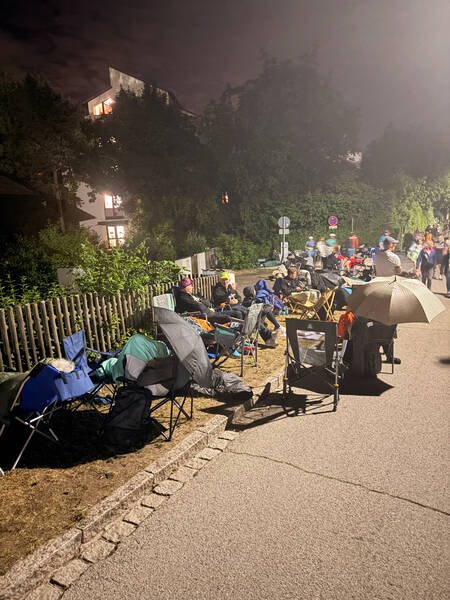
Mathias and I weren’t going to join this overnight experience, but we agreed that it’s worth it. The team around Felix makes this day so special, it’s just an exceptionally great way to spend a weekend during the European summer.
Triathlon is still lots of fun to me. There are more puzzle pieces to put together in order to have the result I’m truly capable of, and I know I’m not there yet. But I also want to take some inspiration from Mathias, who was able to just enjoy the day without worrying about his poor result on a difficult day. Finding the sweet spot between the two aspects is tricky but possible.
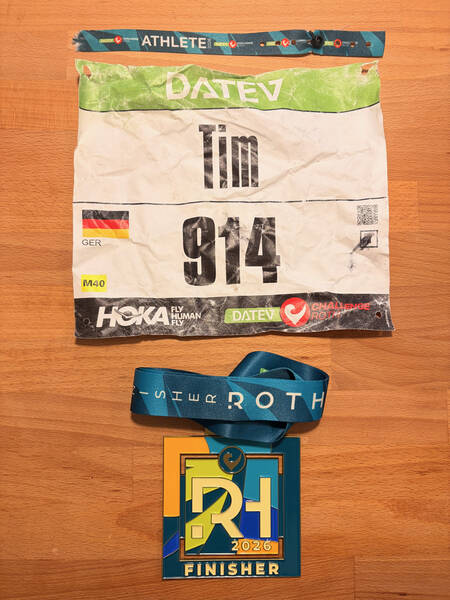
🏃♂️ The Week After Roth
Some people fall into a psychological hole after a big race day like this one was. I experienced that years ago as well, but have since solved it by simply always having something new on the horizon I can get excited about.
Right the next weekend, we had the World Triathlon Championship Series Hamburg event in my hometown. The sprint distance on Saturday, and the short distance — formerly known as Olympic Distance — on Sunday. For the 14th year now, I’ve had tickets and completed the race. My first participation was in 2011 and I only missed two years: 2012 because of our wedding on the same date, and 2020 because of the pandemic. It’s a given annual event to me and every time I enjoy it a lot.
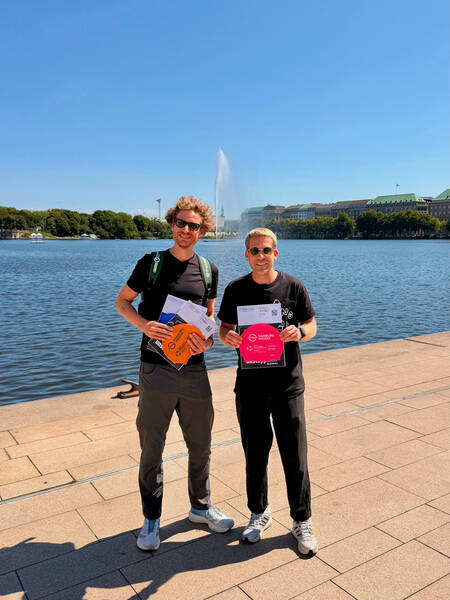
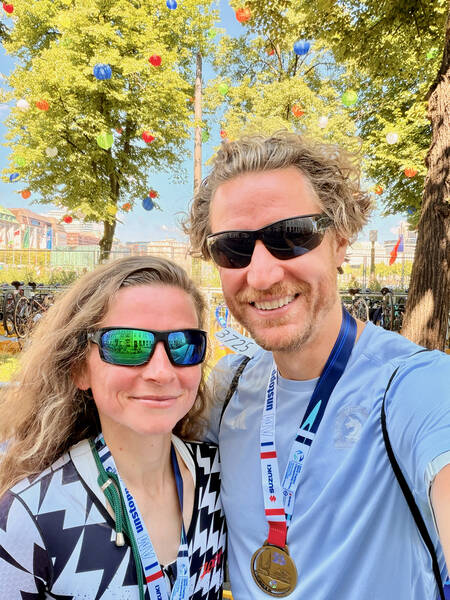
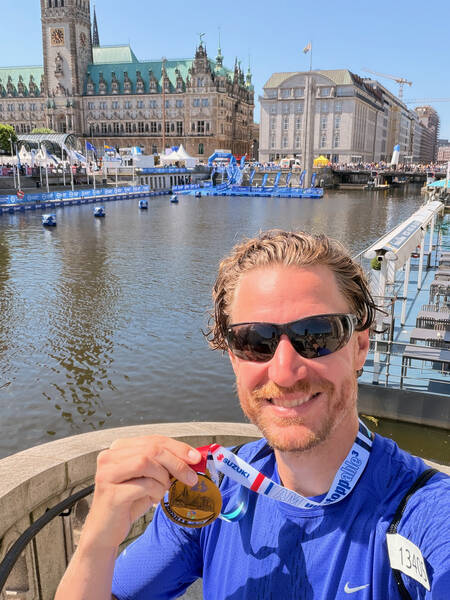
It was yet another non-wetsuit swim on Sunday’s race, so I completed the 1,500 m after a poor 32:14 minutes. My best swim here was over 7 minutes faster. But on the bike my Zwift-based strength helped a lot: I beat my previous best bike split on this 40 km course by nearly 3 whole minutes and reached transition after 1:03:34 on the Speedmax bike. The transition then was awful, because after 40 triathlon races I made yet another beginner’s mistake and couldn’t find my bike rack spot. Searching for about 2 minutes made me question my sanity. But when I finally reached the run course and put together a 38:30 run split over the 10 km, I felt great again. Missed my personal best over the full triathlon here by just 4 minutes — 2:24:01 was on the clock in the end, 157th of 2,323 male finishers. Considering that I completed Roth a week ago, this felt quite successful. No stomach cramps today! The good result has had a redemption character, especially on the run — only 16 men were faster on the final 10 km run than me out of the over 2,000 who finished.
But something even better happened on August 30th, eight weeks later, at Otterndorf Triathlon, a small event not far from Hamburg. Mathias and I went here to check out who of us would win the whole season — I beat him at Roth, he beat me at Hamburg Triathlon by a couple minutes, so we needed a tie-breaker. I had signed up for the race many months ago because I wanted to initially beat my friend Krischi’s old best time here, 1:08:18 back in 2009. But now there were two goals. Conditions were horrendous with rain and 55 km/h crosswinds, but fortunately none of us had a crash or any other major problems. We switched positions multiple times, it must have been super exciting to watch if anyone there had known about our little battle. I beat Mathias in the 500 m swim by a few seconds, he raced past me early in the 20 km bike where I overtook him again after maybe 5 kilometers only to be once again passed by him on the final few hundred meters in the bike. He left the second transition with about 50 meters of a gap, but I chipped away at that and finally passed him after about 3.5 of the 5 km run, securing a victory over him by just 18 seconds! We both had such a blast that day battling it out despite the conditions — but the biggest surprise was yet to come. Many races took part at the same time, so we had no idea about our position in the 200-people field in this sprint distance race, of which 123 were men. When they finally revealed the final results, we gasped. Because we had to stay for a minute longer to be part of the awards ceremony.
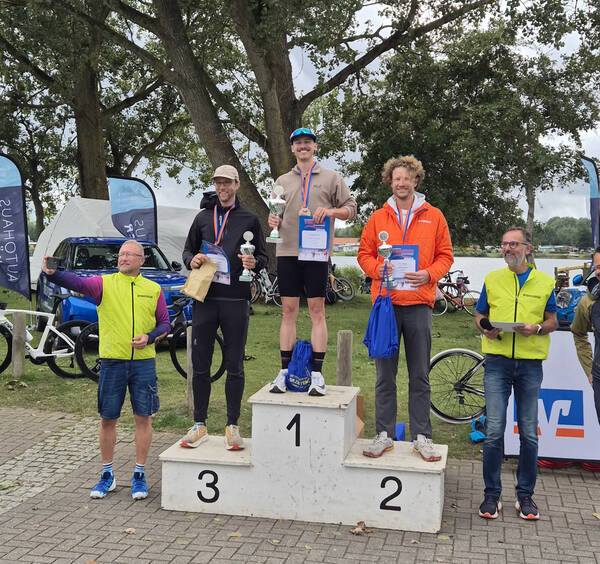
That’s been a big boost in confidence when assessing my capabilities for the next long-distance attempts at a better result.
Speaking of which…
While Mathias and I didn’t join the overnight queue in Roth, we were both immediately in agreement that we would like to come back and race here again.
The day after my redemption race here in Hamburg, the general registration in Roth opened up to the public. There’s no ballot, it’s first-come, first-served. At 10:00 am, the online form appears and you need to fill it out really quickly because people from all over the world are in a competition here to get one of the about 2,500 remaining tickets.
A stressful and sweaty situation, but compared to the race itself it’s an easy task. As soon as the form appeared, I put my data into the fields, hit submit, and hoped. It took me about 13 seconds to get this done. Just after, the Challenge Roth team shared that the 2,500 slots for 2027 were sold out after 15 seconds. Close call!
Mathias succeeded at securing the ticket, as well. But we both had agreed before buying the tickets that we wanted to make use of the option to defer the ticket by one year to 2028. Preparing for and going to Roth to race every single year seemed a bit too much for both of our already full lives, but every two years it should fit well.
I’m looking forward to 2028 a lot. The preparation, maybe modifying a few more things on the setup, and then hopefully making fewer mistakes on race day and getting lucky with the weather!
Until then, the plan is to participate in a few short and middle-distance triathlons created by small teams in the vicinity of Hamburg. There’s no shortage, and triathlon without paying €2,000 for the entry fee feels a lot more like what I would like to do right now. Because triathlons are fun!
How do you feel after reading this?
This helps me assess the quality of my writing and improve it.
Leave a Comment