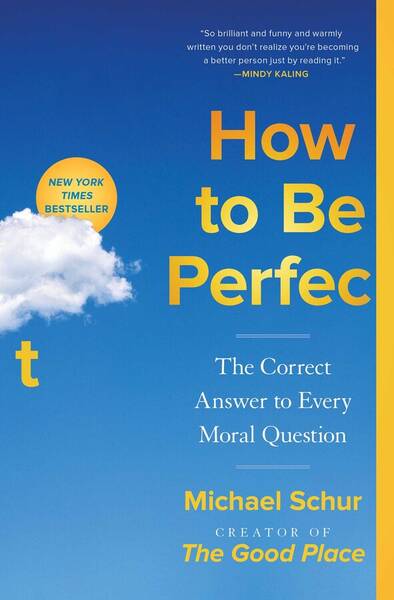
🎨 Impressions
Given to me by my good friend Andreas, this book couldn’t have come at a better time. The two previous books I had read were about ways humanity might destroy itself and showed impressively how there’s basically nothing we can do to decrease the risk. This one focusses on how to be a good person, something that we all have fully under our own control. Refreshing!
That’s not all that’s refreshing about this book. It’s also really funny. Which makes it easy to read and the information and lessons stick. To me, humor is a catalyst for those things.
Taking a step back first. The author Michael Schur is a Hollywood-type producer/director/writer who has worked on hugely successful TV shows such as Saturday Night Live, The Office, Parks and Recreation, and his own development called “The Good Place,” a show that stars Ted Danson and Kristen Bell and deals with the topics of this book. The moral questions that interested him and which he put into that TV show are central here. I have watched the show now that it’s been recommended to me by Andreas and I got the feeling that Schur was not feeling content with the way he was able to put all of it into the show. In order to keep strong ratings, you can’t really talk in-depth about moral philosophy, you can only touch on the themes. It’s a difficult ask of the viewers and you have to throw in the occasional love-triangle in order to keep everyone watching, but still I feel like he managed to do this well in the show. Regardless, he wanted so say more. To talk about his journey into ethics and classical philosophy as well as modern ideas. And that’s how that book came into existence. Together with an actual moral philosophy professor, who made sure all the ideas are presented correctly (and who occasionally provided hilarious footnotes), you can be sure to read something of substance here. Despite all the jokes and entertainment along the way.
The style he chose is sort of colloquial, like talking with a friend over a bunch of beers at a bar. That’s a good choice to convey these sometimes quite dry ideas.
Basically, he presents us with a multitude of scenarios of ever-increasing difficulty, and uses those to explain how the different established schools of ethics would deal with making the best possible decision here.
Early on, Aristotle and his Virtue Ethics are introduced. We then learn about Jeremy Bentham’s proposed principle of Maximizing Happiness and then Immanuel Kant. Especially Kant’s categorical imperative, which basically states that one should always act in a way that it could become a universal law, was really hammered into my brain by this book—finally. I always had trouble remembering what exactly Kant wanted to tell us, and now I do. Setting this idea up across from the obvious counterpart called Utilitarianism is the logical thing to do, and he does so over and over again, without it getting tedious.
He also touches on a bunch more philosophers, such as Sartre and Camus with their Existentialism. But he reaches an end quickly with them, because as he presents it they mainly stated that there’s no meaning, it’s all absurd, and you’re free to create your own meaning in life. Sounds like there’s not much you can do with that when trying to make difficult ethical decisions in a way that improves the overall happiness or quality of life of those involved. To me it also feels a tad self-centered, even though historically Existentialism has been closely connected to Communism, famously neglecting the self in favor of the greater community.
Another interesting philosophy he presents is called “Ubuntu” and originated in southern Africa. Its foundation is that “A person is a person through other people.” Meaning, what’s good for the community is good for each individual and that you don’t become fully human alone.
The latter half of the book is then mainly dealing with the daily struggles Westerners are facing in our modern lives and how to navigate those by applying philosophical ideas to them. Sometimes in a hilarious way, sometimes rather solemnly. The author reaches a point he calls “Moral Exhaustion”—which he defines as the feeling of resignation you get once you realize a given situation just has no single correct answer and there’s nothing you can do except to decide which way you will fail. This resonated a lot with me. The closer you look at anything, the more complex you realize it is. I often wish more people would acknowledge that. We all want simple solutions, but there’s rarely an important situation that really is simple to solve. This applies to almost anything in life, from whether almond milk is a better choice over cow’s milk to whether keeping a huge stack of nuclear weapons is successfully guaranteeing peace and prosperity forever.
It’s easy to be decision-fatigued once you understand all the philosophical implications. Schur then turns this around by stating that trying to become better is basically all that matters. There are no perfect solutions and decisions, so you just have to give it your best shot and you’ll be fine, hopefully. He introduces the concept of a sort of “Moral Bank Account” (he doesn’t call it that, though) and explains that it will grow by making ethically correct decisions but you’ll also sometimes have to withdraw something due to a failure of acting in the best interest of everyone.
The important bit is, according to Schur, to always acknowledge when you’re currently making a withdrawal from the account. It’s inevitable it’ll happen occasionally, but by thinking about it and staying aware of your own actions, you will be more likely to improve your actions going forward. That is something that I already felt strongly before reading the book and have expressed in many discussions with friends, so reading it here written down by someone who spent a lot of time on the topic felt good.
In my opinion, this is a highly recommendable book. And it’s for absolutely everyone. Our society would greatly improve from more people being aware of these philosophical ideas and starting to think more about the implications of their many decisions every day, myself included.
📔 Highlights
Everyone holding this book is “just a guy,” or “a lady,” or “someone who’s concerned with how to behave,” or “a person who was gifted this book on ‘how to be a better person’ by a friend and is only now realizing that maybe it was some kind of veiled hint.”
Part One: In Which We Learn Various Theories About How to Be Good People from the Three Main Schools of Western Moral Philosophy That Have Emerged over the Last 2,400 Years, Plus a Bunch of Other Cool Stuff, All in Like Eighty Pages
If “flourishing” is still a bit slippery as a concept, think of it this way: You know how some people who are really into jogging talk about a “runner’s high”? It is (they claim) a state of euphoria they achieve late in a long race, where they suddenly don’t even feel like they’re tired or laboring because they’ve “leveled up” and are now superhuman running gods, floating above the course, buoyed by the power of Pure Running Joy. Two things to say about this: First, those people are dirty liars, because there is no way to achieve higher-level enjoyment from running, because there’s no way to achieve any enjoyment from running, because there is nothing enjoyable about running. Running is awful, and no one should ever do it unless they’re being chased by a bear.
So in Aristotle’s view, the very purpose of living is to flourish—just like the purpose of a flute is to produce beautiful music, and the purpose of a knife is to cut things perfectly.
And the same way we develop any skill, Aristotle tells us, we become virtuous by doing virtuous things. This is the “lifelong process” part of the equation: “Virtue comes about,” he writes, “not by a process of nature, but by habituation.
To me, this is the true value of Aristotle’s virtue ethics—despite being written so long ago, it’s really on point when it comes to this one aspect of the human condition. If we’re not careful, our personalities and habits slowly and inevitably calcify over time.
This is the full sales pitch for virtue ethics: If we really work at finding the means of our virtues—learning their ins and outs, their vicissitudes and pitfalls, their pros and cons—we become flexible, inquisitive, adaptable, and better people.
The more we try to learn and understand the lives being led by other people—the more we search for a golden mean of empathy—the less we will find it permissible to treat them with cruelty.
The main thing Bentham and the other utilitarians have going for them is their overriding concern for other people, and their belief that all people’s happiness matters equally. My happiness is no more special than anyone else’s, they said, which essentially eliminates the concept of elitism.
If there’s one thing people are bad at, it’s drawing the correct conclusion from a given result.
The great majority of human actions involve incomplete information, either on the front end (before we do it) or on the back end (when we observe the results), so determining the moral value of an action based on the results seems like a risky proposition.
Generally speaking, the best ethical decision is probably not “take the easy route out of self-interest.” It would be awesome it if were! But it’s probably not.
Kantian deontology is the exact opposite of utilitarianism; to that point, while all of utilitarian ethics was based on maximizing happiness, Kant thought “happiness” was irrelevant.
Sometimes with Kant it feels like a game where we have to find either the right way to phrase the maxim we will follow, or a way to avoid not following it, in order to achieve the result we want without running afoul of his rules.
Scanlon’s suggestion: We give everyone on both sides the power to veto every rule, and then we start pitching rules. Assuming everyone is motivated to actually find some rules in the first place—that everyone is reasonable—the rules that pass are the ones no one can reject.
Kant wants us to encounter a problem, press pause, enter some kind of solitary meditation zone, use our pure reason to discern and describe a universal law that applies to the problem, and then act out of a duty to follow that law. Scanlon wants us to figure this stuff out with each other—to sit across from one another and simply ask: “Do you agree that this is okay?”
If we’re able, we should move beyond the “minimum requirements” of contractualism and do that small amount of extra work.
Ubuntu is Scanlon’s contractualism, but supercharged. It’s not just that we owe things to other people—ubuntu says we exist through them. Their health is our health, their happiness is our happiness, their interests are our interests, when they are hurt or diminished we are hurt or diminished.
We don’t just owe things to people—we owe our whole freaking existence to them. And when we think of “other people” that way, well, we’re not going to stop at the minimal amount that we “owe to each other”—we’re gonna damn well return the shopping cart to the rack if we think it eases the burden of those around us.
Part Two: In Which We Take Everything We’ve Learned, and We Start Asking Some Tougher Questions, and We Use the Stuff We’ve Learned to Try to Answer Them, and We Also Learn a Bunch More Cool Stuff
This is that “happiness pump” idea, rephrased: Wolf describes it as a person whose default setting is not “self-preservation,” but rather “other-preservation.” It’s the ego turned inside out.
In other words, Aristotle doesn’t demand that we be perfect little moral saints, smiling all the time, never losing our tempers, and polishing apples for our teachers. In fact, such a person is failing at finding the Goldilocks bullseye for whichever virtue he’s attempting to exhibit. And he’s also super annoying. And boring. Who wants to hang out with that guy?
He might say that there is a limit to self-sacrifice, because someone who tilts too far toward helping others to flourish—a happiness pump, essentially—may be unable to flourish herself. There is some amount of “selfishness” that’s appropriate and even good for us to have, because without it we aren’t properly valuing our own lives.
In philosophy, “desert” deals with figuring out what people are owed, or in some cases what they’re entitled to, based on different actions in different scenarios. Moral desert is the idea that if we do good deeds, we should be rewarded for them—
When we do something good, we want credit, dammit. We want a little gold star. We want to be seen as good people—and I mean literally seen—which I think is both completely understandable and deeply embarrassing.
Pragmatism asks us to be moral referees, watching the action unfold and determining whether there is any difference between one outcome and another—and thus whether the dispute is idle or meaningful.
Shaming someone for caring about Thing X when unrelated Thing Y is far more dire just doesn’t hold water. The common modern-day term for this is “whataboutism.”
When we screw up, deflecting attention onto a completely unrelated action utterly misses the point, which is: that we screwed up.
A person who’s deficient in guilt may never change his behavior, becoming callous to the effects of his actions. A person who feels excessive guilt might develop low self-esteem or become a recluse out of a fear of harming others. Somewhere in the middle would be the mean—let’s call it “self-awareness.”
When we’re trying to become better people, we should remember how powerful the simple act of conversation can be, to help us navigate these choppy waters.
It’s frankly dispiriting that a woman who advocated radical selfishness and utter disdain for everyone but oneself wasn’t booed off the world stage, but even today Rand has plenty of adherents, especially among those who call themselves libertarians.
The solution, however, is simple: we commit to those regular “check-ins”—to simply note, when we morally jaywalk, that we’re doing it.
The ethics of not taking a vaccine and thus relying on those who did for personal safety . . . cheating on your taxes but still using public resources . . . using too much water on your lawn in a drought-ridden city . . . not voting but still complaining about government—these are all Free Rider varietals.
Again, part of the project of this book is to help us accept failure—because, again, failure is the inevitable result of caring about morality and trying to be good people.
It served as a good reminder of two different things. One: the work of making better choices is frequently annoying. We just have to accept that. And two: it can be done—if we want to do it, and can summon the time and energy to make it happen.
Part Three: In Which Things Get Really Tough, but We Power Through and Complete Our Journeys, Becoming Perfectly Virtuous and Flourishing and Deontologically Pure Happiness-Generating Super-People, and Also There’s a Chapter with Some Cursing in It, but It’s for a Good Reason
“The formula is simple,” he wrote in another New York Times Magazine article from 1999, “whatever money you’re spending on luxuries, not necessities, should be given away.” Singer is the consequentialist answer to Immanuel Kant.
Confronting our behavior may be painful and annoying, but it’s also a remedy for apathy, which is the enemy of improvement. We can hardly hope to hit an Aristotelian mean of civil engagement if we feel no consequences when we underperform.
“This is the way it’s always been done” is the last defense of the true ignoramus. The amount of time something has been done is not, by itself, a good reason to keep doing it.
We’re actively not trying to be better, and worse, we’re seeing the not-trying as a virtue. This benefits no one.
And by the way, we’ve also argued that the richer and more powerful you are, the more you owe other people, because when we’re sitting around coming up with rules that define what we owe to each other, the powerful can more easily bear the weight of sacrifice.
Sometimes in philosophy, people throw around the word “heuristic.” A heuristic is a tool that allows us to input a problem and get a solution—a rule of thumb that gives us a guideline for our behavior.
It doesn’t help anyone to dig in our heels and ignore pleas from people who accuse us of a lack of caring or sensitivity. It also doesn’t help anyone to remain silent when our friends or loved ones or casual acquaintances say something racist, sexist, or offensive.
Existentialism, in a hilariously reductive nutshell, believes the following: Human existence is absurd. There is no “higher power” or deity or meaning to be found beyond the fact of that existence, and this condition fills us with dread and anxiety.
“Existence precedes essence.” The most important conclusion it leads him to is this: if there’s no giant structure that fills the world with any kind of meaning before or after we exist, then: “Man is responsible for what he is.”
Camus concludes, in a sentence that has been rocking the worlds of college freshmen for seventy years: “One must imagine Sisyphus happy.”
existentialists say: keep making choices, because choices are all we have in our absurd, meaningless universe. However: despite Sartre thinking his existentialism is “humanistic,” or how liberating Camus’s existentialism might be for the mythical Sisyphus, it can be pretty unforgiving for real people.
“This shit ain’t easy,” and the playing field isn’t exactly level. We do not all have equal amounts of time and energy and money to put toward making good decisions.
We may all be born with those virtue starter kits we talked about back in chapter 1—we all have the potential to be virtuous—but Annas points out that it shouldn’t be held against people when circumstances deny them the chance to develop that potential into actual virtues.
It’s not a meritocracy if some runners start the race ten feet from the finish line and some are denied entry to the race because of systemic biases within the Racing Commission.
Thinking of it this way, everyone who achieves anything, no matter how talented or driven, benefits in some way from chance. Some people—far too few, but some—understand that.
Rawls says that we ought to decide the rules for our society from what he calls the “original position”—meaning ideally, we’d all decide how we would divvy up things like salaries and resources for our society before we knew which role we were going to play in that society.
If we determine that relative to others we’re lucky, which means we can afford to do a little extra, then we should do a little extra.
The ickiness we feel when we apologize—the flushed-face shame that comes from admitting fault to a person we’ve wronged—is good. It means we feel the pain we’ve caused, and we care that we caused it.
Parents and moral philosophers, I’ve come to learn, are annoying in exactly the same way. Both groups spend their lives thinking about what makes a person good and trying to convince other people to buy into their theories.
That’s the bet I’m making, really. I’m placing a decent-size bet on the idea that understanding morality, and following its compass during decisions great and small, will make you better, and therefore safer.
Or you can try this: You can think to yourself, before you do something, “Would it be okay if everyone did this? What would the world be like if every single person were allowed to do whatever I’m about to do?”
Leave a Comment