Mallorca by UTMB, the 104 Kilometer Camins de Pedra en Sec: Focus and Patience
My Western States 100 qualification series: Exploring the beautiful Mediterranean island of Mallorca by running up and down rocky trails for as long as it takes.
Published on 20th of November, 2026
This story begins just a few days after I dropped out at North Downs Way 100, what would have been my first 100-mile foot race, in early August 2026. It wasn’t a tough race on paper over there in southern England, but still nearly half of all runners had to abandon it before reaching the finish line. Most of them likely due to the unusually intense heat on that day, but for me the reason was a combination of completely obliterating my left big toe by accidentally hitting it against rocks embedded in the trail over and over again, and the loss of a functional light source at the beginning of the night. I reached 117 km of the total 167 km race. I was quite disappointed in myself for making these dumb mistakes, and my immediate reaction was questioning if I even had it in me to accomplish such a difficult thing.
But I quickly turned that around into an action plan for the immediate future.
🧑🎓 Lessons learned, won’t make those mistakes again!
I recently came across a podcast episode in which a guy who DNF’d a long ultra trail reported on the race. He seemed to have been a strong runner and he even finished the big Ultra-Trail du Mont-Blanc (170 km and 10,000 m of elevation gain) five years ago, so you would think he knew what he was doing. But the way he told the story of this particular DNF seemed so odd to me. He said his training had gone well and that he had gone to the start line ready to go. It was a race longer than a hundred kilometers, so even for him it would take the better part of a day. After 20 km of spending time running in the top 10 of the field, amongst the literal ten best runners that day, he felt his quads starting to hurt. He took this as a bad sign but kept going until he dropped out at 98 km, with about a marathon left to go, blaming only his quads and stating that his body must have just not been made for these long trail runs. He also stated he had stomach cramping for a bunch of hours and realized later that his stomach just didn’t absorb all the carbs he took in, blaming his stomach. He took those two things as reasons never to do such long trail races again because his body, so he said, just wasn’t made for it.
I found this so odd because to me that’s so far away from the correct conclusion. Of course it’s a super sad feeling having to DNF a big race you’ve spent a lot of time preparing for. But it’s even sadder to attribute the failure to your body as if it failed you and there’s nothing you could’ve done about it.
I see it the complete opposite way: when you’re not reaching an athletic goal you’ve set yourself, it’s probably because you made some mistakes. And those can often be fixed. It’s like a puzzle. Some are more complex than others, but there’s a system in which it’ll fit together. In the situation of the guy I mentioned, the solution was obvious to me because I’ve made both mistakes myself before: if you get stomach cramps from all the gels, you either haven’t tested those gels in race-like situations before or you haven’t given your body the tools to absorb those gels during the race. Which comes down mostly to not drinking enough water. This mistake made me lose at least half an hour at the 2026 Challenge Roth long distance triathlon.
And if your quads are burning after just two hours of a huge ultra trail race, everyone can tell you that you probably went out too hard! Staying in the top ten of the field when you don’t belong there might not have been the smartest choice. These races aren’t won in the first 20 kilometers. Everyone should know that. But blaming your own body? No. Your body is doing great. You can blame your decisions and make better ones next time. It’s all within your power.
Ultrarunning and all difficult endurance sports are about making good decisions, in my opinion. Being in tune with the world around you and your body’s capabilities and limitations in it is the key. If you fail, it’s not your body’s fault, it’s because you didn’t play your cards right.
The smartest thing you can do if you made a mistake or two that led to you having to DNF a race is rethink those decisions you made and learn from them and make better ones next time.
That being said, if you’re just not having fun doing that, or if you feel the need to be in the top ten of the field but just can’t put the necessary work in to make that happen or are simply reaching your genetic limitations, quitting the hobby is a very valid decision as well.
The problem with my own DNF back at North Downs Way in early August was that it meant I now had no Western States qualifier race to my name for the upcoming 2027 lottery that requires you to run a hard and long race that’s on their published list every year you want to enter the lottery.
Running the famous and hugely popular Western States 100 Endurance Run in California has been on my bucket list for a while now, but I’m far from the only one. At the time of writing, over 10,000 people compete for just 369 entry slots each year. The qualification system is simple: if you want to enter the lottery, you have to run a long race the event organizers have approved. Each time you lose at the annual lottery and then enter again the next year with a new qualifier race completed, your ticket count will double, increasing your chances of getting a slot.
I started the quest in 2021 by running 🇦🇹 Mozart 100, my first mountain race with over 100 kilometers in distance. There, I acquired a taste for this type of racing. Long and difficult trails in beautiful scenery really feel like a very efficient type of hiking holiday for me: packing what would usually be a week of hiking through the Alps into one very compressed day.
In 2022, I failed at 🇫🇷 Festival des Templiers due to not enough specific training, basically. But since 2023’s 🇮🇹 Lavaredo Ultra Trail 120K I’ve been on an annual roll. In 2024 I added 🇩🇪 Zugspitz Ultra Trail before unnecessarily completing two qualifier races in 2025, the 🇮🇹 Tuscany Crossing 103K as well as the 🇮🇹🇨🇭🇫🇷 CCC, the shorter, 100-kilometer sister race of the huge Ultra-Trail du Mont-Blanc, or UTMB for short. But at the end of 2025 I still lost at the drawing even though I had by now accumulated 8 tickets for it. The estimated chance of getting a Western States slot was about 2.5 percent for people holding 8 tickets like me, so the 97.5-percent odds of me not getting in quite predictably prevailed.
The qualification window for the 2027 edition starts on November 3 of 2025 and ends on November 8 of 2026. My late DNF in August at the North Downs Way made it tricky to find another redemption race that’s also on the qualifier list for Western States and ticks a few other boxes, such as availability of slots, being not too far away from central Europe where I live, fitting my schedule, and seeming manageable for me in terms of difficulty.
Searching through the long list of well over 200 races and finding surprisingly few good candidates, I had nearly lost hope. But then I remembered I had already signed up on day one for the upcoming ETM (Els Tres Mils) race at the relatively new “Mallorca by UTMB” — a 56-kilometer trail run through the northwestern mountains of the Mediterranean island. Of course, with just 56 km in length, the ETM could never be a Western States qualifier, but what I remembered was that they also have two longer races as part of the race weekend, both of them actually being on the qualifier list.
The CPS (Camins de Pedra en Sec) with 104 km and 3,740 m of elevation gain, and the SDT (Serra de Tramuntana) with 138 km and 5,350 m of gain. Given all the racing of the year so far I immediately decided that the shorter of those two would be good enough, since it doesn’t matter in the end.
But would it be possible to upgrade my ETM 56K ticket to the CPS 104K one, even though all races are sold out?
I emailed the staff, but the first answer was a clear no. I then replied and asked to be put on a waiting list in case someone chose to give up their place, maybe because of an injury occurring in the weeks before it. This is standard at many other races. But the staff again replied that there is no chance for me to enter CPS. They do not do waiting lists, they said. Instead, they sell more tickets than available slots, calculated to result in the amount of total people actually showing up for the race being under the allowed limit the regional authorities have set. Risky for them!
Still, after those two negative replies I didn’t lose hope and asked them if I was allowed to find someone registered for the CPS and willing to swap their CPS entry for my ETM entry. My guess was that this might be an easy task: many people sign up for long races and realize shortly before that training hasn’t gone well enough, get cold feet, and try to move down to the shorter option.
That’s how I got my third reply with a clear NO in it. Also, they informed me there isn’t even a technical possibility in the race’s admin system to move someone from one race of the event to another of the same event. Being a technical guy and coder myself, I do not believe that one bit but stayed friendly and didn’t bring it up.
After some more digging around for options I finally found one. The so-called Charity Bibs.
For a fixed amount of 400 euros which are going to be shared by two non-profit charities, you can buy one of seven charity entries for each race distance. That’s not many tickets, so I asked if these were still available for the CPS race. And finally, I got a YES! Now, 400 euros (about 450 USD) is far from nothing. Added to the 200 I already paid for the shorter ETM race, this would have made it quite an investment for gaining entry into a 100-kilometer trail ultra. Of course, with the money going to two worthy causes, one towards helping beat childhood leukemia and the other to environmental conservation efforts in the Tramuntana region, the decision was made easier.
I slept on it for a night.
The charity donation alone was substantial. But since I had also already booked my flights based on the shorter race, I needed to work out whether the new schedule would be possible without booking another flight and another night at a hotel. It would be super close, but doable with very good planning and being able to stick to the plan under the strain of the race including the sleep deprivation. There would not be much sleep between the finish and the plane taking off. But I came to the conclusion that in theory it’s possible to pull it off.
⚖️ Making the Decision
In the end it’s always a question of how badly you want it. This situation here pushed me very close to my limits but turned out to still be within them. During the hours I contemplated it and talked it over with Sophie I realized how excited I got at the prospect of just going for it. Do what brings you joy, right? And there are worse things to spend 400 euros on than childhood cancer research, that’s for sure.
So I replied to the offer that I would like to get one of the seven Charity Bibs for Camins de Pedra en Sec, donated the money and asked them about the extra money I would need to pay to cover the jump from my ETM ticket to the CPS race. But by now I think they were a bit annoyed by my emails so they just found the allegedly nonexistent switch in the race admin software and put me on the start list without asking for any more fees. So it is possible to move someone from race to race after all!
I thanked them a lot and got to planning this very intense trip to Mallorca. Thankfully, the wonders of AI helped me a lot and together we put a plan into my Notion document with a full timetable. Taking a look at that I thought that if I can make it through this crazy trip, I can really accomplish anything. The trip would last from Friday morning to Sunday midday, with the race taking place on Saturday, followed by about two hours of sleep until leaving for the airport. It would involve three nights in a row of setting the alarm at around 3:00 AM. Artificial jet lag without even changing time zones. The weather would need to play nicely and public transport on the island would have to be on schedule or I’m screwed.
And the race weekend would be the final weekend of a two-week school holiday with the four daughters — who are great but usually wear me out so much I need to go on my own holiday afterwards instead of running a demanding trail ultra.
But there’s a chance! A lot of the aspects are within my control so I can actively look for ways to address these to the best of my ability. The main aspects are proper training, researching the race, and optimizing my gear for it. Starting with the easiest.
👟 Gear Upgrades
Right after the sad DNF at North Downs Way I was sure two particular gear choices were to blame: my headlamp with its failing battery and the shoes that didn’t manage to save my big toes from destruction.
Both assumptions were mostly wrong.
My headlamp actually worked fine. I didn’t lose the detachable battery as I first presumed at the 100-kilometer aid station. It was just completely empty. The lamp is so light I thought I must have lost the battery. It’s funny how running for 100 km in the heat can mess with your ability to think clearly. Of course I would now make sure to have all batteries charged at 100% from that day forward, but I also immediately bought a spare battery for the lamp. And charged up the spare lamp. And the second battery for that one, too. Should I maybe buy a third one?
Moving on to the shoes. My trusty La Sportiva Prodigio Pro apparently betrayed me in England, or so I felt. So I researched and bought trail shoes with even more protection on the toes which actually had the words “TOE PROTECT” written on the toe boxes, leaning very much into this special feature. Unfortunately these were bad in every other regard that mattered. (For those interested, they were the New Balance Hierro v9.)
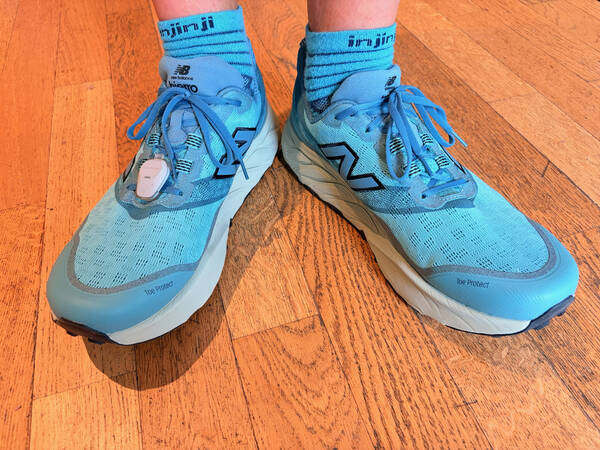
It turned out it wasn’t the shoes; it was my way of running that led to me bumping my toes over and over again. The biggest cause of that was a lack of focus. And that happened for several reasons.
- I went into the NDW100 race rather tired from a bunch of tough weeks right before it.
- My training wasn’t specific for hills and I mostly focused on triathlon-specific strength training instead of workouts specific to trail running.
- My racing strategy was based around the mantra of “relaxing” in order to conserve energy, which made me inadvertently not lift my feet up high enough from the ground by default.
- And lastly, I fiddled too much with gels, my watch, but mainly my running poles. Most of the painful toe impacts happened when I was either trying to put the foldable sticks together while running or taking them apart to put them back into the quiver.
The good news is that most of this is easily fixable.
- I took the training block very seriously and didn’t add any additional fun races to it which would jeopardize my performance on Mallorca.
- I did strength training like I never had before, focussing on the legs, especially the calves, and also my core muscles.
- I changed my racing mantra for Mallorca to “Focus and patience.” instead of “Relax.”
- For good measure, I increased my caffeine intake to stay alert enough during the race at every single step.
- I made the decision to leave the running poles back home in order to prioritize safe footing and more natural balance over maybe a finishing time advantage of half an hour.
- And I gave my beloved La Sportiva shoes another chance to redeem themselves at this race, because the fit and cushioning just feel right to me.
Everything else stayed the same because I was already happy with it. The clothes, the gels, the running vest, my aid station strategy, pre-race meals, pacing — all is good enough for now.
📊 The Specific Training Block
I took this very seriously after the North Downs Way DNF on August 8, but I also had a few races already scheduled in between, as well as a need to recover from the 117 km first. It wasn’t the whole way until the finish line but it also wasn’t nothing. The races in between North Downs Way and Mallorca:
- Three weeks later, Otterndorf Sprint Distance Triathlon
- Four weeks later, Flensburg Marathon: official pacemaker for runners targeting 3:15
- Five weeks later, Bremen Marathon: official pacemaker for runners targeting 3:45
After Bremen, seven more weeks until Mallorca race day on October 31 were open. Well, except for the two weeks right before the race because of the family holiday, so a solid five weeks would be the basis. That’s definitely good enough, especially since you can count the two marathon pacing jobs in Flensburg and Bremen as long runs helping towards building the fitness and actually being part of the training block.
The fixed races went great: especially Otterndorf Triathlon. Out of 200 starters at this regional fun race event I beat everyone but one guy, finishing in second place overall. My friend and training partner Mathias shared the podium with me, coming in just behind me in third place. And he didn’t even try to run a hundred miles three weeks earlier!
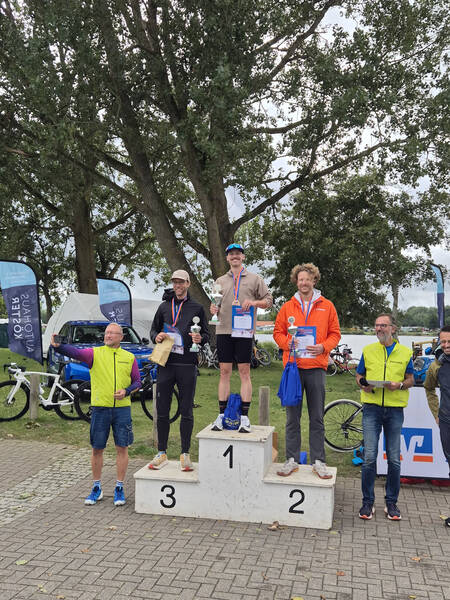
Obviously, this result was a much-needed confidence boost and a wonderful conclusion for me to the triathlon summer of 2026. The training I did for Otterndorf in combination with the rather fast 3:15 marathon a week later was fully planned by ChatGPT and worked out perfectly for me. I got the very best out of myself, so that Bremen Marathon was just an easy jog the week after Flensburg.
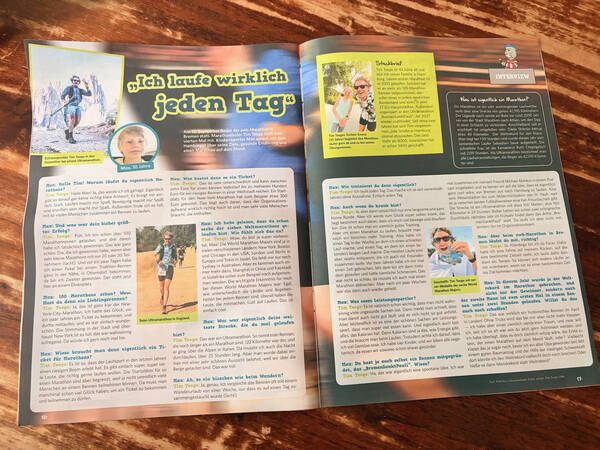
Naturally, I stayed with the system and had ChatGPT come up with a specifically tailored training plan for Mallorca based on my training history and current situation. Very little tweaking was necessary. I had it focus on strength training especially, because I knew that would be the biggest lever for the mountainous trail race, next to the more specific hilly long runs which are always standard staples of such a training plan.
Strength training about twice a week, alternating between a leg and a core focus.
The exercises I found most beneficial are the following:
- Bulgarian split squats
- Single-leg glute bridges
- Side plank
- …and most importantly: Calf raises
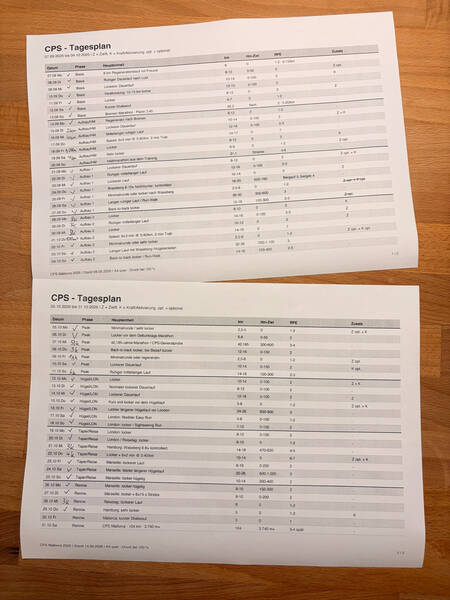
I think the calf raises were the winning exercise for me. I didn’t really know my calves were a weak spot in my chain until I started with these and felt the benefit. With strong calves, you actually get to use a whole new joint for the running motion: your ankles! What a tremendous benefit! In all seriousness, I think this was helping me a lot.
An annoying common cold ruined a week in September, but I was able to get in some very solid hill repeats afterwards, collecting the vert and long days outside as the plan told me to. I once again became Local Legend at Waseberg, the only hill here in my vicinity in flat northern Germany, and that got my body as ready as possible with the options I have here.
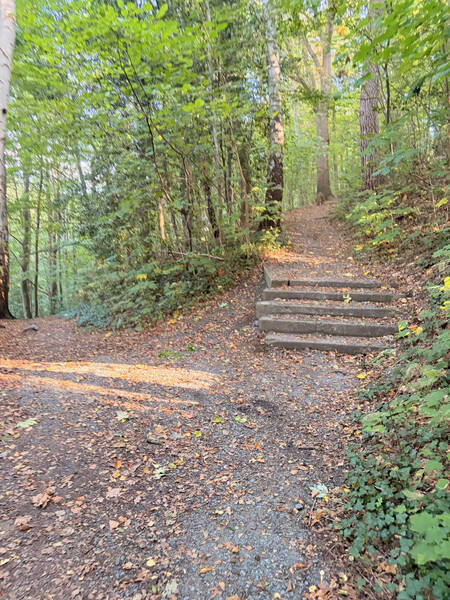
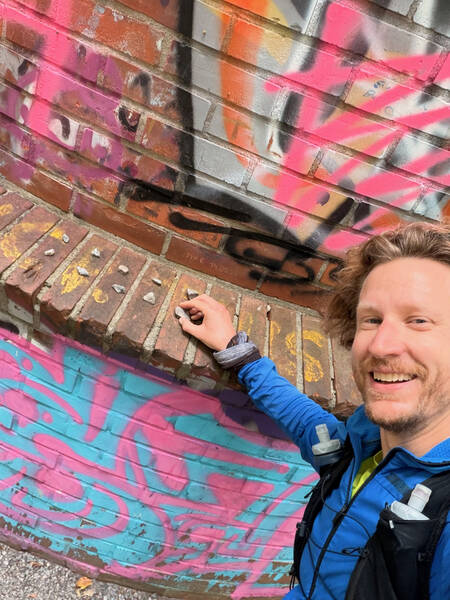
The series of long runs reached its peak on October 7, which mathematically was my 42.195th birthday. The marathon birthday! I knew this years before and had put it into my calendar, already planning to at least run a full marathon in the special occasion’s honor, but now it fit even better because I was in the middle of a training block for a trail ultra. So I added a bunch of vertical gain and made it a round 50 kilometers to celebrate. At low intensity I was able to continue the training just a couple days later, so I did everything right.
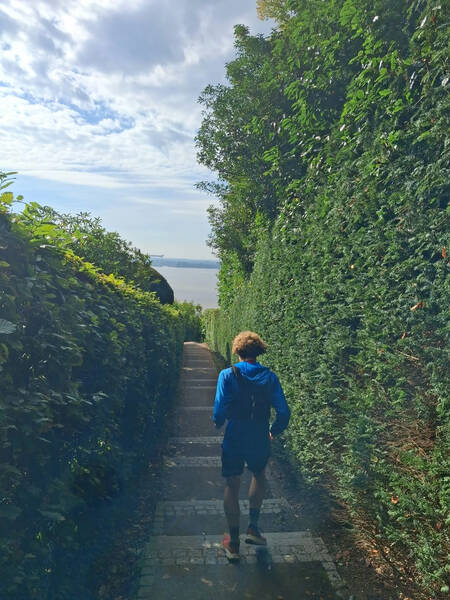
The only thing that didn’t work out well was the virtual cycling I wanted to implement into the plan. ChatGPT had planned for me to do three full ascents of the infamous Alpe du Zwift segment in the virtual cycling software Zwift over the weeks. With over 1,000 m of continuous climbing, this would be a strong session to help me build long uphill endurance. The main problem with the tiny Waseberg here in Hamburg is that I can’t do continuous long uphills like on race day, but would have to do the short intense repeats of the 80 m hill only. Many ultra trail runners do long uphill cycling climbs on Zwift, including champs Jim Walmsley, Kilian Jornet, and David Roche. Not unimportantly, I was also still missing the Zwift achievement badge for 25 full ascents of the mountain. But it didn’t happen, I wasn’t able to do a single one during this build. The reason is that life was too exhausting and there was no energy left over for both demanding runs and demanding cycling. So I chose the one discipline that would more likely lead to a better outcome because of its race specificity: more running. I think it was a smart choice.
Going forward for the next trail races, I likely won’t change much. Maybe a little bit less running in favor of even more leg strength workouts will get me fitter, but I need to test that theory somehow first.
Towards the end of the block I felt like I had improved a lot. That was the point. The hills came easier, the long runs didn’t feel so long anymore, and the strong legs really helped in everyday life, too. Carrying my sleepy daughters up the stairs into their beds at night became much easier, suddenly. Great side effect! The two weeks right before the race consisted of a short trip to London for me with Daughter #3, showing her the city and explaining England, followed by a week in Marseille with wifey and all four daughters in order to catch the last few rays of sunlight before the long and dark Hamburg winter. Especially Marseille wasn’t nearly as exhausting as I anticipated and even had quite a good hill for me to have a final 20k run with 600 m of vert in it. Solid!
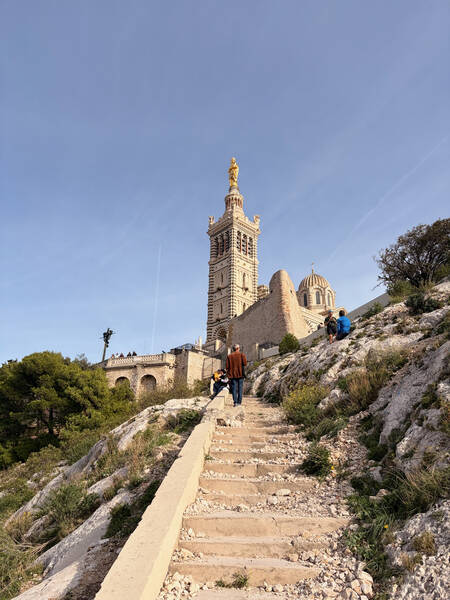
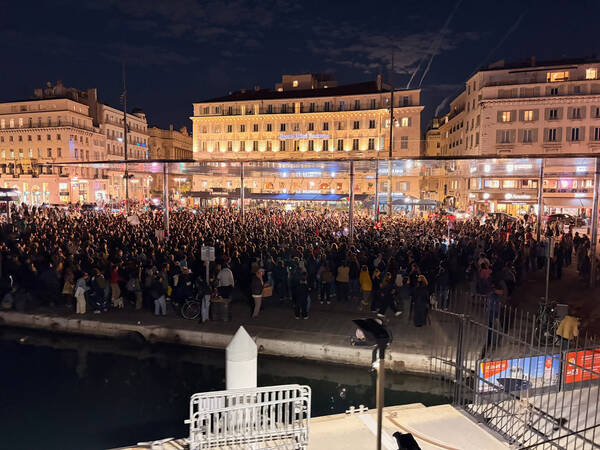
While running through Marseille, I saw a huge number of other runners. Especially those who wear running vests because they’re outside for much longer than a standard evening jog. It cemented my impression that France really seems to be Europe’s biggest running nation at the moment.
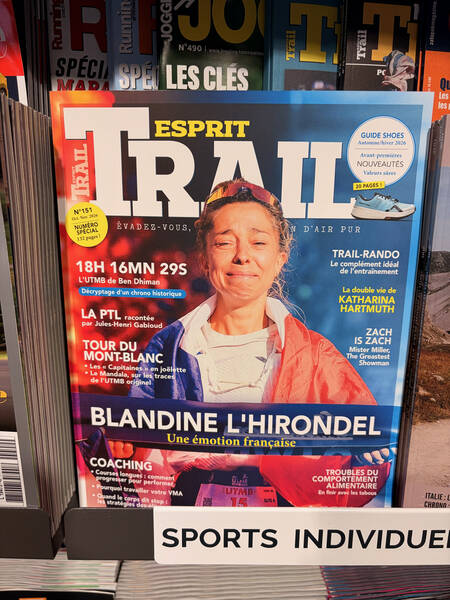
After returning home from Marseille with the family, I had exactly one day to pack and get ready for the trip to Mallorca. Not so easy, because the list of mandatory gear for CPS is very long and I had to fit everything into my carry-on backpack because I’m too cheap to pay for the transport of a suitcase.
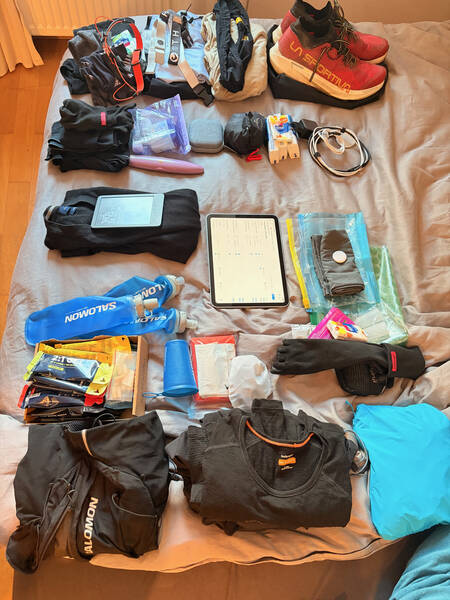
Where there’s a will, there’s a way, so I managed. About 70 euros saved per flight.
Setting the alarm for 3:30 AM, dragging myself to the airport, and boarding the actual first flight of the day leaving Hamburg airport was next.
And suddenly I was in warm Mallorca! I’d been pleased to see promising weather forecasts during the week before today. I was relieved, because in the Mallorca mountains especially, that isn’t always the case. This race had to be cancelled once because of severe weather, and just a few weeks earlier, heavy rainfall in other parts of the island wreaked some havoc. I got lucky in that regard.
But there was another challenge to this particular race. Up until a few weeks ago I wasn’t even aware of it. I just browsed race results and wondered about the relatively slow finishing times compared to other similar races on paper. During a run we shared, my friend Henning then told me about the infamous stones. And I’m very happy that he did.
🪨 The Stony Situation: What Exactly Was I Getting Myself Into Here?
As I learned, the level of technicality of the course was known to be rather high. The median finishing times were therefore quite a bit slower than you would expect looking just at the plain data: 104 km with 3,740 m of vertical gain.
This is nearly identical to the Tuscany Crossing I did in April 2025. It had 103 km with 3,750 m of advertised elevation gain. Judging from my 13:22 hour finish there in Italy and my current fitness that might even be a bit better than back then, a similar result should be expected, right? But no. Far off. The rolling hills of Tuscany with its hard-packed dirt roads were quite a bit different from the rugged grey stones here on the Spanish island. Various sizes and shapes, and you never know what’s better: placing your feet next to the big stones, risking tripping on the next one, or placing them on top of the stones, risking slipping.
Oddly enough, the winning times here were even comparable to those at the CCC race on UTMB weekend, but that one has over 2,000 m more elevation gain over the same distance. And it’s also not known to be easy, from a technical perspective.
The more I researched, the more confirmation I found. Everyone who was familiar with the race said the same thing: be aware of those stones!
This helped me a lot, because it prepared my mind for the difficulty ahead. If you just go into a race expecting smooth sailing and are surprised by the massive challenge and way slower finishing time you’ll end up with, the mental toll is huge. It can even break a race, because the mental part is so important in an effort this long.
A few replies to my stories on Instagram about this race also included the information about the stones. Scary, but helpful. My strategy became even more cemented that way:
Play it as safely as possible, with the only goal being making it in under the Western States lottery qualifying standard of 18 hours. No risk taking, no experiments. Slow and controlled pace all the way.
In an odd way, the stony situation even helped me a bit to overcome the problem I had in England: because the road was usually so easy and uneventful to run on, my toe destruction happened when I felt too secure. But when I actually have to pay attention to every single step because there are big obstacles all the time, I can’t lose focus by accident. Maybe that’s the solution?
🎫 The Mallorca by UTMB Race Center
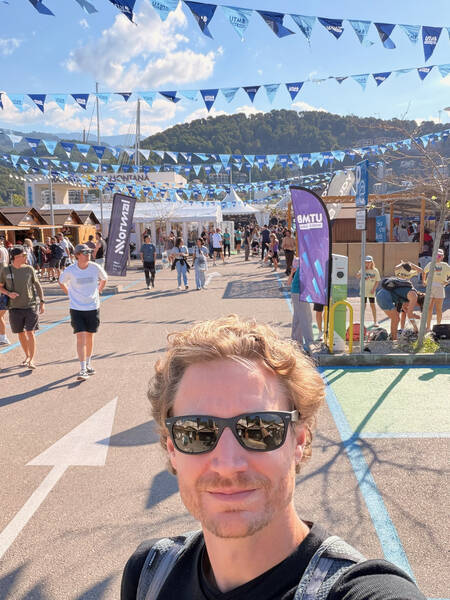
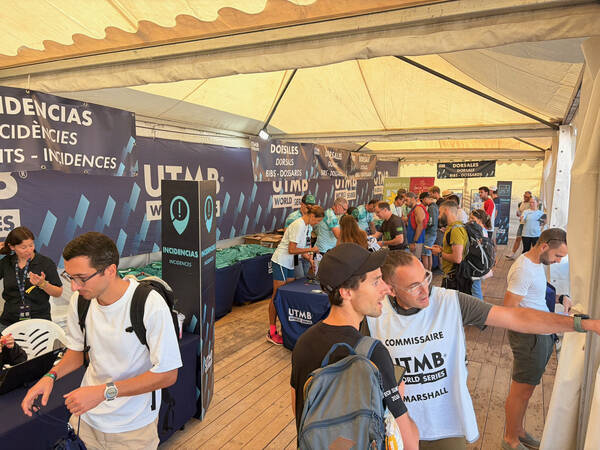
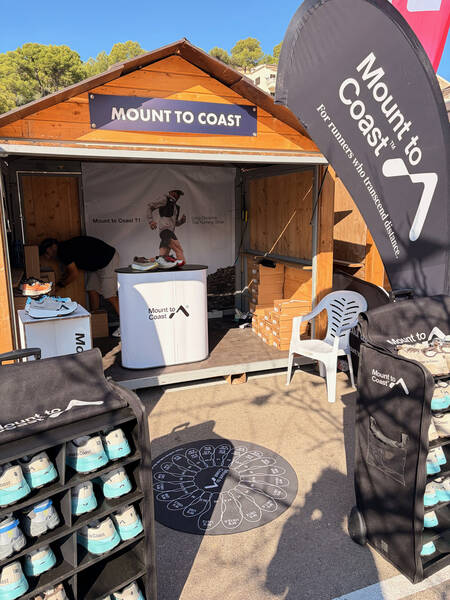
The race center, located in the tiny village of Port de Sóller right on the Mediterranean Sea, was as I expected it from a UTMB-branded event. A bunch of companies were showing off their gear, the bib pickup was highly regulated with a Priority Lane for Business Class runners who have the so-called Trailblazer status, and the merch tent played a big role.
The bus ride from Palma to the Race Center here in Port de Sóller took just about 40 minutes, by the way. Incredibly cheap and reliable, too. Port de Sóller would also become the finish line town for all four separate races this weekend.
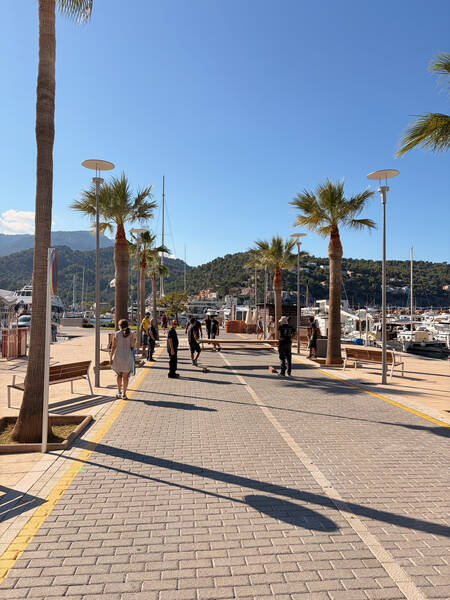
We had to pre-book our time slots for the bib pickup to reduce waiting times. I’m all for it. It went as smoothly as possible and there were plenty of volunteers, all friendly and well-versed in English. Great atmosphere here, looking at palm trees next to the calm water in the sun. It instantly felt like a vacation. A big pizza in a nearby restaurant while watching the beach and a historic tram casually going by added to that.
Time to take care of the chores: back to the hotel in Palma, short 2-kilometer shake-out run to keep my streak of more than 1,750 days alive, a short shopping trip for water and some snacks for the early breakfast tomorrow, packing everything for the race, and an early pasta dinner at an Italian restaurant around the corner from the hotel at 5:00 PM. Lots of boxes ticked.
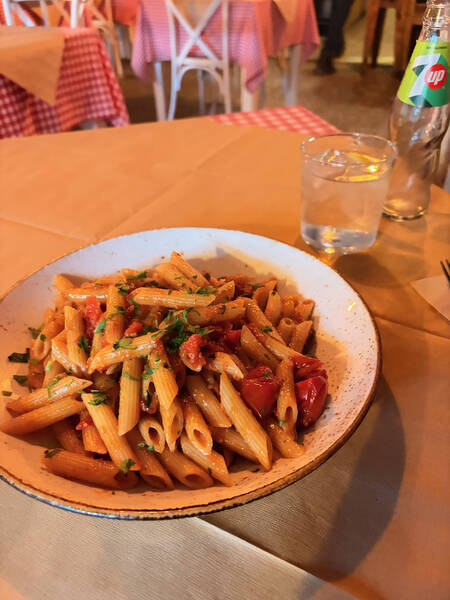
I decided against a powernap after today’s early alarm at 3:30 AM because that would hopefully allow me to fall asleep early in order to be fresh and ready when the alarm would go off on race day tomorrow at 2:30 in the morning. Not a great time of night to see on your phone, but it was necessary to make it to the start line in time.
🌅 Race Day, October 31st, 2:30 AM
So far, the plan was a full success. I actually fell asleep some time around 7–8 in the evening and felt super fresh and relaxed when the alarm went off.
Stepping into the race outfit, don’t forget the vaseline, and off to the shuttle bus station. The place was a 10-minute walk from my hotel. I had picked it for that advantage especially. The start of our race will be in the village of Cala d’Estellencs, over an hour of winding roads across the mountains. The huge bus barely fit through some narrow village sections along the way. Most other runners here inside of the bus were completely quiet. It’s this odd calm-before-the-storm situation mixed with tiredness. I kind of like it. The bus drop-off is at Estellencs, the village just before the one where the start is located. We get rid of our drop-bags for the Alaró aid station here and hope to see them again there after 60 km of running. I put an AirTag into mine, just for fun.
Total darkness. Some stars above us. More and more runners step out of more busses arriving. I enjoy this atmosphere a lot and use the time to eat and drink a lot. The good thing with ultrarunning at my pace is that eating won’t diminish your power output at that low intensity, so I can normally have anything to eat, even right before or during the race. Today I went for three bananas, about 1.5 liters of water, a can of Red Bull, a bottle of Vitamin Well’s Awake variant which has some caffeine in it too, four energy bars made from dates and peanuts, and a couple chocolate cereal bars. Sounds like a lot, but stretched out between waking up at 2:30 and the race starting at 6:00, all that food went into me in three and a half hours — a long time.
Before entering the area of the starting line after the 15-minute walk down to the Cala, which I think means coast, there were random checks for mandatory gear. I was asked to show my waterproof rain jacket, which of course I did. This wasn’t the only item on the list, though. They wanted us to bring a large amount of gear which all had to go into the running vest.
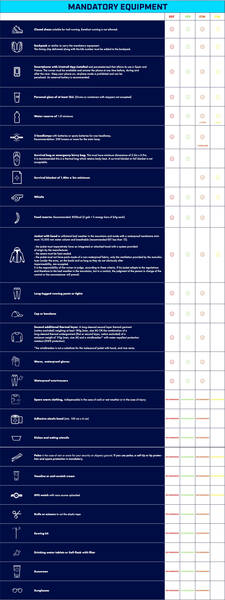
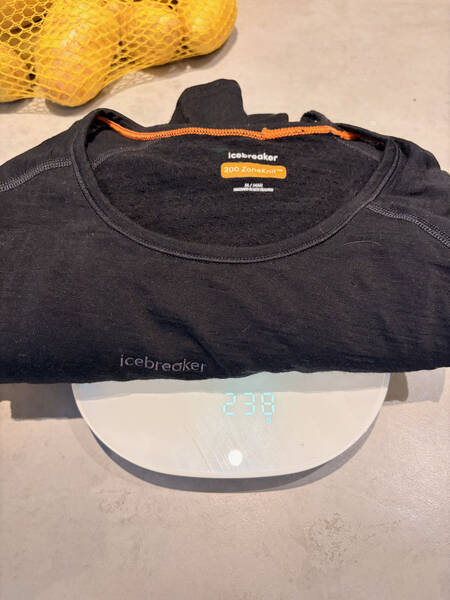
The more unusual items on the list included a survival bag instead of the usual survival blanket, a food reserve of at least 800 calories at all times, long running pants as well as rainproof pants, and a second long-sleeved upper layer that had to weigh at least 180 grams. I had to order a few items during the weeks before today, and I also put my second layer on a scale.
In addition to the mandatory gear they also had a bunch of recommended items on the list. Most of which I didn’t bring. The list included scissors and a sewing kit, for example. What sort of operations do they expect us to do out there? Also, sunscreen and sunglasses? Can’t we be trusted to make those decisions ourselves? Seems to me like the situation with airport security: one person makes the mistake, and the list grows.
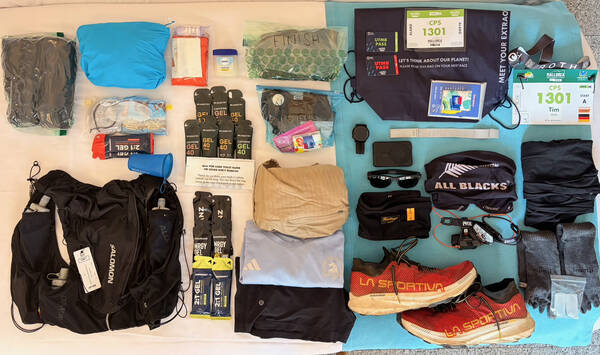
I’m going to name a few items from my kit that have really stood the test of time and are favorites of mine. Maybe it’ll help someone:
- My COROS PACE Pro GPS watch with the upper arm heart rate monitor strap, just super trusty with built-in navigation and maps. Fun fact: after the race it still had 65% battery remaining.
- The Salomon ADV Skin 12, this running vest has held up so well over so many races and training runs, I see no reason at all to change.
- Several different clothing items made of Merino wool by the brand icebreaker. Super comfortable and still great when soaked with sweat or rain.
- Still a favorite, got me through the race blister-free yet again, the injinji toe socks. I like the Ultra Run Crew variants because of their thick padding.
- And of course, the wonderful La Sportiva Prodigio Pro shoes. How could I ever have doubted them? There are over 1,000 kilometers in these particular ones now and they still feel good to me.
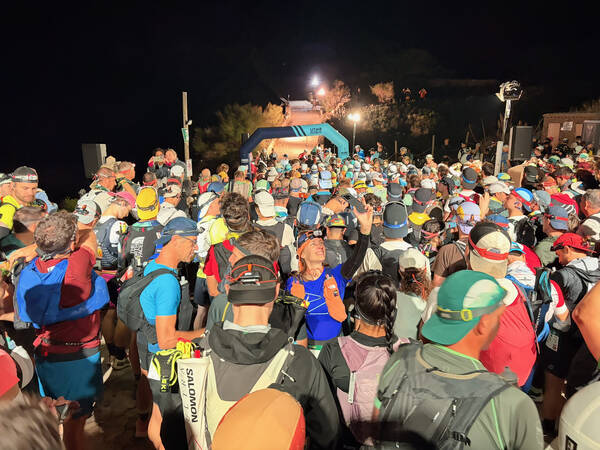
With everything ready to go, we now all had to wait for the clock to move. Meanwhile, loud party music and disco lighting were turned on in this remote village next to the calm sea. Two emcees were excitedly talking non-stop. Mostly in Spanish but also a lot in French. When I realized that one of them asked all French runners in the 600-strong crowd to lift their hands and saw what felt like 80% of all hands go up, I understood why French might have been even more important here than Spanish. Interesting, but not surprising. Lots of good trail runners in France, home of the UTMB. And this island is conveniently just a very short flight away from mainland France.
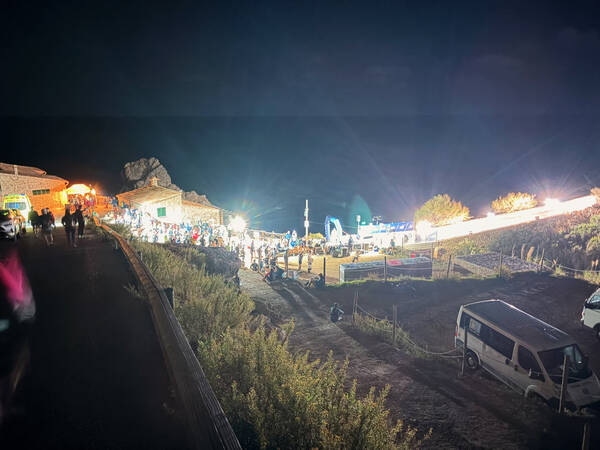
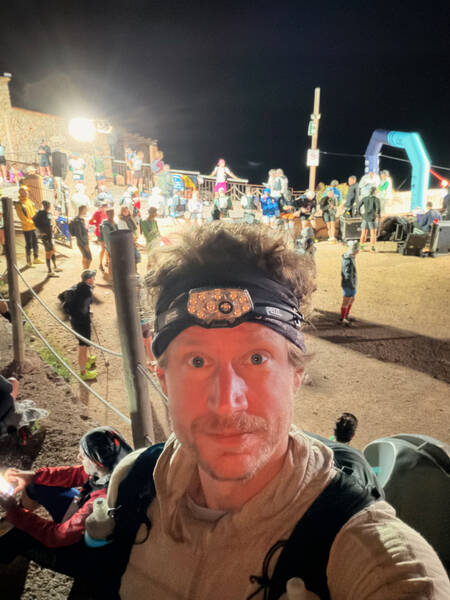
I understood very little, but I gathered none of it was important. The few times the guys spoke English, it consisted of hype phrases such as “Come on, let’s go, everyone!” with a thick Spanish accent. None of us was in the mood to dance now, though. We’re all focused, excited, thinking about the biggest climbs, trying to remember the aid station splits, going over our nutrition plans in our heads, maybe nervously chatting with someone next to us in the packed crowd, but partying to a light show? Not so much. I could have easily done without that bit.

Other than that, I have to say, my impression of this organization here was great. The race village, the preparation, the email newsletters, the shuttle buses, the direct message support on social media I made use of a couple of times — everything just worked. Really well done.
And finally the countdown starts and the excitement immediately transforms into action. Running for the whole day! I can’t wait. A lot of work went into this moment and I’m just happy to be here, for everything to have worked out for me to get another chance at running an interesting and challenging race, and also for another chance at qualifying for the Western States lottery, of course.
🔫 RACE START!
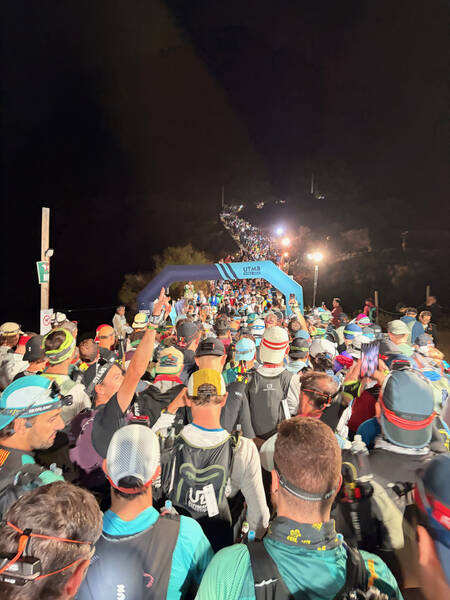
One friend told me about major congestion on the trail here during a previous year’s edition and it didn’t come as a surprise. UTMB events are usually packed and traffic jams during the first few hours are normal. With about 600 people starting here in the same single starting wave, I fully expected that to happen but was very relaxed about it. You don’t lose much time to it compared to what you can lose at aid stations or during the later bits if you went out too fast. So I went for my old strategy of starting at the back of the pack and taking it really easy during the beginning. Today again, this was a smart move. Being forced to go slower in the early stages and then carefully and steadily overtake as many as possible, especially in the later stages, is great for conserving energy and keeps me motivated, too.
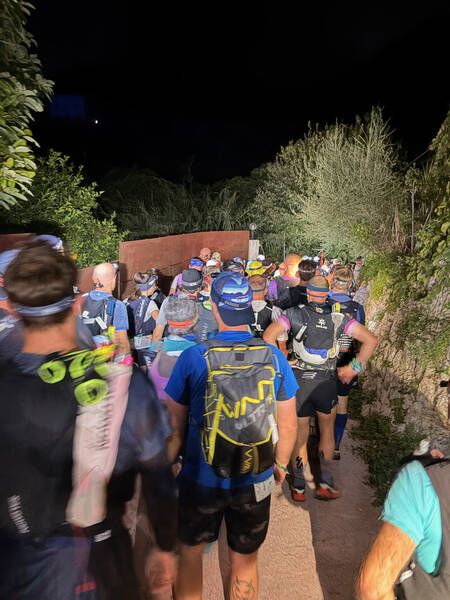
Sure enough, a couple full stops were inevitable, and these may have caused about 5–10 minutes total of wasted time. But I didn’t stress, and neither did anyone else around me. At other races I have often seen people trying to course-cut in these situations, to somehow bypass the congestion, but not here. Good vibes only!
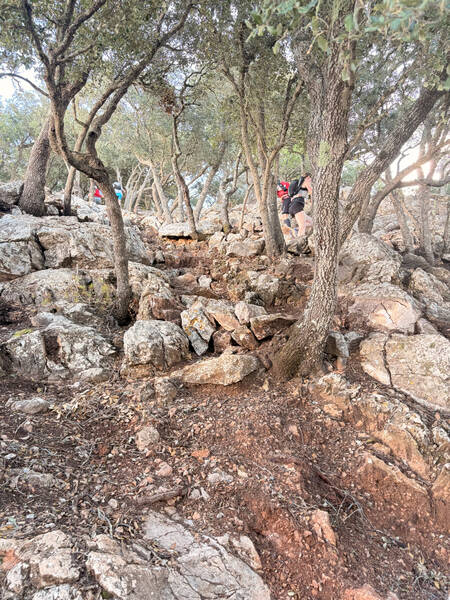
We go up from here for the first few kilometers — the start was next to the water, after all. It’s mostly wide roads for now, leading out of the village. Some short passages of stones appear and I’m keen to find out how these will feel. And yes, they’re tough. I really need time to become friends with them and get into the groove.
🧘♂️ FOCUS AND PATIENCE.
After about 50 minutes of racing, the first really technical single trail uphill section appears, with a bit of a traffic jam on it, too. Perfect, this way I get lots of time to adjust to the stones. It’s great for me that the course starts with a rather long climb, because it’s far easier for me to go uphill on difficult stony passages than downhill.
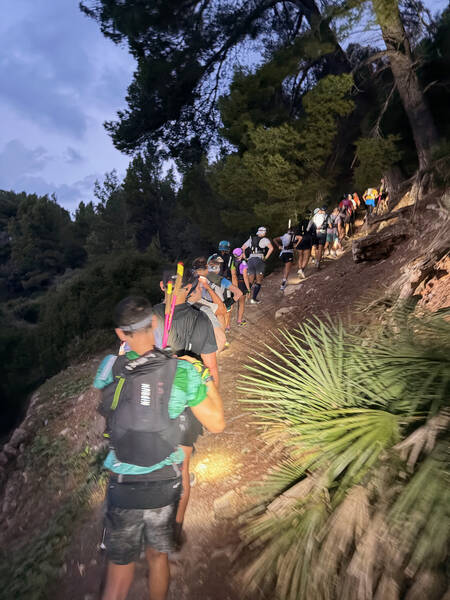
A first really nice moment is when the sun reaches the point during its rise that makes it safe to turn off the headlamps. It’s far easier to coordinate the footing, even though my headlamp with its full battery (and triple backup) is lighting up the night really well. By the way, at first I had the headlamp in its lowest intensity setting because I thought it was enough and might conserve battery, but I then realized I got a bit dizzy like I did near the end of the North Downs Way 100 which I had to abandon partly because of that dizziness in the low light. When I turned up the intensity of the lamp, the dizziness went away immediately. I must have misinterpreted my body’s reaction, which is very good to know!
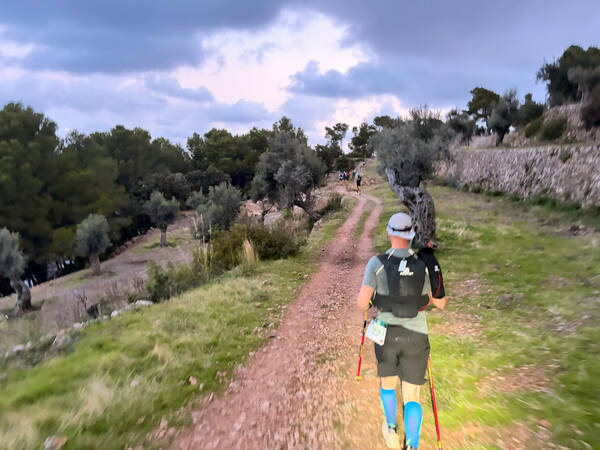
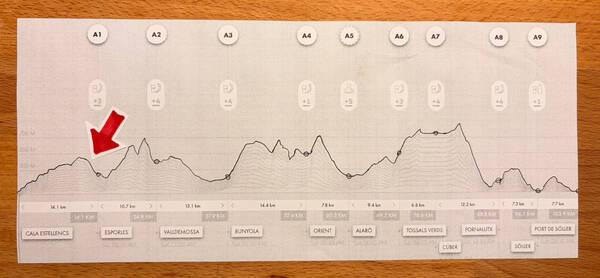
The first tricky downhill section starts after about 9 km and goes on for maybe 3–4 km. I’m very careful and that’s the reason all goes well.
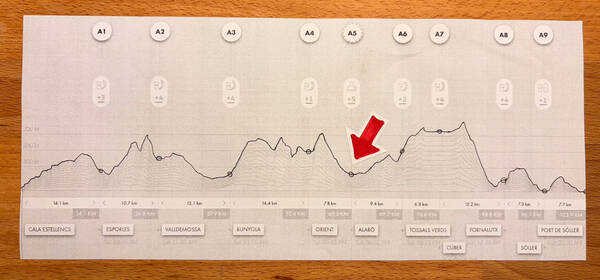
🧃 The First Aid Station, Esporles, After 14 km
This is a special aid station which had to be brought in by car and set up from scratch, because it’s at a bit of a remote place without electricity and running water. So the volunteers also had to bring big plastic containers of drinking water. One thing here was amazing: instead of the UTMB sponsor brand “näak,” they offered the standard sports drink in Spain called “Aquarius.” I knew the drink and I was so happy about that! In my opinion, näak not only tastes bad, but also is lacking in quality and weirdly has 8 grams of protein in it per serving, which no other sports drink does. This might be why it never fails to make me fart. I can count on that. But still, näak is not so bad that I want to carry my own drink mix in powder form around as many others do. I still prefer the easier refilling at the aid stations and just go with the trade-off. At this point I have a little bit of hope that maybe the other aid stations will also offer Aquarius instead of näak, but sadly this turned out to be the only one that did.
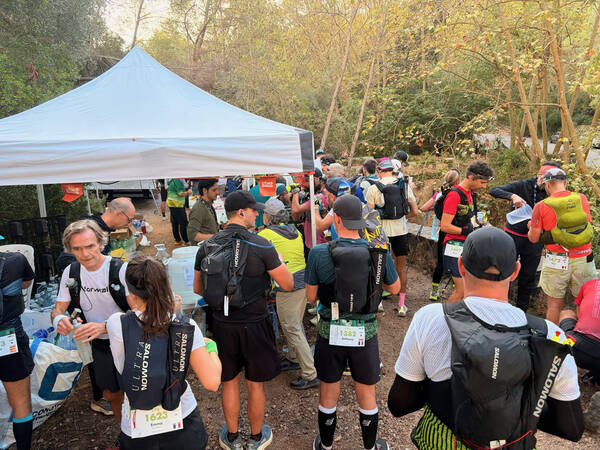
Coming out of the aid station I felt like lots of people have wasted a lot of time here and I just passed by many of them. My analysis said that my total stopping time at this aid station was just 1:34 minutes, very quick for filling up two bottles in the crowds and having a few cups of water to drink right here.
So far I had no idea about my position in the field. I knew only that I started near the back and that about 600 people were on the start list. A few moments later I looked at my phone’s LiveTrail app, because it was mandatory to have it active. They have tracking stations at every aid station, so I should now get a position number. And I did! It said I’m in 508th place right now. That checks out.
Coming through the village of Esporles shortly after the aid station, I felt great. My pace was slow due to the traffic jams and many uphill kilometers, but right within my own set bounds, somewhere around 9:00 min/km. I just have to stay under 10 minutes per kilometer, and I felt like that was totally possible today.
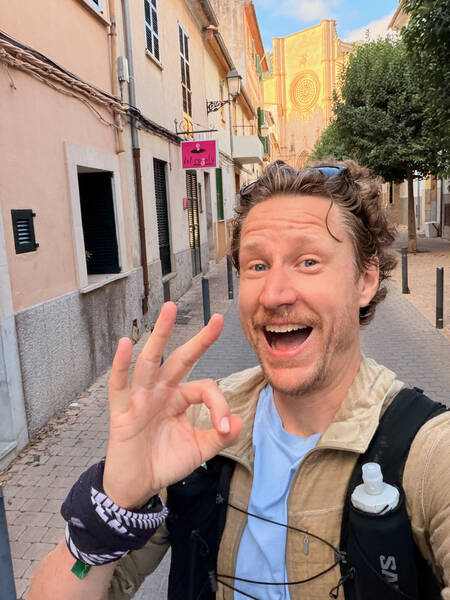
The stones stay on my mind all the time and they do require lots of focus.
🧘♂️ FOCUS AND PATIENCE.
Thankfully, there are also quite a few passages that are easy to run on.
It took about 20–25 km for me to come to terms with the make-up of the route here. Then, I finally felt like I got a feel for it and felt more secure. But not too secure! That would be a mistake, because I know I need to stay alert in order to not make any mistakes.
We’re coming through a forest section where I spot a runner sitting on a boulder, surrounded by a handful of people looking at him. He’s looking fine to me. I can’t see anything being wrong with him, but right when I pass them one of the men says: “We need to take care of him somehow. He’s already passed out three times.” — That’s not a great sign! For a second I think about stopping to help, but since there are already five guys and I don’t spot any bibs or gear on them, I figured they must already be alerted volunteers who hiked up here from the post they had been assigned to, in order to help.
There are a lot of serious things that can go wrong at these races. I’ve seen a bunch of them. We can just hope he will make it out okay.
At the same time I’m very thankful for having no issues myself today. The weather is still great, the trails aren’t muddy, and my legs are really doing well. I’ve gotten lucky in that regard. But one single stupid move could still screw it all up.
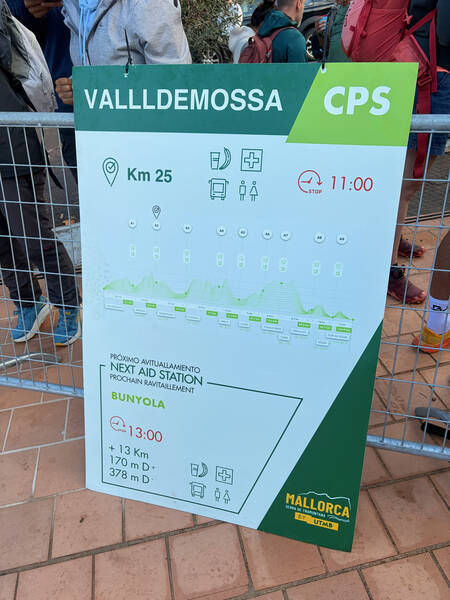
🍹 Valldemossa Aid Station
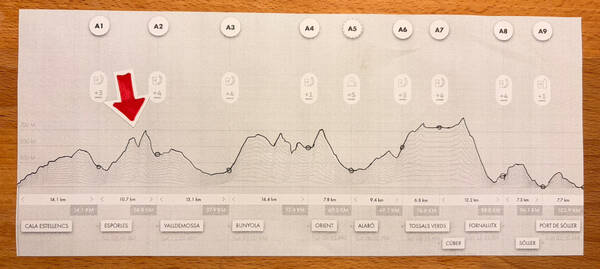
Reaching this place I feel like I’m really in it, now. The aid station is a bit bigger and again has a good amount of very helpful volunteers. It’s still crowded with runners, but also quite a few crew spectators. The village is quite accessible and the time of day is perfect for visiting your participating friend or family member here.
As I already knew from other UTMB-branded events, the aid stations have these big helpful signs, telling you where you are, what services are offered here, and most importantly, how far it’ll be to the next aid station and how much climbing and descending you’re going to have to do to get there. This breaks the course up into digestible little chunks. The cut-off times of when the aid stations are going to be closed down are also mentioned, but those are not important to me.
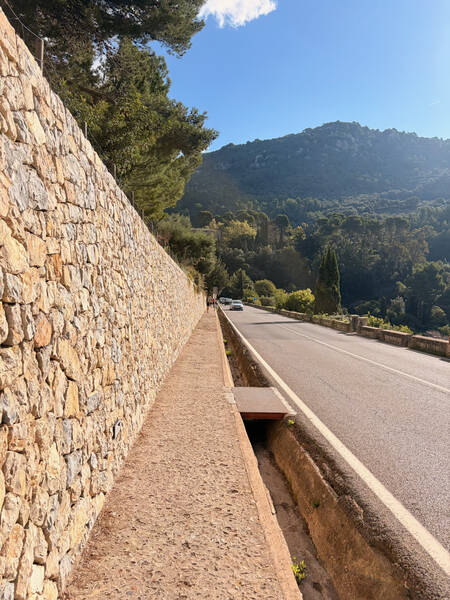
Leaving the village by running on some streets is a welcome change and helps relax the muscles a bit while also allowing for increasing the pace to make faster progress.
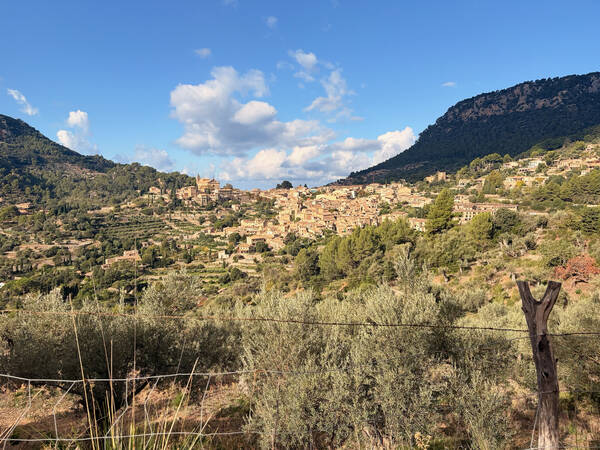
Without any reason to, I look to my right while on one straight street and notice a wonderful view of Valldemossa behind us. What a pretty little corner of the world we have here!
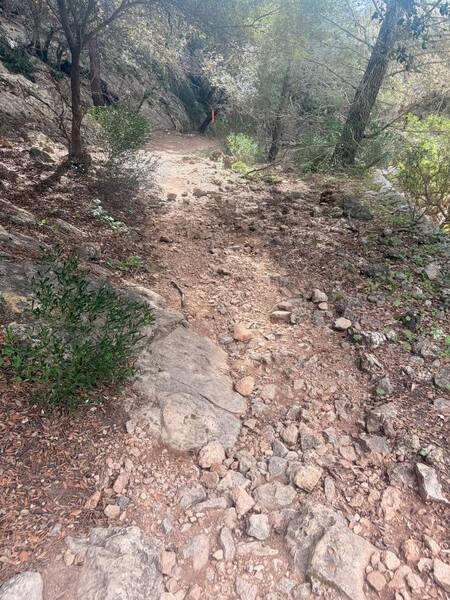
But of course, the next stony section is right around the corner. In fact this is what makes trail ultras interesting to me: the diversity. The ups and downs and flat bits keep it from ever getting boring. How could anyone ever get bored of this?
After about 30 km or so, 4–5 hours into the race, I experience a little mental low. That’s often the moment during an ultra where that happens to me. The remaining distance still seems quite overwhelmingly long but the tiredness is just about to start and you just know what the rest of the race is going to feel like for your body. This is the rough distance at which a normal training run turns into a run that will require recovery. On the other hand, that’s also what makes these runs interesting. How to best move through the rest of the course on tired legs is like a quest.
The low isn’t long-lived, thankfully. Maybe half an hour to an hour and I can already appreciate the situation again. Positive thinking does help. I remind myself of how far I’ve already come and how well I’ve navigated the stony sections so far. I just need to do a bit more of that.
🩼 What’s it like running without poles this time?
As you know I blamed part of my failure at the England race two months ago on not enough experience with the foldable running poles. That’s only part of the truth. In the Alps during the big CCC ultra the poles really helped me and I didn’t feel like they were getting in the way. But for this race I chose to ignore the official UTMB recommendation of carrying poles in order to simplify things. Also, when you fly on a plane with just carry-on luggage, it’s a bit risky to take the pointy poles. Some airlines make you throw away the expensive carbon tools or, even worse, charge you for checking in your bag at the gate! On some infamous budget airlines this can become even more expensive than buying new ones.
About 80 percent here are carrying and using poles. I’m in the minority. And surely they would have helped on the climbs by taking some pressure off the legs. My past estimate of about half an hour gained during such a 100-kilometer race is probably still sort of accurate as I progress through the course, but I’m really glad I didn’t bring them. For the price of losing half an hour I got quite a few advantages: never do I have to fiddle with them to fold or unfold them and put them into the narrow hole of the quiver, my hands are never too occupied with poles to take out a gel, and I never have to worry about the poles catching in bushes or hitting other runners when I spread my arms for balance.
In general, I feel a sense of freedom from not having the poles with me. This gets amplified every time I pass by someone who is having trouble fiddling with their poles. I think it was a good decision for me to leave them home for this race.
Shortly before entering the next village, which is called Bunyola, a few streets make it easier for us for a bit. We came by a lovely lemon plantation. Some support team members are shouting “Courage!” to me because most of them were French. On a street right before the village a seemingly endless stream of people on scooters suddenly appears. It’s more of an Italian cliché, but apparently also the Spanish enjoy their scooters. Bunyola is another of those pretty little villages we have now had the pleasure of getting to know a bit.
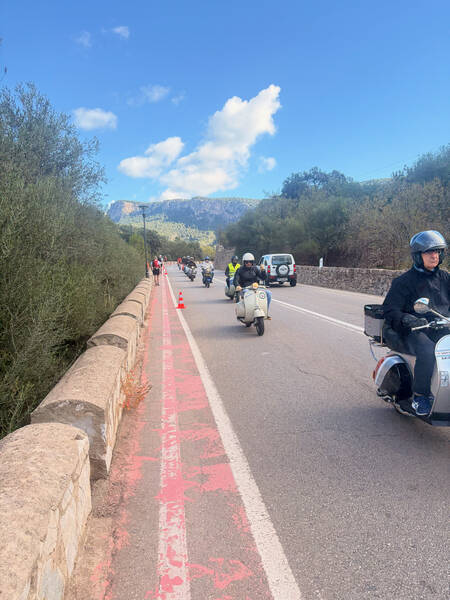
🍬 Bunyola Aid Station
The aid station inside the town doesn’t leave anything to be desired. We’re about 38 km into the race now and I’m looking forward to refilling the two empty bottles with water and even the weird fart-inducing näak electrolyte and protein mix. The body needs as much as it can get of everything. A lot of cups of Coke, for example. They also have some hot broth available and half a cup of that salty stuff seems good to me right now, too. A bit of delicious gummy candy, a few cubes of cheese to neutralize, and I’m off. As I leave the place in the warm sun, I see a runner talk to a race official about dropping out of the race right here. Was it the stones? I’m not sure, but it’s sad to see.
This stop has cost me 4:38 minutes, not a great performance, but I was focused on getting everything I needed and not on being as fast as possible. Again I saw many runners here who apparently decided to take a longer rest. At least two dozen were sitting on plastic chairs or on the floor while I was there eating and drinking, seemingly regaining their composure.
A few minutes after leaving the aid station I decide to take a look at the LiveTrail app to see how I’m doing in the field. It’s cool to be able to see your own live position right after the aid stations. And to my surprise I have passed even more people than I thought I did. Must be because of those sitting in the aid stations. I started in the 500s, and moved up to 428th position by Valldemossa and now in Bunyola I’m at 357 even, another 71 more people behind me. Very motivating! I still don’t feel like I’m pushing it in any way. The legs are tired, of course, but it’s the normal level of tiredness. Nothing hurts.
In fact I’m really happy about how my body is doing. Especially the power I am able to apply during the stony downhills helps me feel a lot safer than I did in previous races. I’m convinced that the most impactful change I’ve made during this training block was the leg strength training, especially the calf raises. My calves feel much stronger while catching my weight on the downhill on every step, which gives me a lot more confidence. I realize this during the race, but also afterwards. Stronger calves are key, apparently. Quads and hamstrings, too, of course, and a strong core doesn’t hurt either, but I guess the calves were my weakest link. Good to know the tedious training really paid off.
Reaching the marathon point at 42.2 km is always something I look forward to and try to witness on my watch in order to have a 2-second internal celebration in my mind. Not so long after I notice I’m getting a little tired. Right then I remember that this happened at exactly the same time at Tuscany Crossing in April 2025, where I then solved it by taking in some additional sodium in the form of my SaltStick pills. UTMB, by the way, advised against those, probably because people make mistakes and aren’t experienced enough, but I know my body rather well. And it helps, like it did in Italy. I also feel like some additional caffeine might not be the worst idea in order for me to keep being focused on hitting the correct stones during the downhills, so a gel with 100 mg of it wakes me up nicely, too. It’s funny and also cool how these quite simple things can get us quite far: water, sugar, salt, caffeine. Deciding on when to take what is a combination of calculation and intuition for me at this point. Lots of trial and error during the training and races of the past years, which was based on reading up on the theory. By now I think I know myself very well. That’s a point I wouldn’t have reached without endurance sports. Realizing this I’m really happy it works so well for me these days.
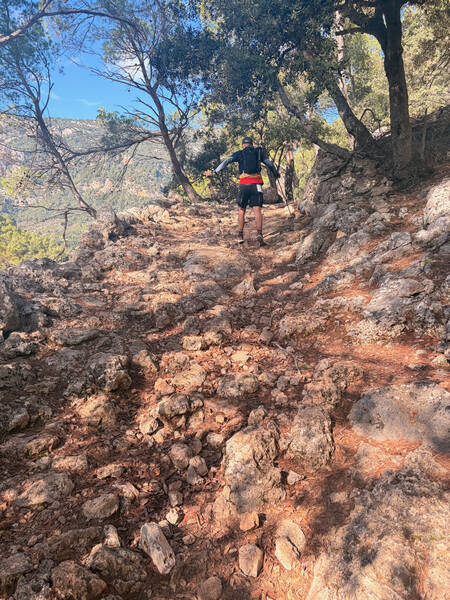
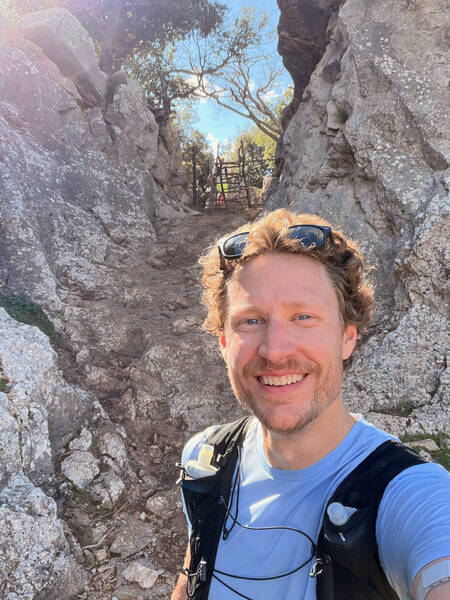
This part is dominated by a stony uphill, which I do quite well on. At one point we have to climb a ladder over a small fence right between two massive boulders, located on top of a ridge.
Coming down on the other side, it’s suddenly windy and a lot cooler. Funny how the weather changes while we are traversing through different micro-climates during this run. I guess it does make sense we were required to carry so much mandatory gear.
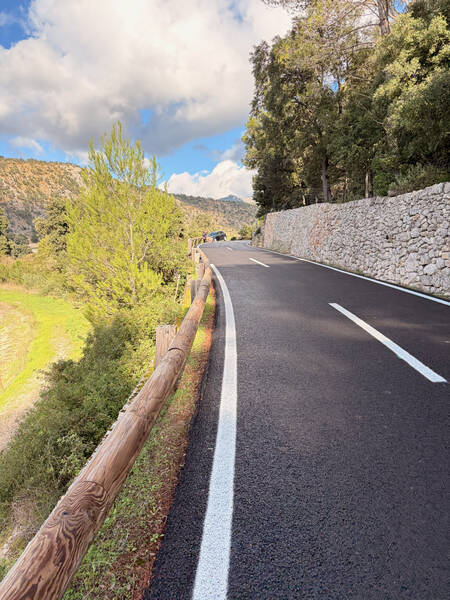
A bit of up and down follows before we’re nearing the next aid station. There’s again a short stretch on a street — but what a street this is! It looks like it was made yesterday and haters would say it was created by AI. Super smooth, so fresh. But also very narrow. Quite optimistic to draw a line in the middle separating it into two lanes. But I’m starting to understand why cyclists love this island so much.
Some spectators appear again as we’re nearing the aid station, most of them shouting “Courage!” — but a few were also non-French and shouted things like ¡Vamos!, ¡Venga!, and ¡Ánimo!
The aid station is supposed to be located after 52 km, but as I enter it my watch has already logged 54 km. Nothing unusual, but I need to remind myself to factor that into my calculations for the average pace. If their course measurement is the correct distance and either my watch added some meters due to poor GPS coverage or because of me running some unintentional extra miles, the average pace displayed by my watch would be too optimistic. If it turned out to come down to minutes in the end, I should be aware of that.
🏕️ Orient Aid Station
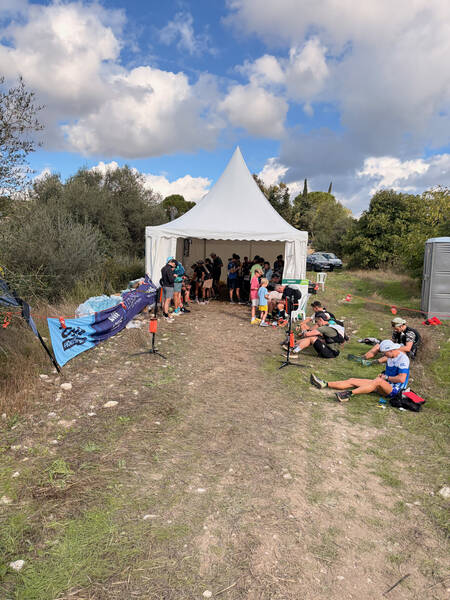
Located at roughly the halfway point of the course today, this aid station was the second one which had to be brought in and set up entirely from scratch. A tent with a pointed roof and lots of plastic water containers were the main foundation of it, but they also had the usual offerings. It’s great that you can really count on this: there are no surprises. Except for maybe the wonderful Aquarius drink at the first aid station. I saw a bunch of runners sitting down next to the aid station, some supported by their families, looking tired. Looking at them, I felt just so happy about my own current situation: fit, still moving, enjoying the day. Many cups of Coca-Cola, some hot broth which again tasted really good — unusually good for a vegetable broth, a cup of Fanta for good measure, some gummy candy, refilling the two flasks, and that’s it for me. It’s now a bit after 2:00 PM and it’s nice and warm outside. This stop cost me just under four minutes, which seems to be my average for a relaxed aid station stop. Compared to the other runners who were here with me, it felt like I was just going in and out while they needed a lot longer. Again, motivating! I couldn’t wait to continue. Reaching the halfway point of the race is for sure another booster.
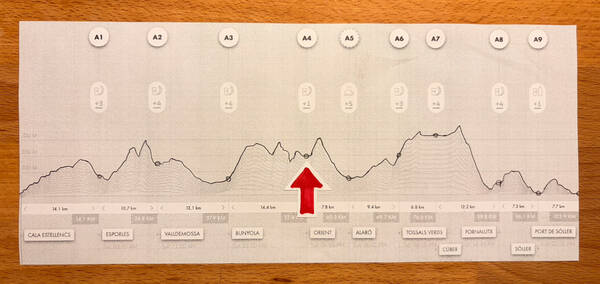
I took another short look at the poster and seeing that it’s just 8 km to the next aid station, which is the very big Alaró station which has our drop-bags and some hot food, made me feel really good. This was definitely a high point of the whole race. I moved ahead of another 47 runners between the previous aid station and this one here, Orient. Now, there’s a tricky 500 m downhill standing between us and the next aid, but I knew by now that I’ve got this. As long as I keep sticking to my mantra.
🧘♂️ FOCUS AND PATIENCE.
Before the downhill, we need to go up for about 250 m first. Nothing huge, no problem. Reaching the top, there was a magnificent view waiting for us.
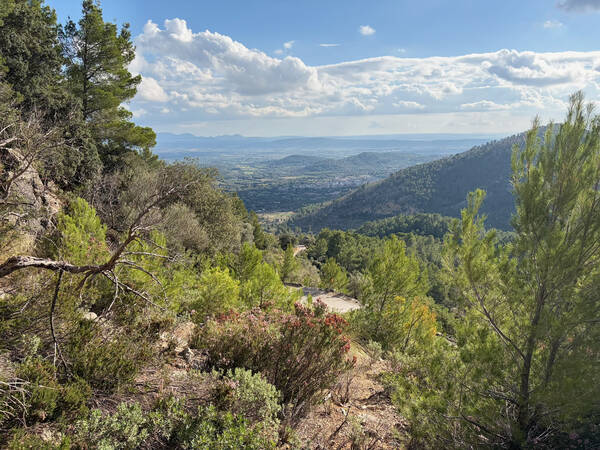
The final bit just before the Alaró aid was again ten minutes on flat asphalt. Really nice to take the focus off of the road and use the newly freed brain power to think about what to do at the aid station in which order. Lots of crews are lining the road, too, clapping, shouting encouragements in the two main languages. A handful of Germans were also here, looking at my bib number which features the country of origin flag, happy to see a fellow countryman.
🥫 The Big Alaró Aid Station
I was looking forward to this one. It’s a marker of really meaningful progress and it also offers many opportunities to take care of yourself with so many options to choose from, mainly in the food category. Coming in to the place, which was located next to and partly inside of a big building which used to be a slaughterhouse but has since been converted into a youth center, it was immediately clear how well the volunteers had organized it all. While I took a look at the looong buffet, someone came up to me asking if I had a drop-bag here, remembered my bib number and jogged off to collect it for me. I just followed him, got handed the bag, sat down for the first time during the race, exhaled and felt great. Made it to Alaró in one piece!
🎒 The Drop-bag
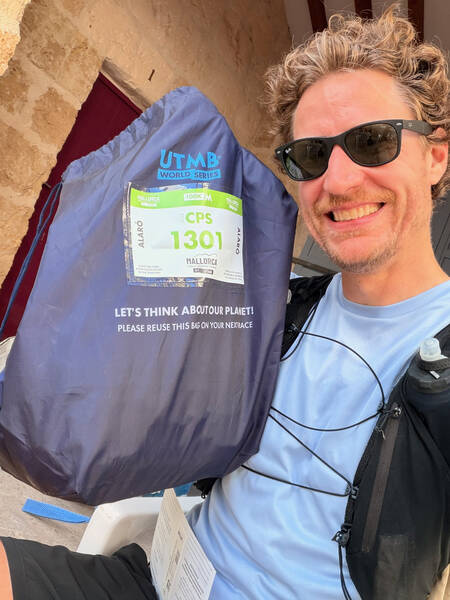
I didn’t want to waste more time than necessary here because I knew that the drop-bag aid stations have cost me over 10 minutes at past ultra races. The time is usually well spent, not only because of getting the logistical tasks right, but also because this little breather and calming of the heart rate seems to have a slight restorative effect on the whole system. Still, I need to keep my focus so I don’t forget any important steps.
- I have consumed all six gels I carried in my vest, so the next batch of seven gels now needs to go from the drop bag into the side pockets of my vest.
- In the bag, I also put two pairs of dry socks, sealed in a ziplock bag just in case everything would get soaked — thankfully those weren’t needed today because my current socks are still dry enough and feel good.
- A refreshing wet wipe I got from a Lufthansa flight earlier in the year to clean off the salt, sweat, and snot from my face is like having a mini-shower now, very much increasing my well-being.
- Since my phone is now down to just 30% battery, I connect the battery pack to it and store both in my running belt. Crazy how bad the battery is. I barely used it today, of course. It’s just a one-year-old iPhone 17, by the way, and I had it on Low Power Mode the whole day.
- Now it’s time for my personal feel-good food: 🍅 TOMATO PASTE! So delicious.
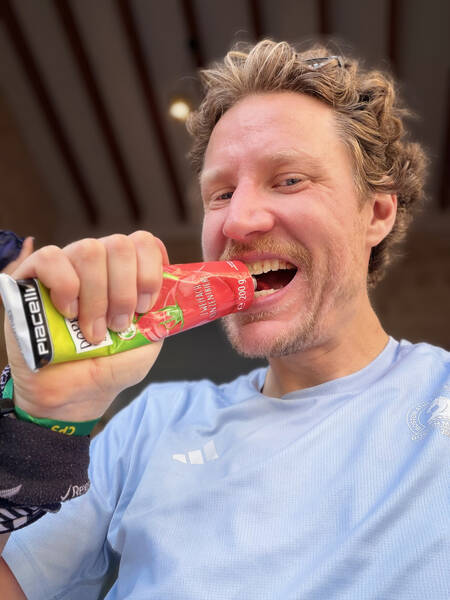
I see a few people devouring pizza and get jealous for a minute, because they apparently had crews bringing it here, but tomato paste is the next best thing for me. I don’t have any hot food from the buffet, just some broth like at the previous stops. Delicious!
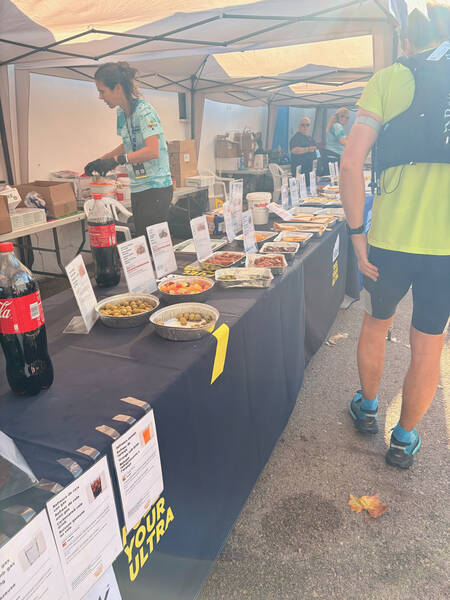
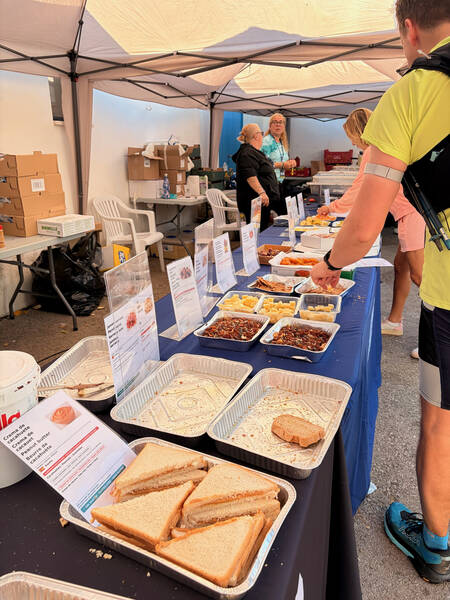
The gels still are the most important item from my bag as they provide me with the actual energy to keep going. So, that’s done. While I’m sitting in the chair to do all these tasks I finally realize there are a lot of beeping noises next to me. They’re coming from the makeshift medical room a few meters away, and the situation isn’t looking good: a middle-aged man is lying there, bare-chested with lots of cables connected to his chest, surrounded by about five people dressed like medical professionals. He is quite a bit overweight. I don’t know what happened to him, but I wondered if it was the best choice to sign up for such a race in his situation, putting so much stress on a heart that already has to work overtime. Putting myself in his position, I would have preferred the great cycling roads here instead, I guess.
Last order of business for me at this place is refilling the bottles and getting rid of the trash from my pockets. The environmental efforts of UTMB-branded races include waste separation, so you need to think about which item to put into which bin right now. Not sure this worked too well with all our mashed-up brains from hours of running.
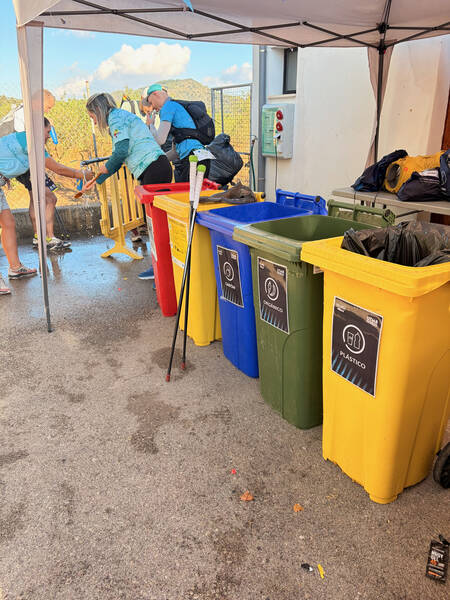
It has been a longer break here than I intended, 12:56 minutes total stopping time. While it was worth it, I think there’s potential for improvement. Still, between Orient and here I moved ahead of another 28 people, now in 282nd place, quite possibly again because many of them stopped for even longer.
🎉 Just a marathon left now!
Moving out of Alaró aid, we’re led back onto the same flat street we came from, which is great to get back into running. There, a German group of fans are doing a Mexican wave for every single one coming through. Very cool! I’ve seen them before. They are probably following a runner who is at about my level. Seeing my bib, they shout “Auf geht’s, Tim!” to which I absent-mindedly but also smilingly reply: “Merci!” — the power of habit.
I pass by a young English guy who is flanked by what looks like his parents. How lovely is that. They are talking about the race and how he feels and he says: “Just one big climb left!”
While I pass they all cheer me on. Good people!
A few minutes later he passes me and we have a little chat. We’re running towards a massive-looking mountain and he says: “Can you believe we’re going to climb that one?” — “You sure?” — “Nah, I’m just messing!” and he laughs, moving on. Finally someone who is enjoying this as much as I am! I’ve seen too many sad and exhausted faces today, especially those sitting at the aid stations doing nothing.
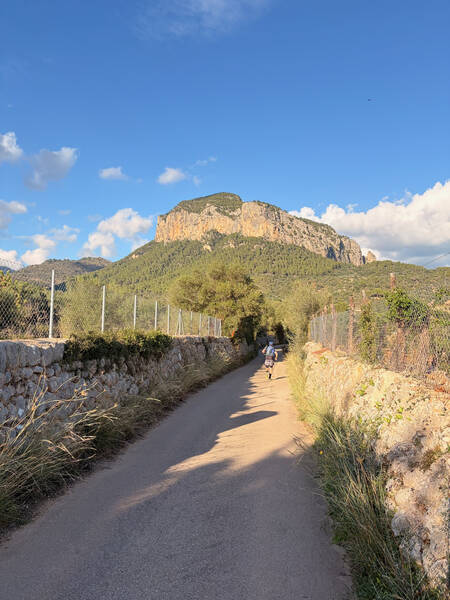
I still see him for a while. He is running at roughly my pace, but just slightly faster. The next bit is a long uphill: we need to climb about 800 m, but it doesn’t feel that tough. The grade isn’t huge, I guess. Also, the scenery is just beautiful and as the day is slowly coming towards its end, the light of the sun makes it even more pretty.
One tricky, stony descent is left until the next aid station, called Tossals Verds, located at about 72 km into the race. It’s a little mountain hut, tiny and isolated, but right in the middle of a long climb, breaking that one up nicely. The options here are reduced, because everything again had to be carried here by van. For me it’s another standard 4-minute stop. Today this seems to be my default even after what have now been over 11 hours of running.
I feel like I need some more salt. The broth and bad näak electrolyte drinks don’t have enough. Two more SaltStick pills, and again the situation is much better about twenty minutes later as it really enters my system. But that’s it for me in terms of the pills. Four of them total for the whole day, just about 1,000 mg of sodium. This isn’t much at all, but it really helped.
Leaving Tossals Verds aid station at about 5:00 PM, the sun is now very low. There’s no phone reception here so I can’t find out what my position in the field is, but afterwards I saw I moved ahead of yet another 57 people, now in 225th place. This is a really good feeling, because it confirms my smart pacing.
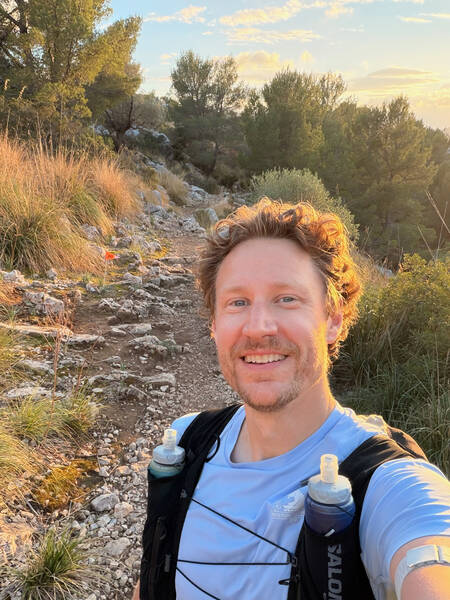
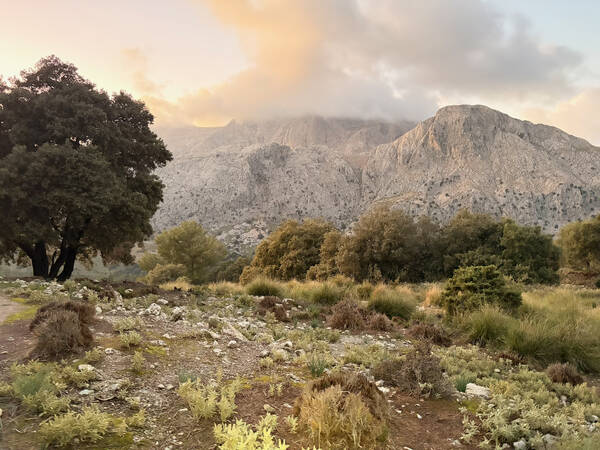
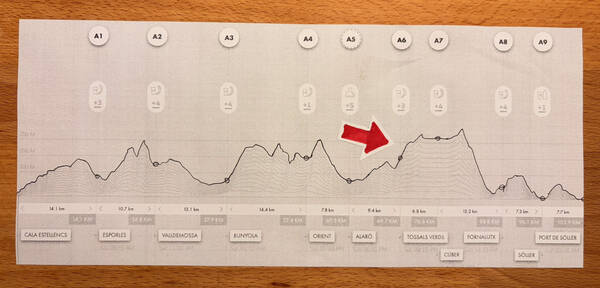
The top of the climb, at about 800 m of altitude, is followed by a 6 km flat section, partly muddy. It must have rained here recently — another little micro-climate section. It’s a bit cooler up here, but I’m still fine in my shirt. I do need to switch the sunglasses for my headlamp now, though. The night is about to start and that also makes me feel tired, so I have my second caffeine gel of the day, this time only containing 75 mg, of the delicious MNSTRY Cherry variety. Another twenty minutes go by until I notice the boosting effect, and my focus is back to 100%.
🧘♂️ FOCUS AND PATIENCE.
I’m careful with caffeine, because I’m very sensitive to too much caffeine, becoming super jittery and just feeling awful. And since caffeine has this long half-life of 12 hours, overdoing it is hell for me for a very long time. Still, so far, I have put quite a lot into my system. Red Bull, two of those gels, and the caffeine from at least two liters of Coke. My estimate is about 500–600 mg total. That’s really a lot, like 6 cups of strong coffee, but since I’ve had it over the course of the whole day, over 12 hours now, there hasn’t been a shock to my system.
The muddy plateau up here is very lonely. For me that’s a short and tiny low, because the views are now gone in the dark, removing one motivating item. We’re so far into the race that it has also become rare to meet another runner. And when I pass someone now, I unintentionally switch to just whispering the word “Merci” because it’s such a quiet night. This is so different from the noisy aid stations of just a few hours ago. The variety of what you’re experiencing, as I’ve mentioned, is huge. On a short little downhill a guy passes me and says “Dankeschön!” in a French accent. He must have seen my bib number’s flag, which I’m wearing at the back right now. How nice of him! Another unusual thing, he’s a dark-skinned guy. Happy to see that, we’re having far too little diversity in that regard in ultrarunning.
Looking at my watch I’m very happy and even surprised to see that I still somehow manage to run a solid pace without giving it much effort. My average pace for the finish time calculation is also still right where it needs to be. There’s absolutely nothing to worry about in that regard. But even with so much progress already behind me, one single mistake can still end the run, so it’s absolutely mandatory to keep paying attention to every single step. By the way, my toes are doing great and the shoes and additional toe covers are protecting them really well. I had two little scary moments when I caught a stone with my left foot, but got out of those without any harm occurring. And the old shoes are really doing amazingly well. Still bouncy enough on this flat section, protecting my feet from the mud, providing enough grip.
My relief about still being able to run well is growing into surprise and even a bit of euphoria over time. How is it possible that I’m still doing so well?! At times I can’t believe it myself! My conclusion is still that it must be the strength training that played the biggest role. Now between 70 and 80 kilometers of the race, I remembered that my pacing strategy was about running as conservatively as possible until at least 70 kilometers before seeing if I can increase the pace. Usually at that point it’s all about survival, but not this time. I ask myself how I’m doing, what the legs feel capable of, and if I might be able to increase the pace a bit. And the answer is yes. So I run faster. That’s definitely new! As for pacing, I think I’ve played this one perfectly for once.
In the middle of the flat section, I reach the seventh aid station.
🔦 Cúber Aid Station
It’s completely dark but the tents here are well lit, of course. I remember to turn off my headlamp so I don’t blind the volunteers. The buffet is again really nice, and I have been craving the delicious broth I’ve had a few times before the most. This is the first time I catch a glimpse of what they put into the big heater for the broth, and I, the vegetarian, see the big word: POLLO.
I don’t speak Spanish except for a handful of words, but I think it has become an internationally recognized word, right? Maybe some of you remember “Los Pollos Hermanos”?
So that’s why that stuff tasted so much better than I remembered broth tasting.
Of course, over the years situations like these just sometimes happen. I don’t worry much about it, but right afterwards when seeing the delicious-looking Spanish serrano ham I catch myself thinking, why the hell not? But I resist, for now. Remembering how I once ate the delicious fatty Tyrolean sausage at an ultra race in northern Italy and how that lifted my spirits for maybe ten seconds, I decided: not worth it. Gotta keep some standards while I can.
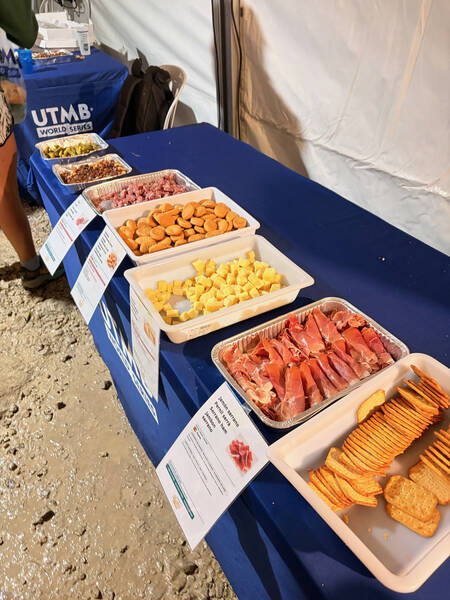
Some Fanta right after the broth from the same collapsible cup. Ultra running things. Oddly, I don’t feel like drinking any more Coke right now. Maybe it was already enough for a week.
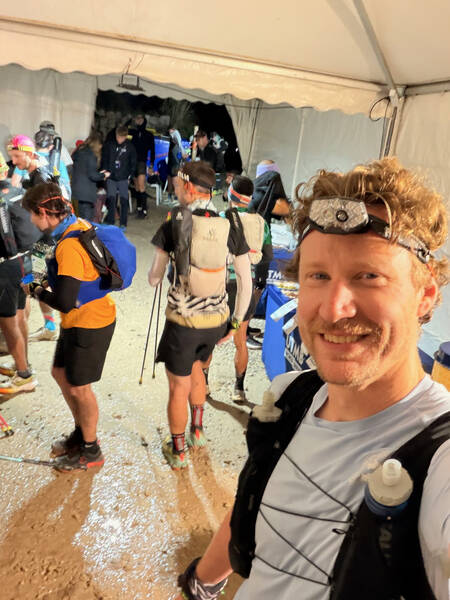
The break here was slightly longer with 6:18 minutes, I think because I spent some time fiddling with getting my Merino jacket back on. It got colder. Maybe that’s also why I only moved ahead of one single runner during this section, 225th to 224th. At least I’m still keeping up the streak of moving through the field!
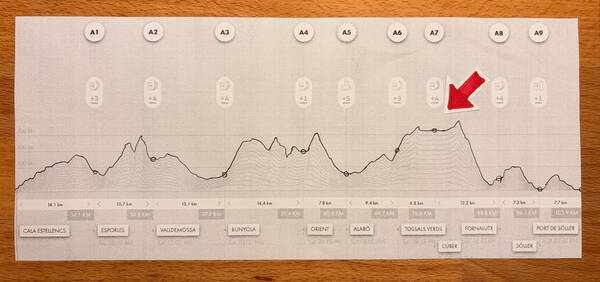
Leaving the aid station, there’s the German Mexican-wave gang again, cheering for everyone. Good to see them. Because I’m a bit sad I don’t get to see the pretty Cúber lake right here due to my late time of arrival. I would have needed to arrive one or two hours earlier. Running around it right now, everything is just flat and black. Could’ve been a meadow for all I know. Slight disappointment, but fortunately the only one. My legs are still carrying me really well towards that big downhill that’s about to start. First we’re moving slightly upwards to reach the highest point of the course at about 870 m above sea level, before dropping down almost the whole way towards zero in one big go. I feared that section the most, because long downhills are not my strength usually, and this late into a race the quads are smashed and the darkness makes it even harder to choose the right spots to put your feet down. With a lot of respect I’m moving along. It is very tricky: lots of huge stones, some are slippery and wet, some are dry and dusty, which is also not very grippy at times. The downhill part of this section is just 6 km long on the way down to the town of Sóller. Fortunately the caffeine is still doing its magic and I’m able to focus. It’s about 7:00 PM, we’re 13 hours into the race. I’m moving very carefully and my splits are getting naturally slower. I knew this, but I don’t need to focus on my average pace because that one is still super safe.
Of course I have also spent a lot of time calculating what finishing time I might be able to achieve during the past hours. It’s hard to predict though, because the distance measured by the watch and also the stats on the posters are often incorrect, and over such a long distance that can make a difference of up to a quarter of an hour in my experience. The main difficulty, though, is that you can’t know what the remaining bits of the course are going to look like. Even a correct distance and elevation number won’t suffice. Is it slippery mud? Even more tricky stone fields? Or just smooth asphalt, as a surprise? In my head I come up with 17 hours as a likely outcome, hesitantly. There’s no point in making it under 17, and rushing would just jeopardize a healthy result for no reason at all. But I still catch myself during the flatter sections thinking how I could just run faster right now. So I do. Putting a little bit of pressure on it also makes it more fun.
Somewhere in the middle of the downhill, a beautiful view of the town of Sóller presents itself. Wonderful, I really like it. It reminds me of my first 100k race in difficult terrain, the Mozart 100 back in 2021, where the nighttime view of Salzburg from above a few hours before reaching the finish right there was a big motivator. Great moment.
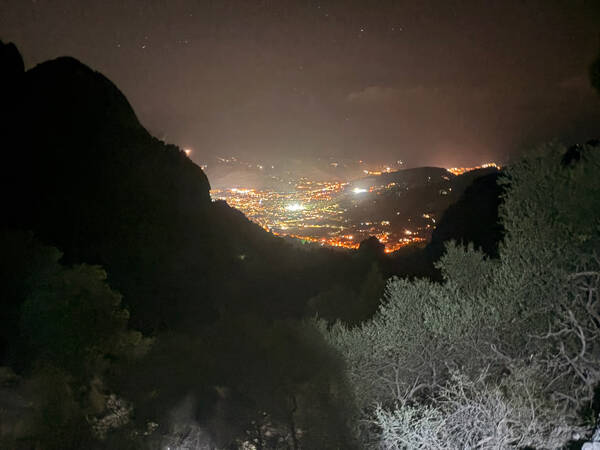
After making it through the full downhill section without any falls or injuries, the next stop is located in Fornalutx, right next to Sóller. The 12.5 km from aid station to aid station took me a bit over two hours because of the tricky downhill. It’s 8:30 in the evening and the people here are sitting outside in restaurants, having a good time cheering for me as I come through. Quite nice!
🍗 Fornalutx Aid Station
Right now, 91 km are done. Sounds like I’m almost there, but no. About 15 km are left to go and they involve two more hills. Not huge ones, but I know from reading reports of the race that these will still require an effort. Because of what? Exactly, because of the stones.
🧘♂️ FOCUS AND PATIENCE.
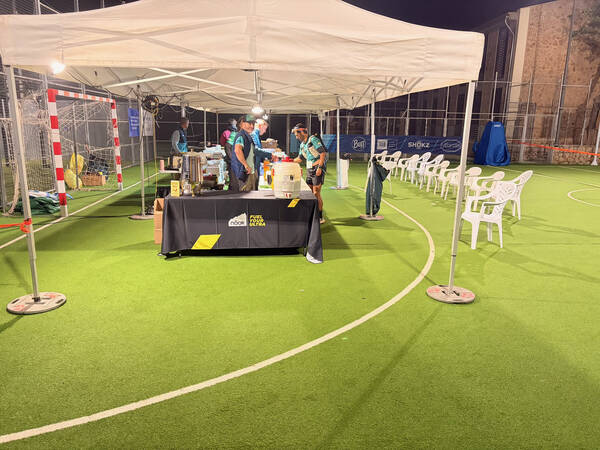
For now, I get another refill of my bottles on the soccer field here where the aid station is located while trying to joke around with another German runner who is here with me. He seems to be too tired to get my jokes. Maybe the jokes just sucked. Anyways, some more broth de Pollo because it’s just so good and I don’t care anymore, and I’m gone. It took my standard four minutes. And somehow, on this super slow descent, I made up another 11 positions, now at 213.
The two hills coming up are both not huge, as I said. One is about 300 m up and down, the other one 200 m. That’s so little I mentally divide them into reps of my tiny Hamburg home hill I practiced on, Waseberg, with its 80 m of elevation. The first one is 3–4 Wasebergs, the latter one just 2.5 Wasebergs. Easy Thursday morning run, right? Well, if it weren’t for the stones, of course. But still, it helps to picture it this way and thus stay aware of the progress I’m making.
On this section I pass by a few runners with different bib numbers from mine: red instead of green. That’s how I know they’re running the longer-distance race which started the previous evening, eight hours before us, and used much of the same route except for a 35 km extra loop which also featured a huge ascent. Definitely much harder, and it’s tough to see these super tired people here. Some of them look like zombies. I can almost feel their exhaustion, it’s so apparent in their faces. In total, I maybe passed a handful of them here.
🏎️ Sóller Aid Station
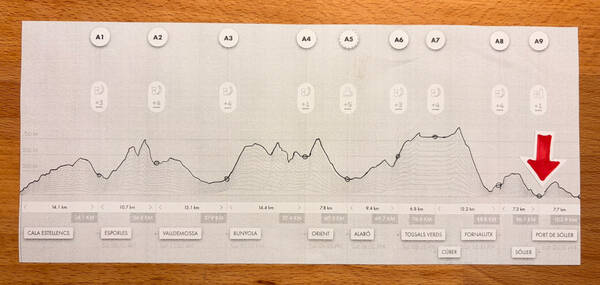
The final one, located at 98 km officially. We’re very close to the finish line now, but the remaining 7 km are going to lead us away from it once more. This time I’m just rushing through the aid station, very quickly topping off the two bottles. I don’t remember if I even had something to drink. Possibly. But the whole stop just cost me 2:00 minutes and I was out again. Knowing that there is just one minor hill between me and the finish line is motivation enough. I passed two more people. Looks like I’m now finally at around the place in the field where I belong.
On the short flat section surrounding the aid station I am again astonished at how well I’m still able to move. Even after nearly 100 km and about 4,000 m of climbing and descending I’m able to churn out a 6:30 min/km pace on the flat. I’m shaking my head in disbelief, no lie. It just feels so good to be this fit after my failure in England two months ago. I’m so happy about it! I can run!
The watch has switched from 99 to 100 kilometers, the remaining distance is in the single digits, just a couple more Wasebergs to climb and descend. I switch my watch to the elevation page I created, so I can see a countdown of the remaining climb. I loaded up the route on it for navigational purposes, just in case. It’s great to see it drop below 100 meters. Up on top of the final hill there’s the view of the actual finish line town, Port de Sóller, which is right next to the beach and about 5 km from Sóller, its bigger brother town without the port. Beautiful view. But still a double-edged sword because I know it’s going down once more, and it will be stony.
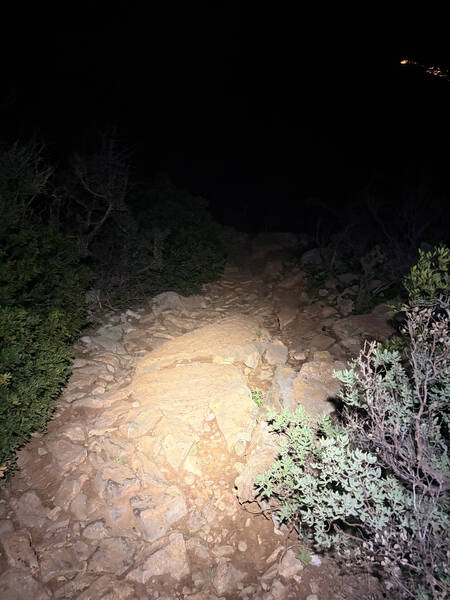
And yes, I’m glad I read those reports of the course. Even the final short descent is difficult. I need to remember one last time that one wrong step could still destroy the whole plan.
🧘♂️ FOCUS AND PATIENCE.
With about three kilometers to go the route now leads us onto a road. We have Port de Sóller in view from here and are very close to the water, but still about 100 m above it. Realizing that this last descent will happen on roads instead of big stones is very calming. I can finally let go of some of the tension. It’s quite steep still, so the quads are burning. The watch says 16:43 hours so far. Can I make it in under 17 hours? The tracking on the map helps me make a quick calculation: I would need to throw down a 4:30 min/km pace now. Usually no problem, but now? Absolutely not. Doesn’t matter, fortunately! My heart rate is capped at 115 bpm currently, the tiredness makes sure of that. That still translates to 6:30 min/km and I’m happy to see it. Really flabbergasted by how well my body has been doing today.
The final kilometer is right next to the beach, completely flat, people strolling around after having dinner at one of the many restaurants here. A few finishers are walking towards me, medals around their necks, clapping their hands for me. I smile from ear to ear. It worked! Just a short little jog, all the stones are behind me and none of them was a serious problem. Amazing. These last minutes feel so good. I see the total time cross into 17 hours, but it’s okay. This wasn’t the actual goal. There’s the finish line area, a few dozen people are making noise for me as the announcer says my name and the light show and loud music turns the night into a party. One final turn to the left, palm trees, twenty more meters, the tracking chip beeps — done.
I made it. Last-minute Western States qualifier! Redemption! I’m still good at ultra trails, even the tricky ones! So happy about it.
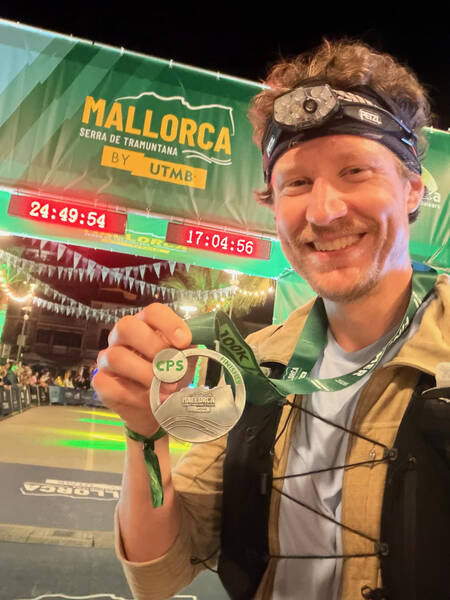
🏁 Finish Line Party in My Head
My watch logged 17:01:55 of running, but I started it when I crossed the starting line, out of habit. At these ultras, there’s usually only one official time, measured from when the gun went off. My official result is 17:03:10 because I stood at the back of the field during the start. Funny, at Zugspitz Ultra Trail I needed 19:00:30 and at the CCC last year 20:10:42 — seems like I tend not to put in a big sprint to the finish. That’s about right, because what’s the point?
I receive a medal and a high-five from some official helper here and move on towards the tent just behind the finish line where all the food is.
The feeling is just indescribable as it slowly sinks in.
I did it. It certainly was a fight and required me to take the preparation very seriously. Even getting the ticket required perseverance, as you know. Not to mention the race itself. These stones! I’ve seen enough of those for a while. By the way, I did some calculations during the race and found out that if I had taken about 100,000 steps during this race, which is roughly correct, and at each step seen ten million new stones, that would amount to as many stones as Elon Musk has dollars. How about that? I think Elon wins this one, as unbelievable as it is.
But now is the time to sit down on a plastic chair for a minute. I don’t really know what I want to eat and drink from the buffet until I see the grilled cheeseburgers. Remembering the chicken broth causing me to fail my vegetarian lifestyle today, I impulsively grab one and wolf it down. Yes, that’s what I wanted. The poor cow, though.
They hand me a finisher’s gift which is an embroidered blanket. Good idea, keeps me warm now. They also have cold beer on tap, containing alcohol. Usually I wouldn’t have said no to this right now, but the next few hours will be very stressful for me, so I somewhat sadly have to pass. I need to be at the airport in five hours to catch my plane. I just missed the hourly shuttle bus back to Palma where my hotel is, which is actually quite nice because it allows me to relax until the next shuttle arrives at midnight.
Slowly walking towards the drop-bag return I’m surprised by how well my legs still work. Slowly, for sure, but no pain worth mentioning. With my stuff I walk to the portable shower boxes they installed and I’m very happy about the hot showers. Finally removing the socks reveals what I suspected: no new blisters and the silicone caps have succeeded in preventing any further damage to my two already battered big toes!
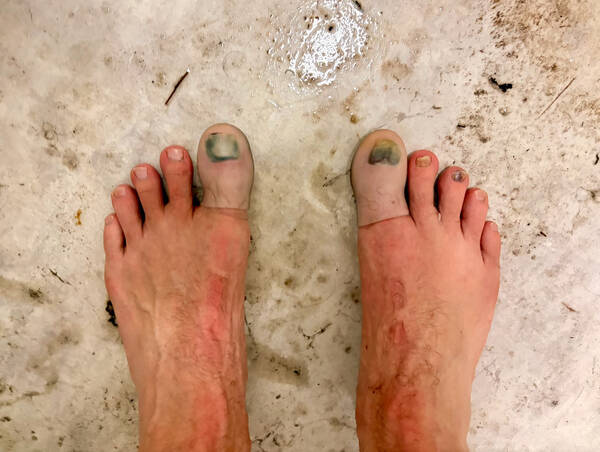
I use the change of clothes in my drop-bag and add the mandatory gear I didn’t need to create a new dry outfit that keeps me comfortable. Being clean and warm is really nice, isn’t it?
The midnight bus takes me and five others back to Palma and takes about an hour for the trip. During it I took today’s first look at my emails. There’s one from Sophie, why? “Don’t panic” it says.
Oh no.
In it, she tells me how our little Daughter #4, who is just 8 years old right now, broke her left arm in the afternoon! They spent the past hours in the emergency department of the hospital. Sophie didn’t want to tell me via text so I wouldn’t mess up my race by thinking about the poor girl. How thoughtful is that? But now it’s all my brain can think of. The poor little cutie with her broken arm. It’s great how Sophie was able to take care of that while also managing the other three daughters. Nothing I can do right now: even if I needed to get back as soon as physically possible, the next flight home actually is the one I booked.
At one in the morning I walk through Palma to my hotel and come across a lot of dressed-up folks on the way to or from a party, it seems — oh right, it’s Halloween! At the hotel, I quickly sort all my stuff, pack the carry-on bag, and at 1:30 I’m asleep. Finally lying down. Alarm clock for 3:30 AM, two hours of sleep. I slept through despite the 600 mg of caffeine today. Taxi to the airport because no buses run this early, while drinking water as if it’s my job. The dehydration from ultra races is real! The airport is empty. It’s still dark, of course. At 5:50, my plane leaves. The cramped seats of the budget airline make one of my feet go numb. The numbness stays for a week. Am I getting too old for budget airlines? Anyways, I’m home before lunchtime. My rhythm is weird. Three days in a row of getting up in the middle of the night: 3:30, 2:30, 3:30. It feels a bit like jet lag. I try to make it to the end of the day, but fall asleep on the couch from 1:00 to 4:00 PM unfortunately. No willpower left to stay awake.
What a weekend!
And now the fun part for nerds like me.
🤓 The Stats
I reached the finish line as the 186th man out of 391 male finishers. At the start line there were exactly 600 people total, of whom 140 dropped out at some point, so we had 460 finishers, 85% of them men. Among them, I finished in the top 48% of male finishers, basically right in the middle. That’s not a great position for me, so I guess that the others here were just much more confident and used to the stones, apart from probably also just being more fit than I am. From a plain fitness point of view, I think I would have come in further in front, as I did at the Tuscany Crossing in April 2025, where I finished in the top 23%. Technical routes just don’t play to my strengths yet, but that’s fine.
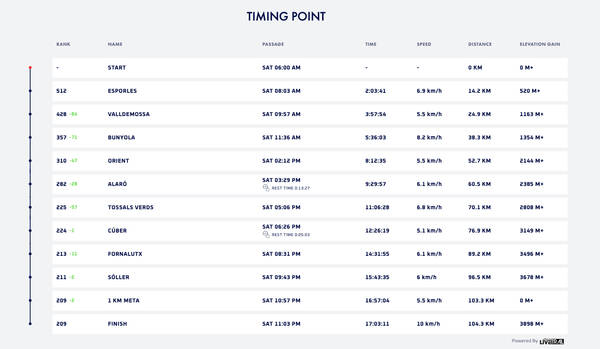
My total time spent at aid stations was 44:04 minutes. Quite a lot, but I think it helped me to regain focus, take care of my body, and therefore eventually make it through the whole race without any mistakes.
That’s the main thing I realized afterwards. I didn’t make any mistakes.
It was a defensive strategy, centered around maximizing my chances of getting to the finish line, sure. Taking my time aided me there.
🌲 The Tuscany Comparison
The two races are just so interesting to put next to each other, because on paper they are almost identical, but in reality totally different. The weirdest thing is the qualifying standard that the board of the Western States 100 has set for the two qualifying races. Here on Mallorca, you have to make it in under 18 hours, while in Tuscany you get 21 hours, three more.
Looking at the stats alone, that’s confusing:
Tuscany
- 📏 103 km in distance
- ⛰️ 3,750 m of elevation
- ✋ Qualifying standard: 21:00 hours
Mallorca
- 📏 104 km in distance
- ⛰️ 3,740 m of elevation
- ✋ Qualifying standard: 18:00 hours
When you then take a look at the course difficulty, it’s especially confusing. I looked up the median finishing time, and found out that at Tuscany it was 15:47 hours, while at Mallorca, it’s 17:27 hours, confirming my hunch.
At Tuscany, 93% of all finishers made it within the Western States qualifying standard, while at Mallorca, only 56% got in. A huge discrepancy I’m sure can’t be intentional.
I started to wonder about two things: what rules does the Western States board apply? And secondly, which one was the intended qualifying standard, and which was the mistake?
If we had applied the harder Mallorca qualifying standard to Tuscany, people would need to have finished in 16:13 hours instead of 18:00 hours. The other way around, the easy Tuscany qualifying standard applied to Mallorca would come to 21:06 hours.
As a side note, the easier course in Tuscany also reduced stopping time at the aid stations for me, and maybe also for many others. You don’t need to recover so much if there are no huge stones to navigate through. I only needed 27:52 total in Tuscany compared to the 44:04 from Mallorca. My strategy was basically the same: drinking and refilling flasks at the stations, some snacks, and one longer break at the big drop-bag aid station.
I wrote to the Western States folks with my findings and we had a few interesting emails back and forth. I was told that they often double the winner’s time to come up with a qualifying standard, but not always. I compared that with the results, but here it didn’t add up, so it must have been a different decision. In the process I noticed that there’s just one qualifying standard for all genders. So I also wrote to them that if they double the male winning time — it’s still rare that women win these competitive races overall — this would make it harder for women, obviously. A qualifying standard for women should then be based on twice the female winner’s time, maybe. It would be more fair, wouldn’t it? They promised to look into that, fortunately.
🇺🇸 Speaking of Western States…
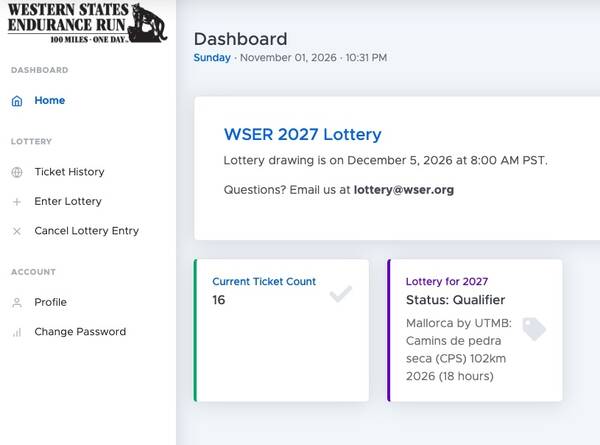
Just a couple days after my finish at the Camins de Pedra en Sec in Mallorca, the application window for the 2027 Western States lottery drawing opened up. With the publication of the official finishers’ list I was eligible to enter. How great that felt!
This time, I’m entering with 16 tickets to my name because I’ve already lost in four different years and the tickets double each time you lose. At the time of writing, just over 11,000 people have entered the lottery and there’s someone among them who has 1,024 tickets. Incredible.
I did the calculations, and if the number of people stays somewhere around 11,000 until the window closes, the Monte-Carlo simulation of the drawing says I have about a 3.8% chance of getting in directly, and a total chance of 4.5% of getting in or making it onto the waiting list. Still over a 95% chance that I’ll have to continue this quest for at least another year!
By the way, with my 16, this is the first time I hold more tickets than the average person in the drawing currently has, which is 10.6 tickets. My 16 are also a lot more than the median applicant has, which is just 4. Of all applicants, 84% have fewer tickets than me, 9% the same, and just 7% have more tickets. They are pulling the average up.
For me personally, I actually hope I don’t get drawn for 2027. There’s a conflicting race on my schedule, a very special one. The oldest ultramarathon has its 100th anniversary edition on June 13th, just two weeks before Western States. And I have a ticket. It’s, of course, the Comrades Marathon, 90 km of non-technical running in South Africa. Very much looking forward to it. Not a qualifier, in case you’re wondering. Much too easy.
🌟 Post-Race Glow
After Mallorca I was still over the moon about pulling this difficult task off. It looked quite unlikely but I got it done, and that made me very happy so I walked around smiling for the next 2–3 days before it wore off. It gave me a bunch of confidence for the next hard races, too. If I can find a way to make it over these stones, I can probably also do more difficult stuff! I also felt like I’ve got the 100K category down, now. The failure at the 100-miler in England still stings, but I’m now sure I can take another step in that direction and will be able to finish a race in the next distance category, too.
To help the sore muscles recover, I planned this week to consist of only minimum-length streak runs each day, 2 kilometers. A little bit of cycling. I think it was good for my body but I hated it after four days. Movement makes me happy, so that’s when the post-race glow stopped. Recovery went really well. I felt strong enough for the first tempo run ten days after Mallorca. Doing such a big ultra at the low intensity I chose really makes recovery easier. Lots of water and calories during the days after were also helping and that is never a problem for me.
The next race for me will be Pisa Marathon in Italy, in the middle of December. I’ve been invited to pace runners targeting 3:15 and gladly accepted.
And for next year’s Western States qualifier, I had already picked another 100-miler in England, put together by the same Centurion Running team that organized the race I failed to finish this year because apart from my failure I really like their events’ style and want to try again. It’s the Thames Path 100, leading from western London to Oxford along the river. Non-technical, very flat. But focus will be important yet again.
🧘♂️ FOCUS AND PATIENCE.
No technical trails for me in the foreseeable future — but I’ll be back.
For now, I’ve had enough of the stones.
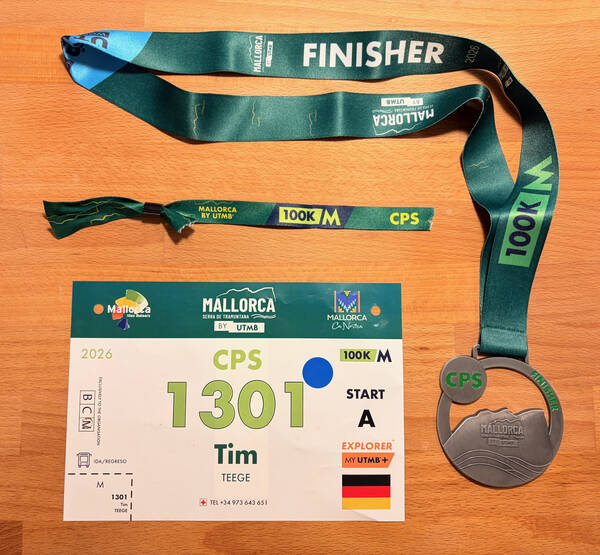
How do you feel after reading this?
This helps me assess the quality of my writing and improve it.
Leave a Comment